A Philly defense contractor operates the Iowa plant where the Army plans to detonate unstable munitions
Federal officials say a controlled detonation is needed to head off a potential spontaneous explosion that would present more danger to the public.
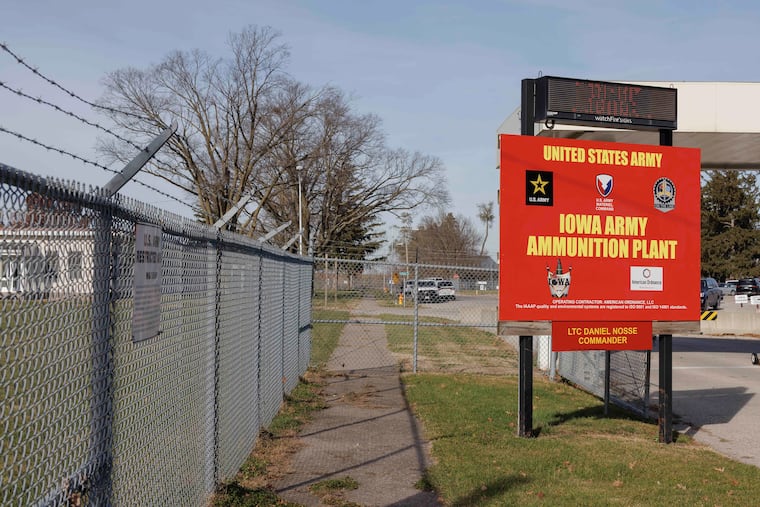
The U.S. Army has been planning to detonate nearly five tons of lead azide, an explosive used to initiate munitions, at a military facility in Iowa that is operated by a subsidiary of Philadelphia-based defense contractor Day & Zimmermann.
The controlled explosions are expected to produce a dust plume that could expose people to lead, a toxic metal, though public officials say they are working to mitigate negative health impacts. The Army has encouraged some local residents in Middletown, Iowa, to temporarily evacuate.
Federal officials say a controlled detonation is needed to head off a potential spontaneous explosion that would present more danger to the public.
Environmental groups sued to block the detonation, and a court has ordered a pause while it considers the claims. After the Army signaled it planned to move ahead this week regardless — citing legal authority to act without a permit in the event of an immediate threat — President Donald Trump on Monday said he had ordered the military to hold off.
The 19,000-acre Iowa Army Ammunition Plant, established in 1940, is one of five government-owned, contractor-operated munitions plants in the country. Day & Zimmermann says it helped design the plant during World War II, and it has operated the facility since 1998. The family-owned company says it has $2.9 billion in annual revenue and 32,000 employees worldwide.
Here’s what to know about the situation.
Why is this happening?
The U.S. Environmental Protection Agency says it was notified in March that the Army had determined that 68 drums of lead azide at the Iowa munitions plant were “potentially unstable.”
“The Army reported the material to be crystalized and potentially shock-sensitive,” the EPA wrote in a Nov. 20 letter to Iowa Gov. Kim Reynolds.
The Army considered treating the barrels containing lead azide with a chemical solution, among other alternatives, but found that even removing the lids could cause a spontaneous explosion, according to the EPA.
The compound was stored in a mixture of water and ethanol, but it degraded over time, causing the formation of crystals that increased the lead azide’s sensitivity to friction, according to a court declaration by Col. Aaron C. Teller, an explosives or munitions emergency response specialist.
The EPA earlier this month issued an emergency permit authorizing the Army to blow up the drums. The Iowa Environmental Council and the Sierra Club filed a lawsuit on Thursday challenging the validity of the permit.
Earthjustice, the nonprofit representing the environmental groups, said the detonation could “release a toxic plume of lead dust into the air that could travel 100 miles north of the site, depending on weather conditions.”
Elected officials in Iowa and Illinois also called on the Army to delay the planned explosion.
A federal appeals court put the permit on hold, but the Army said federal regulations allow it to act without a permit in the case of “an immediate threat to human health, public safety, property, or the environment.”
That threat is present in Iowa, the government said.
“The barrels holding the waste cannot be removed due to the risk of explosion, which prevents the Army from taking other measures to reduce that risk,” U.S. Justice Department lawyers wrote in a Nov. 21 court filing. “As the outside temperatures drop, the risk of an uncontrolled explosion increases because the formed crystals can break more easily in freezing temperatures.”
Trump wrote in a social media post on Monday: “I feel the proper course is to get rid of this long-term problem, but, at the same time, have ordered the military not to do so until such time as the Eighth Circuit agrees that we can go forward.”
The Iowa Department of Health and Human Services said potential health concerns include breathing in lead-containing particles or contacting lead dust on soil, playgrounds, and other surfaces.
Pregnant women and young children are at particular risk for lead exposure, health officials said, adding that no safe level of exposure has been identified. Lead exposure can cause brain damage in children, according to the federal Centers for Disease Control and Prevention.
The Army, in a joint statement with the EPA and the U.S. Department of Health and Human Services, said late last week that “all agencies involved are prepared to take the most extreme mitigation measures available to ensure there is no risk to the public and any disruptions are minimized.”
What is Day & Zimmermann?
Day & Zimmermann subsidiary American Ordnance operates the Iowa munitions plant. D&Z spokesperson Matt Rivera didn’t respond to a request for comment Monday.
American Ordnance also operated a U.S. government-owned plant in Milan, Tenn., until it was deactivated last year. In addition, D&Z owns munitions plants in Kansas, Texas, and South Dakota.
“Together, these sites provide the Army with mortars, artillery projectiles, grenades, propellant systems, and a wide range of energetic components essential to modern warfare,” the company said in a news release earlier this year.
In June the company won a $2.3 billion, 20-year contract to operate, maintain, and modernize the Hawthorne Army Depot in Nevada.
D&Z is owned by the Yoh family, brothers Bill, Mike, and Hal. In addition to defense, D&Z also specializes in construction, engineering, staffing, and security.