Ninth death confirmed in Pennsylvania measles outbreak as case count climbs to 1,638
Pennsylvania has the nation's highest number of measles cases and the most deaths.
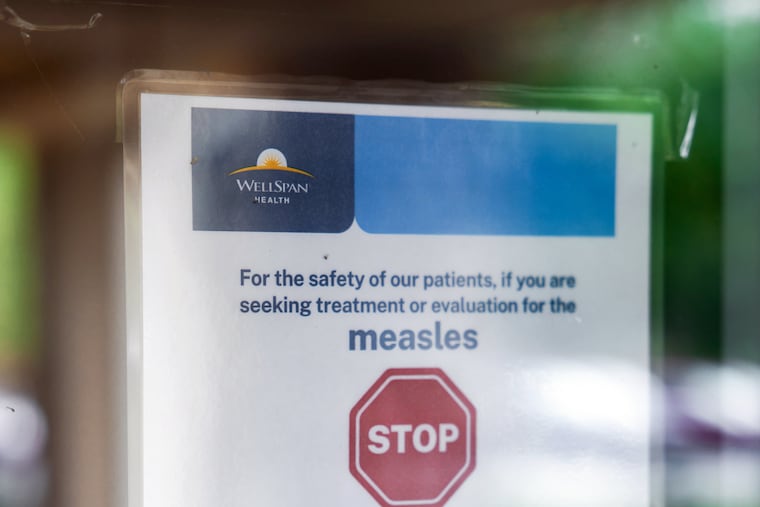
A ninth person has died in Pennsylvania’s ongoing measles outbreak, with more than 1,600 cases reported in the nation’s largest outbreak in decades, state health officials said Monday.
The unvaccinated Centre County resident had tested positive for measles, Pennsylvania Department of Health said in a news release. Citing state privacy laws, officials did not release additional information about the death.
The announcement came less than a week after the state had announced another death in neighboring Clinton County. Until this summer, Pennsylvania had not seen a death involving measles in 35 years.
All nine of the state-confirmed deaths occurred in people who were not vaccinated or too young to be vaccinated, according to state health officials.
The state defines a “measles-associated death” as one that occurs within 30 days of a person developing measles symptoms, with clinical evidence of an infection and a positive lab test for the virus, that is not caused by another unrelated incident, like a car crash.
Centre County, the central Pennsylvania home to State College and the main campus of Pennsylvania State University, has reported 50 measles cases.
Lancaster County remains the epicenter of the outbreak with 558 reported cases as of Monday, state data shows.
In suburban Philadelphia, Chester County has reported 101 cases, the state’s fourth-highest total this year. Montgomery County reported three cases this past winter, in a separate, smaller outbreak. Bucks County reported one case earlier this month.
Pennsylvania has identified 1,638 measles cases so far this year, with 80 new cases tracked in the last week. Pennsylvania’s measles cases have spread across 46 counties, or more than two-thirds of the state’s 67 counties.
About one in five people sickened have required hospitalization.
Centre County Coroner’s Office referred questions about the latest measles-related death to the county’s prothonotary office, which handles civil court records, including death records. A spokesperson for the prothonotary office could not immediately be reached for comment.
According to local coroners and news reports, the state’s deaths have included two infants from Amish families in Lancaster County, as well as a 20-year-old Lancaster County woman who had received treatment for cancer.
Additionally, an 18-year-old in Mifflin County died from a serious neurological complication of measles, and a 40-year-old woman with severe respiratory conditions was one of two deaths reported in Jefferson County. Another death reported earlier this month involved a Montour County resident.
The health department said it has concluded its investigation into a measles-associated death reported by Franklin County’s coroner and deemed the case did not meet the state’s criteria to be considered a measles-associated death.
» READ MORE: Politics and misinformation shadowed the measles response in Pa.
Outside of Pennsylvania, there have been four measles-associated deaths — all children — reported by states: one in New York; two in Wisconsin; and one in Virginia.
Nationally, the Centers for Disease Control and Prevention has confirmed 5,838 measles cases in 47 states and jurisdictions.
The CDC has been slow to update its online measles tracker to reflect the deaths confirmed by the state. As of Monday, the federal dashboard listed only six deaths without specifying where they had occurred.
Last week, the Pan American Health Organization, a regional office of the World Health Organization, stripped the United States of its measles elimination status.
Losing the largely symbolic designation indicates that measles — a highly contagious, vaccine-preventable disease — is once again circulating continuously in the US.
“We all find ourselves in complete shock and sadness that we’re here,” Pennsylvania’s Health Secretary Debra Bogen said Thursday at a webinar hosted the Association of State and Territorial Health Officials (ASTHO), a national nonprofit made up of public health agencies across the U.S.
Staff Writer Aubrey Whelan contributed to this article.

-
Your questions about Pennsylvania’s measles outbreak, answered
-
Measles is thought of as a childhood illness, but more Pa. adults are getting sick
-
New vaccination data show hundreds of Philly-area schools vulnerable to a measles outbreak
-
Chester County has more measles cases than most entire states in the country
-
Pa. measles outbreak is nation’s worst, echoing deadly 1991 Philadelphia epidemic
-
Pa. measles vaccine messaging depends on word-of-mouth to reach the Amish community