CEO of robot tech company Exyn is out after unauthorized credit card spending
Exyn Technologies CEO Brandon Torres Declet resigned after an investigation found $287,000 in personal expenses.
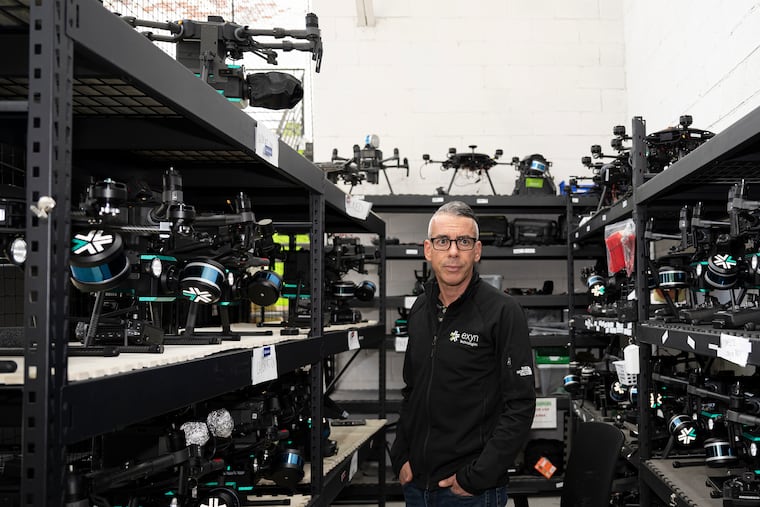
The CEO of South Philly drone software and hardware maker Exyn Technologies resigned Wednesday after an internal investigation showed he used a company credit card to rack up $287,000 in unauthorized personal expenses, according to a statement Exyn filed Thursday in a revised quarterly financial report with the SEC.
Brandon Torres Declet, the CEO, had pledged to boost sales and profits after taking the money-losing company public in an IPO in May.
Exyn named chief operating officer Benjamin Williams as acting CEO, a role Williams also filled for five months in 2023 after founder Nader Elm left the company and before Torres Declet’s hiring. The company named director Gregory McNeal as board chair to replace Torres Declet in that position.
In a Wednesday filing, Exyn had said the CEO was “terminated.” In a brief interview Wednesday night, Torres Declet said he expected the company would amend that statement, as it did. He declined further comment.
Torres Declet’s departure followed an internal investigation opened Aug. 11 by the board’s audit committee into allegations that Torres Declet “used a company-issued credit card to pay for personal travel and other personal expenses that were recorded as business expenses in the company’s books and records.”
Torres Declet was denied severance, according to the filing. Exyn added that it has asked him to return the unauthorized payments.
Torres Declet joined Exyn in late 2023. He was paid a salary of $366,667 plus a bonus of $200,000 for 2025, plus stock options. The stock went public at $7.70 but has traded lower ever since, closing Wednesday at $2.
On Aug. 3, eight days before the investigation opened, the board boosted his salary to $482,000, plus a bonus of up to $362,000.
Exyn raised $19 million in the IPO. Sales of Exyn’s drone hardware and software, used by mining companies and offered to military and commercial users, totaled $5.8 million last year, up modestly from $5.6 million in 2024. But expenses in each year, including salaries for the company’s staff of 45, totaled around three times that much.
Before joining Exyn in 2023, Torres Declet, a lawyer, had worked for years in the drone business and earlier as a counsel to Congress and for the New York Police Department, according to his posted resume.
Interim CEO Williams, who holds engineering and business degrees from the University of Pennsylvania, worked previously at AT&T, Lockheed Martin, and for the U.S. Navy. He also ran a string of small start-ups, including Reelio Inc., purchased by an AT&T affiliate in 2018.
After Torres Declet’s departure, Exyn said in its SEC filing that the company acknowledged poor credit card controls. The company listed other “material weaknesses” in its accounting procedures including a lack of oversight in tracking inventory, failure to properly report its loan agreement with Arizona-based Western Alliance Bank, and failure to properly recognize expenses.
Exyn attributed the accounting issues to having too few staff with technical accounting knowledge.
The company is based in a former brewery barn on Washington Avenue in Philadelphia. Torres Declet said last spring that he was looking for larger quarters to accommodate growth after Exyn’s lease agreement expires next year.
Exyn’s investors represent the breadth of interest in industrial and military drone projects. The largest shareholder before and after the IPO was Reliance Strategic Business Ventures Ltd., owned by India’s multibillionaire Ambani family. Others include Wilmington-based Longview Innovation; Israel-based Neolync Holding; and Penn Engineering dean Vijay Kumar, an Exyn cofounder. Early investors included Chicago-based Alyeska Investment Group; military-focused Anzu Partners, a firm linked to the Japan-based Softbank Vision Fund; In-Q-Tel, which invests in tech companies that sell to the CIA; Pennsylvania-funded Ben Franklin Technology Partners of Southeast Pennsylvania; and Penn alumni-funded Red & Blue Ventures.
Early funding also came from the Defense Advanced Research Projects Agency, the research and development arm of the U.S. Department of Defense.
Exyn was founded in 2014 by Kumar and Elm, a Penn robotics scholar who worked for Kumar’s General Robotics, Automation, Sensing & Perception (GRASP) lab, which helped develop drone quadcopters. The company’s initial clients included mining companies hoping to reopen closed deep mines in the U.S., Canada, and other countries.
The IPO prospectus said the company’s Exyn Defense Inc. subsidiary focuses on such military uses as “autonomous systems for reconnaissance, contested logistics, and force protection,” for use in underground tunnels and on city buildings.
Exyn’s Range-brand products offer “uncrewed” navigation and mapping to military and national security users on battlefields and in other places where GPS doesn’t reach.