Navy shipbuilding returns to Philly in $269 million deal for a Marine landing ship
Hanwha will build at least one Medium Landing Ship for the Marines, says construction manager TOTE Services Inc.
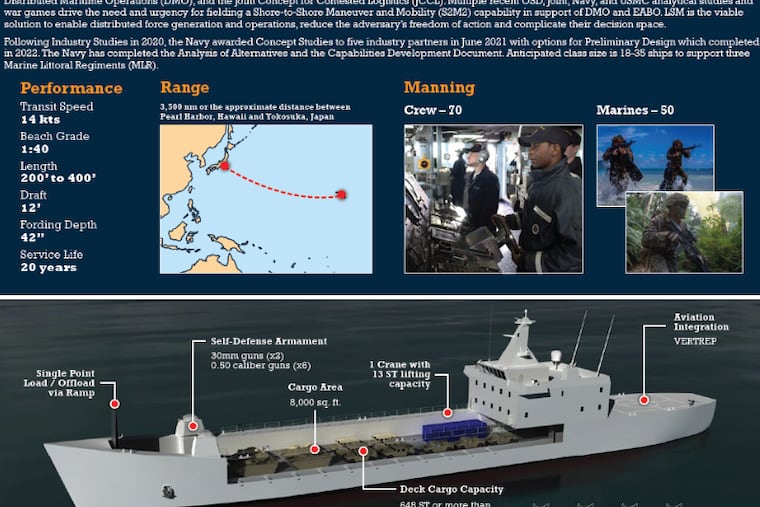
Hanwha Philly Shipyard has been chosen for a $269 million contract to build at least one of the Navy’s new Medium Landing Ships, which can speed Marines onto islands and coasts for combat, construction manager TOTE Services Inc. confirmed Friday.
The ship will be the first Navy vessel to be built in Philadelphia since the former Philadelphia Naval Shipyard ceased operations in 1995. Work will begin in late 2027, Jeff Dixon, president of TOTE, said in a statement. TOTE has an option to build three more of the ships, if work goes well.
Other yards under consideration for future Medium Landing Ships include the Bollinger yard in Louisiana and the Fincantieri Marinette yard in Wisconsin. The Navy has proposed building as many as 35 ships in the series, with the first to be delivered in 2030.
Dixon said last summer that he hoped to build at least one landing ship in Philadelphia but added that the yard first had to expand so it can make more ships more quickly.
Hanwha is finishing work on the last of five training and hospital ships for the U.S. Maritime Administration and the first of three cargo ships for the Matson commercial shipping lines in the Pacific. Hanwha occupies the 110 acres at the heart of the former Navy shipyard, which it purchased from Aker ASA in 2024.
In September Hanwha agreed to lease 47 additional acres and has started work on new facilities such as a second 1,000-foot dry dock, so it can build more ships simultaneously.
The company says it has spent $350 million since 2024 on updated welding, painting and training equipment, plus “collaborative” robots, and plans to invest another $400 million on the dry dock, a larger training center, and more production sites. Last year Hanwha said it would invest $5 billion over time to expand the Philadelphia yard. It is also bidding to purchase shipyards in Alabama.
The Korea-based, family-owned company says Philly Shipyard has been producing ships at the rate of about one every eight months. It wants to boost the total to one every few weeks and turn profitable.
In a July visit to Philadelphia by Secretary of Transportation Sean Duffy and other Trump administration and military officials, TOTE was lauded for supervising construction of five training and multi-mission ships for the U.S. Maritime Administration since 2001, at close to the original $300 million per ship construction price.
TOTE’s Dixon noted that the Navy’s Portfolio Acquisition Executive for Maritime office had approved the same private construction manager arrangement used on those training ships for the new Navy landing ships.
He said TOTE’s management system removes barriers that slowed recent Navy ship construction. He promised to do the work “faster and more efficiently.”
Navy officials have blamed delays and cost overruns afflicting Navy ship construction programs on relentless change orders, among other issues. The TOTE system is designed to reduce all but the most necessary changes once all parties have agreed to plans and begun building.
Hanwha bought the heart of the former yard in 2024 for $100 million and says it has since invested $250 million in new welding, painting and training equipment. Its predecessor, Aker, had built civilian government and cargo ships. Hanwha has hired retired senior Navy officers and lobbied for Navy contracts to boost production far beyond the civilian and commercial ships that sustained the privately run yard after the Navy turned it over to the Philadelphia Industrial Development Corp. and its tenants in 1996.
Congress members including Rep. Mary Gay Scanlon (D., Pa.) and Sens. Dave McCormick (R., Pa.) and Andy Kim (D., N.J.) have visited the yard in support of Hanwha. In a statement, Scanlon noted Hanwha’s “skilled union workforce,” led by the Metal Trades union group representing welders, operating engineers and other trades, would benefit.
The yard employs around 2,300, up from 1,800 before Hanwha’s purchase. Hanwha says it hopes to employ 4,000 or more as it boosts production.