Women are CEO at 8 of the Philadelphia area’s top 92 public companies
“Progress doesn’t happen automatically, and it requires intentional leadership and a commitment to the next generation of women leaders,” Forum of Executive Women CEO Meghan Pierce says.
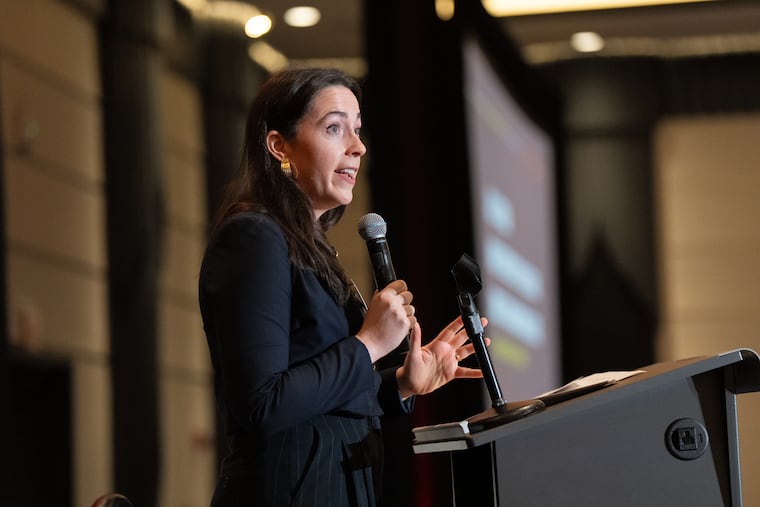
Madeline Bell didn’t expect to become a CEO.
“I was really happy as a nurse,” said Bell, who stepped down this month from her role as CEO of Children’s Hospital of Philadelphia. “If somebody had given me a letter back when I was a nurse to say you’re going to be a CEO someday, I would have said they had the wrong person.”
Bell was CHOP’s first female CEO. Throughout her career, she was many times the only woman in the room, she says. While she tried not to focus on that, others made her aware of it at times, which “automatically makes you feel different, and feel a little less comfortable.”
She often turned to a small group of women leaders in healthcare who shared personal and professional support. When she was preparing for an interview to become a Comcast board member, women in the group coached her on what to expect.
For women CEO hopefuls, only a few role models exist at Philadelphia’s public companies.
A woman is CEO at just eight of the largest 92 public companies in Philadelphia by revenue, according to an annual report released Friday by the Forum of Executive Women. Female representation on the boards of directors at those companies has also stalled.
“We’ve made significant gains over the past decade,” Forum CEO Meghan Pierce said. “But women remain under-represented in the places where the most important decisions are made.”
Who are the women CEOs in Philadelphia?
The number of CEOs who are women has seen some movement in recent years. There were nine last year, when the report covered 100 public companies instead of 92. There were four in 2024, and just one woman CEO in 2022.
Still, progress has been slow.
“Progress doesn’t happen automatically, and it requires intentional leadership and a commitment to the next generation of women leaders if we’re really going to see these numbers change and not plateau year over year,” said Pierce.
Newcomers to the list are:
Lindsay Androski of Arbutus Biopharma
Lauren Ranalli of First Resource Bank
Women CEOs who reappeared on the list this year are:
Ellen Cooper of Lincoln National Corp.
Lori D. Koch of Dupont de Nemours, Inc.
Denise Dignam of Chemours Co.
Winnie Park of Five Below
Suzanne Foster of AdaptHealth Corp.
Nicholle Taylor of Artesian Resources Corp.
Women held 28% of board seats at the top 92 companies in the most recent report, down from 30% the prior year.
At these companies, 22% of all executives were women, unchanged for the past two years.
Each year’s report is based on data from the prior year.
“It takes a long time for those limited C-suite positions to turn over, so if you’re not planning intentionally to create more diversity in your succession planning, these numbers are not going to change,” said Pierce.
Corinne Low, an economist and professor at the Wharton School is studying what helps women advance in the workplace.
“I want the firms [in this year’s report] to take a hard look in the mirror and say, not where did women fail, but where did we fail, and how can we support them better?,” says Low.
This month, Wharton announced that Low will lead the school’s new Workforce Futures Lab, which is being launched with a $2.5 million grant. Those funds are part of a total $60 million the nonprofit Aspen Institute is disbursing, with funding from a group of organizations founded by Melinda French Gates. Low’s initiative is one of 18 chosen among 900 proposals for funding that are intended to help women succeed in the workplace.
Low aims to partner with companies to experiment with benefits like on-site childcare, meal service vouchers, or household management help to be used during work travel.
Companies shouldn’t just say “Well, that’s their personal lives, and we can’t do anything to support that,” says Low. “I actually think that firms can get creative with that.”
Companies can support women by showing them that they can advance in their careers while maintaining some boundaries at work, says Low. That can look like sharing work among colleagues to allow someone to take time off when needed, or protecting some weekends from work. It also helps if bosses model taking vacation or male higherups use parental leave, she says.
For high-level corporate women who are on the verge of becoming CEOs, Low recommends they look at how male CEOs spend their time.
“You need to think about what’s on your plate compared to them,” and eliminate some of that, said Low. That could mean outsourcing housework, for example.
“If you want to climb that corporate ladder, if you want to be a CEO, your time is too expensive for that,” she said. “We need to be willing to invest in ourselves, not just by taking out the loan to go to an MBA, but actually by hiring help and support.”
Choosing a partner is an important career choice too, says Low, adding that a CEO level career is “a joint venture.”
“You don’t meet people who are CEOs married to other CEOs,” said Low. “If there is somebody in the family who has a CEO-level career, it is typically not that the other person is having that career at the same time, because those careers are greedy.”