Musk’s SpaceX tumbles back to Earth, dragging Tesla stock down with it
After a record-setting IPO last month, SpaceX’s honeymoon is over. Investors in companies led by Elon Musk, who has lost his trillionaire status, want results.
It seemed to be only good news for Elon Musk and investors in companies he oversees.
SpaceX had marked a record-setting IPO, Musk was the first trillionaire in history, and the rocket company vaulted to an all-time high of more than $225 per share.
That was last month. Since then, their fortunes have shifted.
Musk has shed hundreds of billions in wealth, demoting him from trillionaire status, and SpaceX’s stock price has been cut practically in half. The stock closed at $116.41 a share Tuesday in trading on Nasdaq. On top of that, electric vehicle maker Tesla has lost about 18% of its value over the past week, in part after falling short of its quarterly earnings expectations, as investor patience for its artificial intelligence and robotics bets has worn thin.
Musk cheekily nodded at the situation in a post on X on Friday.
“(Former) Trillionaire,” he wrote.
But while the world’s richest person could become a trillionaire again with a few big up days in the market, the challenges for SpaceX are deeper. It’s a new era for a company that was once on a glide path, that seemingly could do no wrong on its way to a historic $75 billion initial public offering.
For SpaceX, “one of the benefits of being private is that there wasn’t a market to weigh in on and evaluate business decisions,” said David Meier, senior investment analyst at the Motley Fool. “Being publicly traded means everything will be evaluated and information transmitted through market prices. So every SpaceX launch, every Starlink decision and every xAI decision will be scrutinized by the market,” he added, referring to the company’s satellite internet service and artificial intelligence arm.
Case in point: After SpaceX aborted a launch because of engine issues this month, the company faced another problem — a plummeting stock. SpaceX’s IPO documents had touted its plans to establish a colony on Mars and put data centers in space.
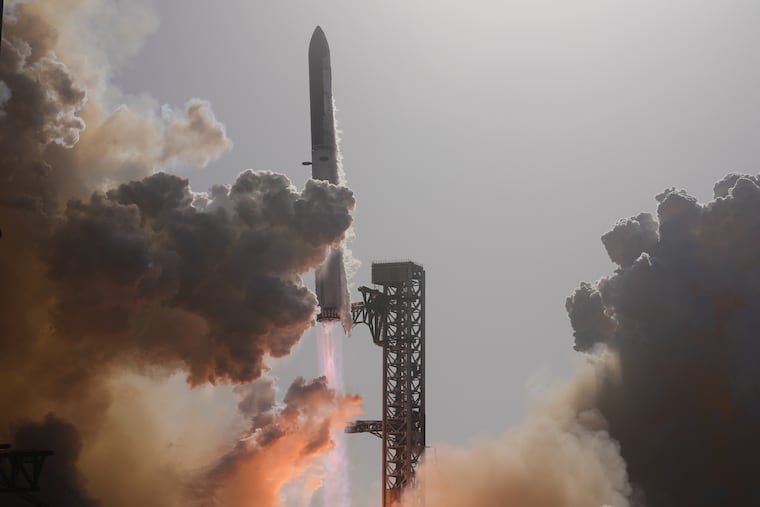
Then SpaceX was dealt its latest setback in propelling Starship off the ground. The company is trying to power its data center and exploration bets by using a roughly 400-foot rocket to carry out missions including taking humans back to the moon.
But the program has been marred by reliability concerns and repeated explosions. While SpaceX has proved its ability to put satellites and even people into orbit, much of its success has been built off of earlier and less capable launch vehicles. The company ultimately conducted a successful flight test on Friday, after what it said were issues with four of the rocket’s engines during the aborted launch the prior week, but the questions about Starship’s overall viability remain.
“The future of the company is riding on the ability to make Starship work. … They essentially have a very successful pickup truck that can move things across town,” said Clayton Swope, deputy director of the Aerospace Security Project and senior fellow at the Center for Strategic and International Studies, a nonprofit focused on policy research in areas including defense and geopolitics. “What they’re trying to do is switch to a freight train and get the economies of scale [of] something of that magnitude.”
Meier, the Motley Fool analyst, said the “sharp sell-off” has been surprising to him.
“One possible explanation is that investors had the time to digest the financials and believe the valuation is too risky,” he said. In the lead-up to its stock debut, SpaceX disclosed it had a record of significant losses, including at least $13 billion since the beginning of 2023.
Things have hardly been rosier on the other side of the Musk empire, at Tesla. Battling what he said was an illness on the company’s earnings call, Musk tempered expectations about Tesla’s performance, saying the electric vehicle company would be spending heavily to fuel its ambitions. Tesla reported a decline in profits compared with the same quarter a year earlier, despite 26% higher revenue than during the same period last year.
As Tesla has shifted away from the auto business that propelled its meteoric growth — making it the world’s most valuable car company — investors have clamored to see results from its new direction: a pivot toward robotics and what the industry calls “physical AI,” driven by products such as its forthcoming Optimus humanoid robot. Musk delivered little news of significance on those bets, sending that company’s stock sinking as well.
“We’re investing a lot in growing the core business and really preparing for the future,” Musk said. “This is a massive [capital expenditure] year, but I’m confident that all the things that we’re investing in will yield incredible returns.”
“I’m a little under the weather here, a bit ill, so if I sound a little off … I’m a little bit ill today,” Musk said later on the call.
Tesla’s declines and the larger consolidation of Musk’s empire have fueled speculation that it could be absorbed into SpaceX. Musk did little to quell that speculation on the call.
“Obviously we can’t talk about combining companies and that kind of thing on an earnings call, it’s got to be done with the appropriate process,” Musk said after citing increasing overlap between the two companies, before turning a question about a theoretical merger to the company’s general counsel.
For SpaceX, meanwhile, there is little relief on the horizon, analysts said. Gene Munster, managing partner at Deepwater Asset Management, said the company is feeling the strain of looming lockup expirations, where people who acquired shares at low prices are suddenly able to sell their stakes. Until that is resolved, he said, SpaceX is likely to continue facing challenges.
“It’s like a crushing unknown,” he said. “Typically what happens is the stock keeps going down, down, down until the lockup [resolves].”
Swope, the senior fellow at the Center for Strategic and International Studies, said the public scrutiny on SpaceX could, however, have benefits. He said a publicly traded SpaceX could be even more attentive to risks.
“I think we all know there is a bit of showmanship to how SpaceX and Elon Musk do business,” he said. “If anything, I guess I could see maybe this will attenuate some of that showmanship a bit and it will be more cautious.”