The ugly truth behind Trump’s ‘kinetic’ drone strikes | Will Bunch Newsletter
Plus, is there any way to stop Trump’s $1.776 billion slush fund?
You may have noticed there’s a lot of stuff happening right now that’s bad. Or dumb. Or both. Today is a day people can actually do something about it: Primary day has finally arrived in Pennsylvania. OK, there aren’t a ton of marquee races — Democrats in the Philly-based 3rd Congressional District are the exception — and it’s bad that Pennsylvania doesn’t let independents (like me) vote in primaries. But voting is a fundamental American right that they are trying to take away from folks. Exercise it when you can!
If someone forwarded you this email, sign up for free here.
Trump says a cartoon ‘boom’ while his tin soldiers blow up human beings
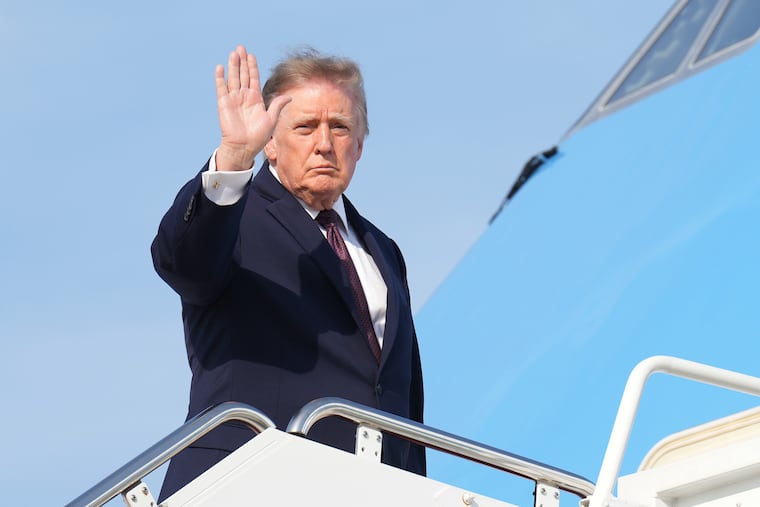
Late Sunday afternoon, the PGA Championship at suburban Philadelphia’s Aronimink course was headed toward a thrilling conclusion, but the world’s most powerful golfing enthusiast didn’t seem interested. Over a 90-minute stretch, Donald Trump went on a Truth Social posting binge with some 20 “truths.” They weren’t actually “true,” however; most were AI- or computer-generated fictions mocking his enemies.
One of them stood out among the insanity. It showed an American battleship, presumably in the Persian Gulf, firing its big gun and shooting down an incoming drone with a missile that lit the sky with a red streak before exploding its target. This video also shows Trump in a small box at bottom-right — air-pounding on an invisible keyboard, as if he is programming the missile. On impact, the 47th president of the United States mouths one word.
“Boom.”
Of course, the truth (that word again) is that for all his shoot-someone-in-the-middle-of-Fifth-Avenue bluster, Trump and his bone spurs have never personally blown anything up or killed another human being … that we know of. But he often makes it clear he’d really like to. And, because he’s commander in chief, he has people for that.
And Sunday, at nearly the same time Trump was uttering “boom,” this president’s tin soldiers were hard at work.
The U.S. military later announced that “kinetic strikes” in Nigeria had killed members of the Islamist group ISIS. Trump would later declare on Truth Social that a high-ranking member of ISIS had been killed, but we don’t know other key information, like how many people overall died in the attack, and whether any were civilians.
Or why we are even “war-fighting” in Nigeria at all.
The president who promised in his second inaugural address that U.S. success would be measured “by the wars that we end — and perhaps most importantly, the wars we never get into” has gotten into a whole mess of them.
America has dropped bombs or fired drones not just in Nigeria but also in Iran, Venezuela, Yemen (at least that’s what Pete Hegsteth texted us), Syria, Iraq, Somalia, and Ecuador (bet you’d already forgotten that one), plus at sea in the Caribbean and the Pacific. Not counting the guy we blew up in Mexico (maybe). Or baseball-loving Cuba, in the on-deck circle.
“Boom” doesn’t begin to describe it.
It’s bad enough we don’t really have an exact count of how many human beings have been blown to smithereens with our tax dollars, although the exact tally for the running campaign of attacking the boats of suspected drug smugglers is up to a staggering 194 deaths. Far worse, we don’t seem to know if these victims of U.S. attacks are really the bad guys … or who they are, period.
I’m taking Trump’s Monday night bluster about the attack in Nigeria — “No games!!! Watch what’s next on your favorite subject,” he posted (that subject apparently being murdering folks) — with a giant grain of salt, and here’s why:
In March, reporters for the New York Times reached the site of that joint U.S.-Ecuador attack on what government officials described as a camp for drug traffickers, and found by all accounts that the site was a modest dairy farm.
Even worse for the nonexistent credibility of the Trump regime, journalists are beginning to learn more about the real stories of at least a few of those 194 people summarily executed for midlevel felonies on their boats, with no chance to prove their innocence. It’s as bad as you expected.
Juan Carlos Fuentes and Luis Ramón Amundarain from the poverty-stricken Venezuelan town of Güiria, who, according to relatives interviewed by the Latin American Center for Investigative Journalism (CLIP, in Spanish), went to nearby Trinidad and Tobago to work in a car wash. They were headed back home — against the normal northward flow of drug traffic — when American drones attacked their vessel and killed them.
In its lengthy investigation, CLIP was able to give names to just 13 of the 194 who’ve been murdered, and said some “victims were fishers with no indication of involvement in the drug trade.” Indeed, regular fishers in their poor neighborhoods stopped going to sea for weeks for fear that they, too, would be obliterated.
María Teresa Ronderos, director and cofounder of CLIP, told the Guardian that “young people living in extremely precarious conditions, doing whatever work they can to support their families, are being targeted … The U.S. is not taking down any Pablo Escobar or Joaquín ‘El Chapo’ Guzmán.”
The Pentagon has never released any names or information about the alleged “narco-terrorists” who are the victims of Trump’s “favorite subject,” a.k.a. wanton violence. We do get the regime’s “secretary of war,” Hegseth, and his subordinate war-fighters releasing snuff videos of the explosions — which aren’t so different from the AI video game stuff the president posts — and using macho words to describe them.
The most overused term in the Trump/Hegseth lexicon is kinetic, which is now used to describe any type of bombing or shooting, which is happening every day under this out-of-control regime. The word kinetic simply means “relating to or resulting from motion,” and when I hear it, I think of that toy everybody had in the 1960s with five metal balls called Newton’s cradle, in which you swung the ball on one end, and the one on the far side flew up in the air, blinding you with science.
But in Hegseth-speak, kinetic strikes are a kind of war-fighting that brings maximum lethality to narco-terrorists and other assorted bad people. He thinks this ridiculous jargon makes him sound manly and cool. “There’s sort of a macho element,” Lawrence Freedman, emeritus professor of war studies at King’s College London, told CNN. “‘Kinetic’ sounds like you’re being really tough.”
Words like kinetic or lethality are also meant to numb your brain, so it doesn’t linger long on what is actually happening here, which is utter barbarism. Fishing boat hands and farmers — or small-time drug runners who’d get a six-month sentence in an American court — are being decapitated or burned beyond recognition by our 21st-century flying death robots.
Trump’s juvenile Truth Social cartoons are going for the same novocaine impact. MAGA wants to excite its cruelty-is-the-point base, and yet anesthetize everyone else to not dwell on the fact that these summary execution “kinetic” drone strikes are war crimes — among the worst offenses against humanity ever ordered by an American president.
The normalization of these humanitarian outrages that take place thousands of miles away, on the high seas and in remote rural villages, is happening at the same time the Trump regime creates a supersized domestic army of masked goons, launches an illegal $1.776 billion slush fund for those who committed violence for its cause on Jan. 6, 2021, and seeks to build a $1 billion bunker under the White House.
Will Trump still be posting his “boom” cartoons when he brings the war home?
Yo, do this!
One cultural event dominates the calendar as we race toward the Memorial Day weekend: the last days of CBS’s The Late Show with Stephen Colbert, whose contract was not renewed in what the new owners of the Network Formerly Known as Tiffany insist was not retribution for his nightly mocking of Trump. Thursday’s final episode at 11:35 p.m. should be a rare monoculture event that will be seen by millions in our otherwise fractured media world. What parting wisdom will Colbert offer? (Also, CNN did an interesting — albeit clearly rushed — hourlong “flash” documentary, The Last Laugh: Stephen Colbert, that a) is still worth checking out and b) seems a warning shot against its likely new owner, David Ellison, whose firm also owns CBS.)
I never thought I would say this, but thank you to MS Now’s Morning Joe, which has a “book club” (who knew?) and which recommended the audiobook I recently downloaded: 2023’s Necessary Trouble: Growing Up at Midcentury by acclaimed historian Drew Gilpin Faust. The former president of Harvard writes about growing up in the 1950s and ‘60s in rural, segregated, and conformist Virginia horse country, and how, as a college student, she fought to break free in that tumultuous era. A compelling story that mines the deeply personal to recapture a pivotal, vanishing time.
Ask me anything
Question: Can you speak to the value of the little moments of joy in the bleak everyday? I’m going to see Springsteen this weekend and I’m excited for the show but it also feels like, with the world the way it is, does happiness even matter? — LauraB (@lbw215.bsky.social) via Bluesky
Answer: Laura, this is the perfect question ahead of Memorial Day weekend, which is one of the best times of the year for cookouts, the beach (well, maybe not this year), and talking about anything but politics. There is Bruce Springsteen, who comes here May 30 (after delaying his show so the Sixers could be embarrassed by the New York Knicks … typical North Jersey guy move), but also the surprisingly resilient Phillies, and the looming arrival of the planet’s coolest soccer players, who will make us forget about FIFA’s corruption. And yet, the best moment was the hour I spent last Saturday walking Maisie on the bay beach down the Shore, with no clouds and a cool breeze. They are not going to ruin our summer.
What you’re saying about …
Some surprising results after I asked you last week about the future political prospects for the Democrats’ youngest star, New York Rep. Alexandria Ocasio-Cortez. She is near the top of some way-too-early 2028 presidential primary polls, but not around these parts. About two-thirds of you said mostly nice things, but agreed she’s a much better fit for challenging (or replacing) Senate Minority Leader Chuck Schumer in that same year. Only one reader, Jeff Miller, said she should enter the presidential primaries, but quickly added that AOC, who’ll be 39, can’t win. “Yes, run in the primary, represent the Bernie wing and send the message that they will have at least a seat at the presidential table,” he wrote. But AOC is too far-left or too tough on Israel for about a third of you. “Spare me,” Meg Berlin wrote dismissively. “Democrats need someone who 1. Can win; and 2. Knows what it takes to be an effective president …”
📮 This week’s question: Few issues have fired up grassroots activists in recent years like the madcap rush to build massive, noisy, energy-and-water-guzzling data centers. A large coalition just asked New Jersey Gov. Mikie Sherrill to impose a statewide moratorium. Do you think this is a good idea, or do we need the jobs and economic activity that come with these projects? Please email me your answer, and please put the exact phrase “data center moratorium” in the subject line.
Backstory: Who can stop Trump’s illegal Jan. 6 slush fund?
When did America cross the red line from backsliding, flawed democracy into full-blown dictatorship? There’s a powerful case that Donald Trump’s illegal attack on Iran — a war that was launched without congressional approval, let alone any explanation — was the ultimate unchecked doing of a mad king. But the total breakdown of any democratic accountability really came into focus on Monday with the U.S. Department of Justice’s so-called deal with Trump that ends the president’s absurd lawsuit against the leak of his tax returns by creating a $1.776 billion slush fund for others prosecuted during the Biden administration. The presumed main beneficiaries would be the 1,600 or so Trump acolytes who staged a violent insurrection on Capitol Hill on Jan. 6, 2021, in an effort to undo his 2020 election loss.
There are many more questions than answers so far about how the fund will operate, and just who exactly is eligible for payouts from a pool of cash that amounts to more than $1 million for each Capitol rioter who was prosecuted, although other Trump allies might also be eligible. What is clear is that a massive sum of taxpayer dollars is slated to be spent without congressional approval by an authoritarian regime that just pretended to negotiate against itself. “This is one of the single most corrupt acts in American history,” Donald K. Sherman, president of Citizens for Responsibility and Ethics in Washington, told the New York Times. Which raises the question: Can anything be done to stop it?
It also wasn’t immediately clear whether the bypassed members of Congress or aggrieved taxpayers will have recourse in the courts, but clearly some of them are going to find out. Nearly 100 congressional Democrats signed onto a legal amicus brief in hopes that a judge can halt the arrangement. It does seem there’s a viable case. For one thing, critics say the arrangement isn’t really a settlement of Trump’s legal claim, but a brand new expenditure that would clearly require a vote on Capitol Hill. Maryland Democratic Rep. Jamie Raskin, who is also a constitutional scholar, told the New Republic’s Greg Sargent that the slush fund is “an outrageous desecration of congressional power of the purse.”
That’s not all. Raskin also pointed out that there’s specific language in the post-Civil War 14th Amendment that bars the government from taking on any “obligation incurred in aid of insurrection or rebellion against the United States.” Most rational people believe that what happened that January afternoon five years ago was exactly such an insurrection, although telling that to a judge would not be a slam dunk. (The amendment arguably also barred Trump, who egged on the uprising, from running for president in 2024, but the U.S. Supreme Court had other ideas.)
Raskin told the New Republic that a Democratic Congress in 2027 would move to shut down the slush fund, which may explain why the Justice Department raced to implement this now, while the GOP still runs the House and Senate. Until this abomination can be somehow stopped and overturned, the Trump regime has created a vehicle to funnel substantial dollars to the Americans who’ve already shown a willingness to use violence to keep Trump in power. This could not end well.
What I wrote on this date in 2022
This time four years ago was the height of another midterm election season, and this columnist was in the middle of a crusade: to warn Pennsylvania about the dangers of the Republican gubernatorial nominee, State Sen. Doug Mastriano. On the heels of the right-wing election denier’s GOP primary win, I wrote that “Pennsylvania’s fall election is now a referendum on whether voters want to continue on the flawed but hopeful democratic path launched from Philadelphia in 1776, or whether they want a ruling philosophy based on Christian domination for the fifth most populous state in the country.” So what happened to Mastriano, who lost that fall to Gov. Josh Shapiro? Last week, Trump nominated the state senator to be America’s next ambassador to Slovakia.
Ponder that as you read: “Doug Mastriano race to decide if Pennsylvanians want their votes counted or cheaper bacon.”
Recommended Inquirer reading
Keeping up with Donald Trump’s corruption and the unraveling of the American Experiment in democracy remains a full-time job. In last week’s Sunday column, I tried to go beyond the headlines about the U.S. Supreme Court-enabled racial remapping of the South’s congressional districts and look at how losing their voices in Washington will hurt everyday Black folks. I focused on the predominantly African American residents of Louisiana’s “Cancer Alley,” the most polluted corridor in the nation. Over the weekend, I voiced my shock and outrage over the president’s 3,700 stock trades in the first three months of 2026, most in companies that benefited from his own policies.
As someone who, as a teenager, muddled through the 1976 American Bicentennial, I know firsthand the U.S. has a weird penchant for celebrating its biggest birthdays in times of democratic malaise. That said, excitement, or at least acknowledgment, of the nation’s 250th birthday on July 4 is starting to arrive, including in the pages of The Inquirer. “Made by History” is a cool project from the University of Pennsylvania’s Brian Rosenwald that enlists historians to offer unique perspectives on what’s gone right or gone wrong during two-and-a-half fraught centuries. Readers have been treated to Michael Bobelian’s look at how Trump’s MAGA revolution is abusing the vast power of the federal government created during FDR’s New Deal, while the University of Iowa’s Cory James Young wrote on the ties between George Washington and slavery. These brutally honest assessments of where America has been are essential as we struggle to figure out where we are going. They are also one more reason to subscribe to The Inquirer and support another 250 years of press freedom.
By submitting your written, visual, and/or audio contributions, you agree to The Inquirer’s Terms of Use, including the grant of rights in Section 10.

Sign up for the Will Bunch Newsletter