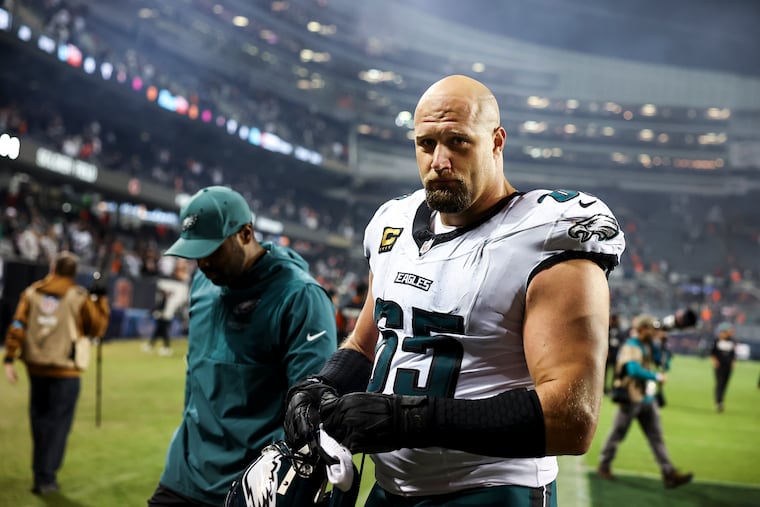
The Eagles offense starts the post-Lane Johnson era on Sunday. The film points the way to where they must adjust.
Rookie Markel Bell's permanent presence isn't likely to help much, but the Eagles' stagnant attack still has some opportunities for growth.
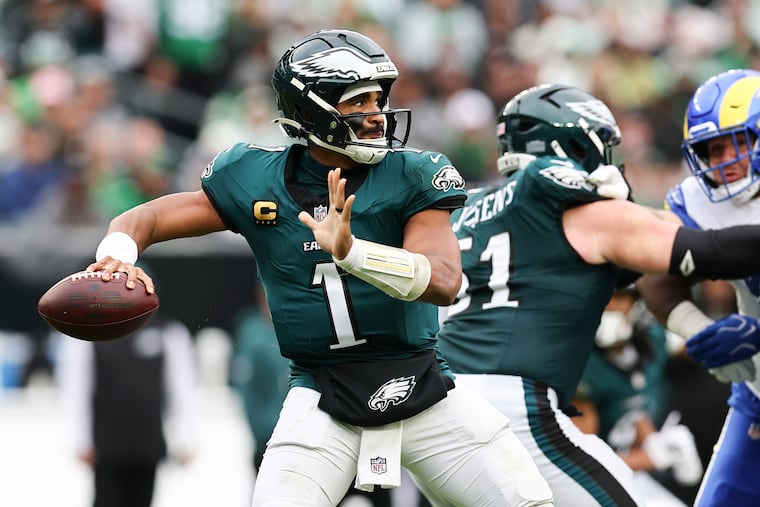
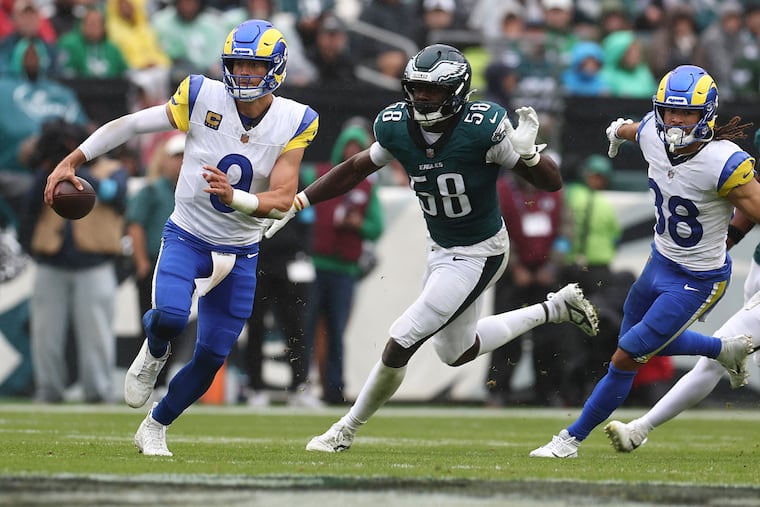
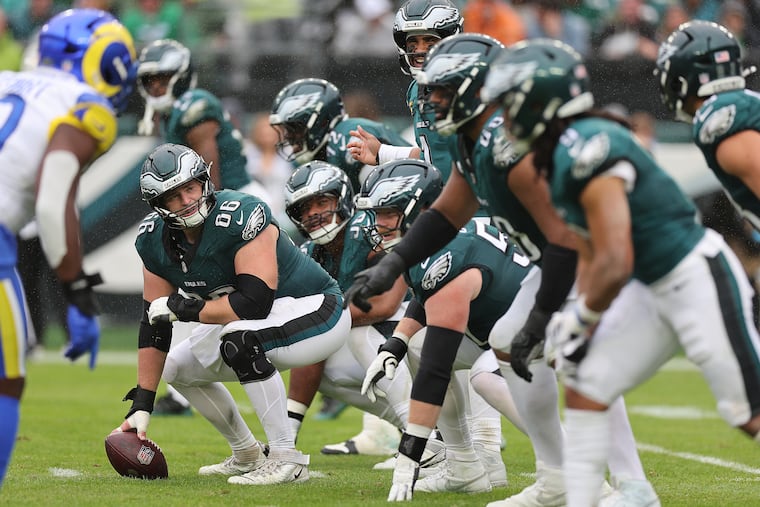
Adjusting to Sean Mannion’s scheme was always going to take time, but the Eagles offense hit a new low on Sunday. From going 0-for-12 on third downs to being shut out in the second half of the 24-20 loss to the Rams, the offense has not worked as designed and has resulted in an ugly six quarters, dating back to the Bears loss last week.
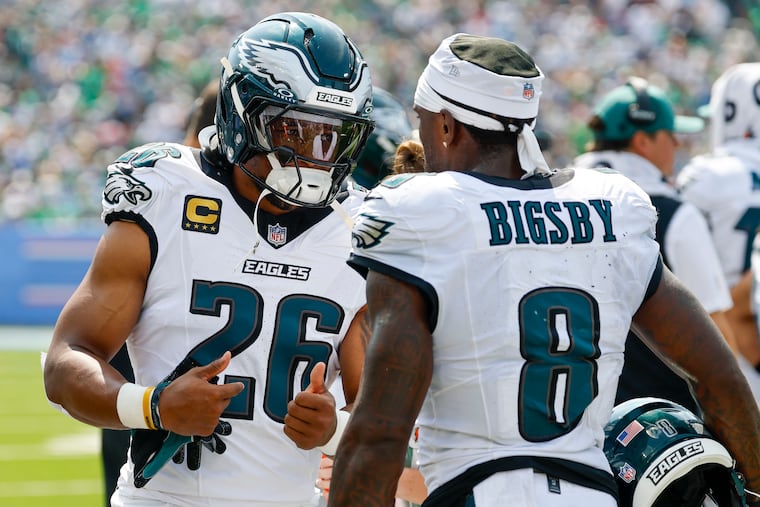
Injuries have started to mount on offense, too. The Eagles were without four starters entering Sunday, lost running backs Saquon Barkley and Tank Bigsby during the game, and could be also without Cam Jurgens in London after he entered concussion protocol. Star right tackle Lane Johnson’s surprising in-season retirement on Tuesday will further hamstring the group, to say the least.
The offense is well below average in most metrics, and by the eye test. With the Jaguars up next across the pond, we evaluate what has gone wrong thus far for the unit, and where it can improve as it begins the post-Johnson era,
Here‘s what the film says about Mannion’s scheme, about one-quarter through the season:
Under center ineffectiveness
A staple of the Kyle Shanahan/Sean McVay offense is the ability to operate under center in some capacity. FWhether running or throwing from under center, the Eagles haven’t produced many enough consistent positive plays in those formations.
Since hitting a 64-yard pass to Dontayvion Wicks in Week 1, the Eagles have created minimal explosive passes play off play-action. On under-center play-action passes, Jalen Hurts is 5-for-16 for 93 yards across 18 dropbacks, according to Sumer Sports.
Over the last two weeks, the Eagles have hardly gotten a pass off before Hurts faces pressure. When turning his back to play-action and running bootleg concepts, backside defensive ends have not been fooled by the play fake, causing Hurts to quickly throw the ball away.
A big reason that the play-action passing game has been ineffective is the overall struggles of the run game, particularly under-center runs with condensed formations and heavier tight end personnel.
According to Sumer Sports, on under-center runs from “12″ personnel (one running back, two tight ends), the Eagles have a minus-0.81 expected points added. which measures the value of individual plays. That ranks 29th in the NFL.
Early down, under center runs in general have not been successful either: The Eagles have a 33.3% success rate on first and second down runs from under center, which ranks 23rd in the NFL, according to Sumer Sports, and that number drops to 21.1% in the second half of games.
One counter teams have employed to stop under-center runs, specifically outside zone, and play-action, is blitzing a linebacker or corner. Every week since facing the Commanders in Week 1, teams facing the Eagles have dialed up the pressure, especially to combat early down runs and play-action.
On play-action fakes when Hurts doesn’t turn his back to the defense, teams have blitzed a linebacker through the middle of the offensive line, which either causes confusion up front or forces the running back to quickly pick up the blitzer and flushes Hurts from the pocket.
That tactic also proved effective for Chicago last week. Barkley was held to just nine yards on four rushes in the second half after he rattled off 11 carries for 73 yards in the first two quarters.
According to Sumer Sports, the Eagles rank 23rd in the NFL in EPA on under-center runs, and 25th in success rate. Because the Eagles are either running the ball or throwing off play-action, defenses are dialed in to what is coming and sending extra bodies toward Hurts and the running backs. The Eagles have just two passing attempts this season with no play-action calls from under center.
Dropback passing woes
The team’s struggles handling the blitz and inconsistencies in route spacing, timing, and pass protection have contributed to an up and down passing game. Against the Rams on Sunday, Hurts completed 5 of 15 passes for 46 yards against the blitz, according to Sumer Sports. On third downs specifically against Los Angeles, Hurts completed 1 of 7 passes for five yards and was pressured seven times and sacked twice.
Like in 2023, when Hurts particularly struggled against the blitz, the Eagles have struggled identifying where pressure is coming from and having quick answers for it. In 2023, Hurts finished 22nd in the NFL in EPA (minus-21.3) against the blitz; through four games this season, he ranks 26th (minus-17.8).
The Eagles’ struggles on early downs lead to third-and-long situations, and force longer developing plays downfield that require pass protection to hold up. But the Eagles’ O-line has struggled in that area as well this season.
According to Next Gen Stats, Hurts has been pressured on 43.5% of his dropbacks, which is tied for the third highest in the NFL among qualified quarterbacks. He has also been blitzed on 39.1% of his dropbacks, which ranks third-most among NFL starting quarterbacks.
Hurts and the passing offense, when DeVonta Smith was still in the lineup, showed promise attacking the middle of the field and hitting explosive plays against Washington and Tennessee.
The script has flipped in the past two weeks, with Chicago and Los Angeles playing more man coverage vs. the Eagles and forcing Wicks, Makai Lemon, and others to win their one-on-one matchups.
A big part of the Eagles’ quick passing game has been throwing screens and swing passes to the perimeter. Mannion often sends Lemon in motion behind or parallel to Hurts and that particular swing pass has had issues with blocking from wide receivers in space, along with the screen passes to running backs and receivers.
There are passing situations when Hurts seems to hesitate or turn down quick-hitting throws, which could also prevent opportunities for his receivers to create after the catch. Hurts seemed more sure of such throws through the first two games.
On throws under 2.5 seconds, Hurts had an EPA of minus-14.1 (second-lowest) and was pressured on 20.5% (seventh highest) of his dropbacks, according to Next Gen Stats.
How Markel Bell fits
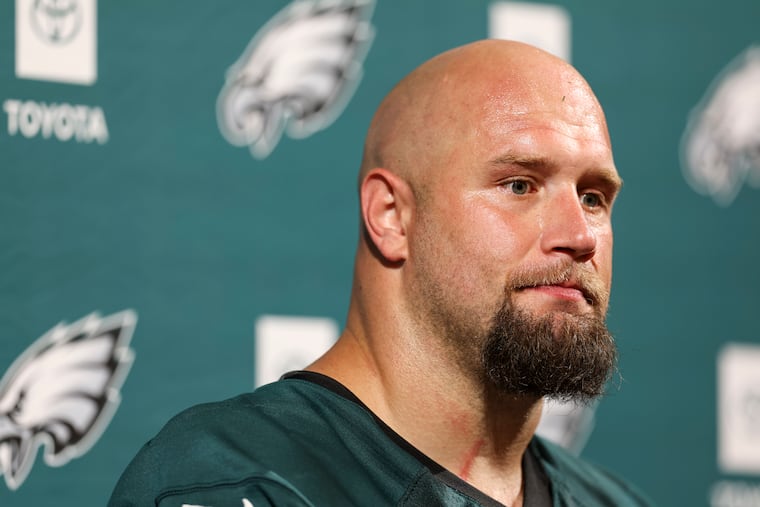
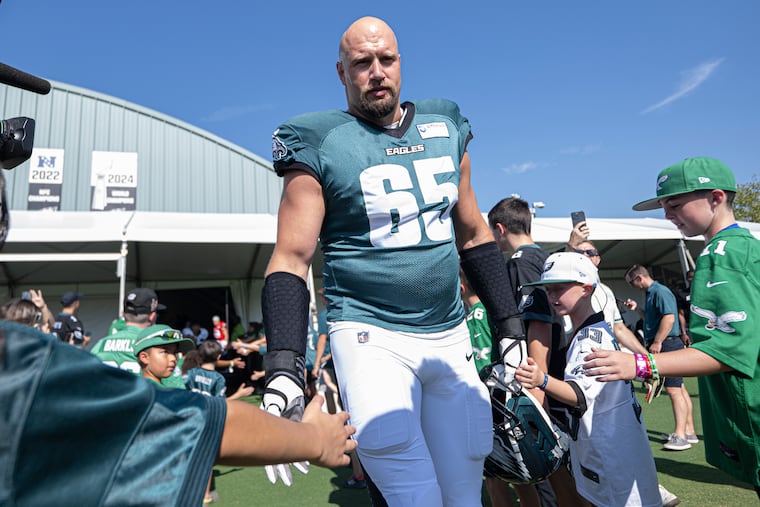
Part of the Eagles’ protection woes on Sunday against the Rams was rookie tackle Markel Bell being thrust into action, with Johnson out with a personal matter that would be followed by his retirement two days later. Now that Johnson is officially retired, the right tackle spot becomes Bell’s for the foreseeable future.
The 6-foot-9, 346 pound Bell is a massive target for edge rushers to work around and through in pass protection, and his athleticism out of his stance pops in the run game. He showed some of that ability on a double team up to the linebacker, and getting two defensive linemen knockdowns in the process.
That said, Bell has big shoes to fill with Johnson and is not ready for a full workload of one-on-one situations against pass rushers. He allowed four pressures and two sacks on Sunday over 32 pass blocking attempts, according to Sumer Sports.
He has the tools and size to develop into a solid starter, but it will take time. He started just 21 games in two seasons in Miami and needs more reps. Johnson’s retirement paves the way for it.
More shotgun and pistol runs
The Eagles had their most success on under-center runs in their Week 3 loss, but the run game seems to operate better from the shotgun.
According to Sumer Sports, the Eagles have a 42.9% success rate on early down shotgun runs, which is tied for 12th-best in the league. Against the Rams, the Eagles were relying on zone runs, and even threw in some misdirection to free up Bigsby for a 19-yard gain.
The Eagles do not have the personnel to run the multiple-tight end sets that are a league trend. Dallas Goedert’s injury and the lack of true in-line blocking options has contributed to some of the Eagles’ run game struggles.
Because of that, they should continue to lean into “11″ personnel (one running back, one tight end), and the numbers back that up: The Eagles rank eighth in EPA per rush in that grouping (plus-0.05) and 17th in success rate (43.3%). Those numbers changed drastically in “12″ personnel, which is minus-0.3 in EPA per rush (26th) and has a 27.3% run success rate (26th).
Pistol formations, with a running back aligning behind Hurts, should be in the plans as well. The Eagles ran just four plays from the formation, but had a 66.7% run success rate, according to Sumer Sports.
Hurts continuing to be a threat as a runner will help. Twice in the Rams-Eagles game, Hurts had a designed quarterback run, and it has been sprinkled into the game plan more frequently in recent weeks.
The offense will face another tough defense in Jacksonville that has a stingy run defense and has allowed the second-fewest passing touchdowns this season.
It may be a while before the Eagles offense is back at full strength with its litany of injuries and Johnson’s sudden retirement, but determining its identity will be the key to how successful this season can be.

Different year, different offensive coordinator, yet still, it feels like Déjà vu all over again. The Eagles had little margin for error Sunday vs. the Rams because of injuries. They played hard despite being shorthanded, but in the end, couldn’t put the Rams away, mainly because of poor execution on offense. Why hasn’t Sean Mannion's scheme clicked? How culpable are head coach Nick Sirianni and quarterback Jalen Hurts in the offensive rut the Eagles find themselves in? The Inquirer's Jeff McLane and David Murphy analyze the fallout from the 24-20 loss to L.A. Listen here.
Listen to all episodes here or wherever you get your podcasts.