Jalen Hurts has a blood clot, and the Eagles now have major questions to answer
Can a Hurts-less offense help its tired D? Is Hurts' latest injury part of a worrying QB trend the Eagles must confront?
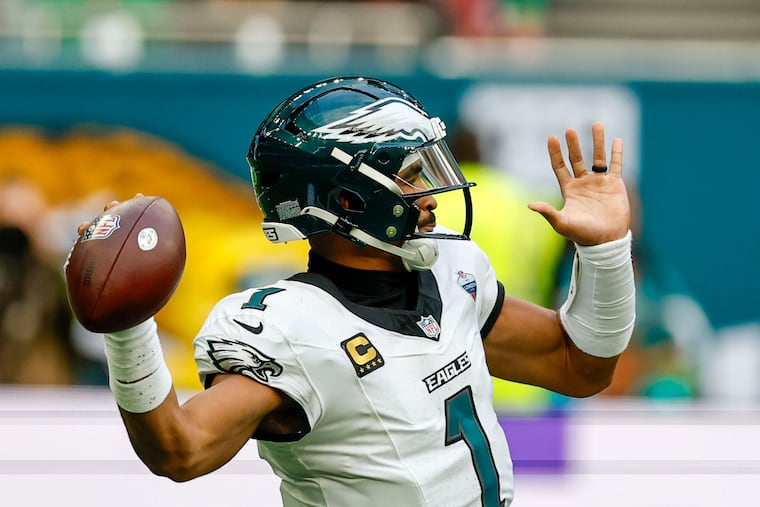
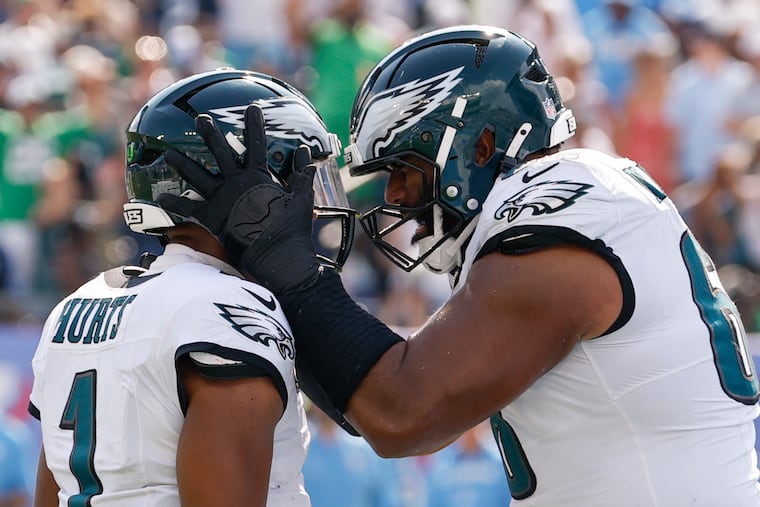
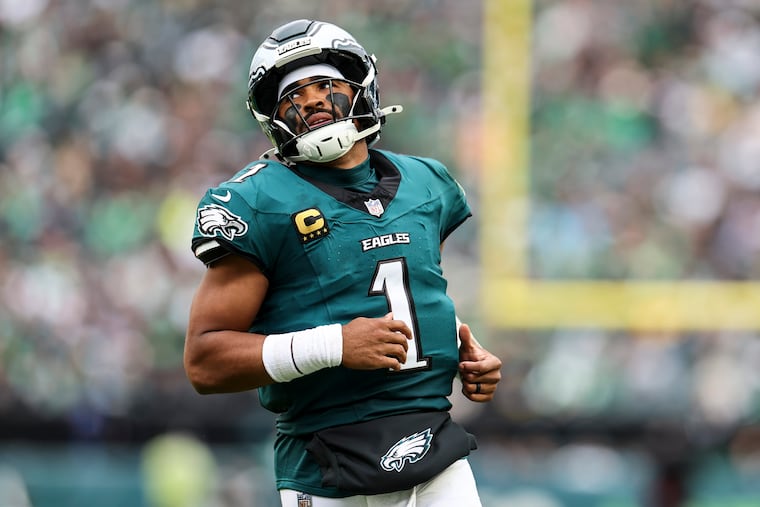
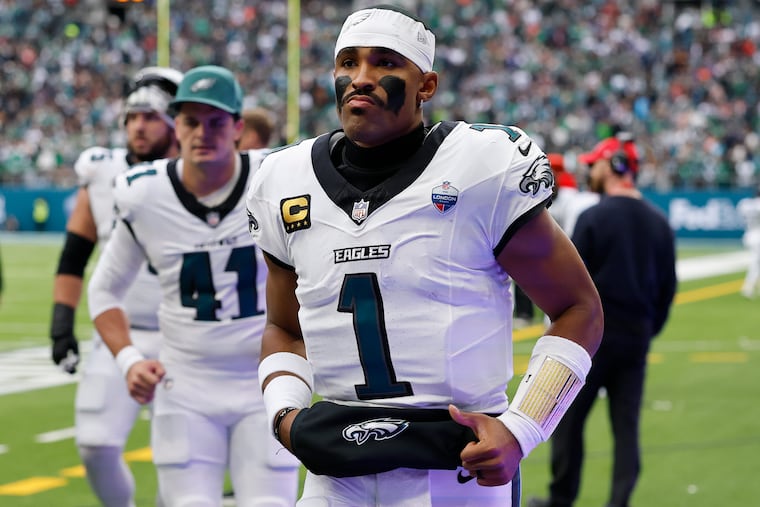
The revelation Thursday that Jalen Hurts was suffering from a blood clot in one of his calves and will miss the Eagles’ game this Sunday against the Carolina Panthers would have been stunning enough during a run-of-the-mill season. But after the last few weeks, after a string of injuries to several of the team’s most important players, after the retirement of Lane Johnson and the trade of Cam Jurgens, after two gut-punch losses to the Los Angeles Rams and the Jacksonville Jaguars, after questions about Nick Sirianni and Hurts and Sean Mannion, the Eagles’ mission has to be simple: Just survive. Calling this season stormy doesn’t quite do it justice. These are the kinds of conditions to which meteorologists assign obscure names.
Consider a few ramifications of this development:
A tired D?
The Eagles’ offensive line has been in upheaval. Saquon Barkley and DeVonta Smith have been out. Now Hurts is, too. The Eagles’ defense had kept them close against the Rams and the Jaguars. Its burden would seem even heavier now.

Mike Sielski alerts
“Not really,” cornerback Riq Woolen said. “When you’re a great team and a great competitor, it don’t really faze us too much. It’s tiring, yes, but at the same time we’re getting our reps in, and we’ve got to go out there and play ball.”
Tiring? You mean staying on the field during games?
“A little bit, yeah,” he said, “just because when anybody runs a lot, they get tired. Getting a lot of reps and getting them in different games, you get tired a little bit. But we just go out there and play ball, whether it’s 50 plays or a hundred.”
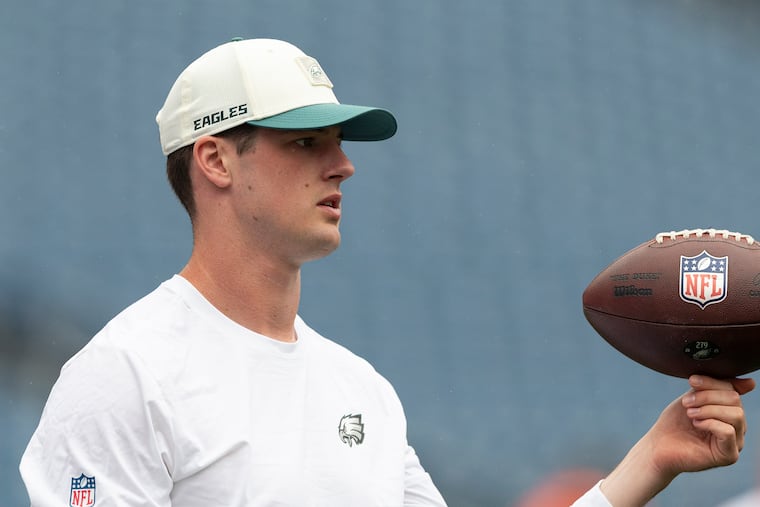
As much as Woolen tried to downplay it, his admission that the Eagles’ D might be wearing down was concerning. Too many three-and-outs will do that to a defense. For the Eagles to right themselves, maybe Tanner McKee doesn’t have to go full Kurt Warner and turn Mannion’s system into a point-producing machine. Maybe he just needs to help the offense gain a few extra first downs.
A familiar history
Ever since he signed off on Andy Reid’s insistence that the team draft Donovan McNabb in 1999, Eagles owner Jeffrey Lurie has favored the team having a mobile quarterback as its centerpiece. There have been exceptions, sure: The Eagles wanted Kevin Kolb to succeed McNabb in 2010, and they of course won a Super Bowl with Nick Foles, and you could have timed a footrace between Kolb and Foles with a sundial. But all things being equal, Lurie and the Eagles like to have a QB who can move. McNabb, Michael Vick, Carson Wentz, Hurts. The appeal is obvious: A quarterback who can throw on the run, who can avoid pressure, who can dash for a first down is a multi-dimensional weapon.
Eventually, though, one of those dimensions diminishes or disappears altogether. The quarterback ages. He suffers injuries. His body breaks down bit by bit. That attrition slows him down as a runner and, in turn, forces him to rely even more on his passing skills — skills that he presumably has been developing throughout the early years of his career.
McNabb doesn’t get enough credit for his evolution in this regard. After averaging more than 37 rushing yards per game from 2000 to 2002, he had progressed enough as a pocket passer that he averaged 22.2 rushing yards in 2003 and just 14.7 in 2004, which was his finest season. He only rushed for more than 17 yards a game once in his final five seasons with the Eagles. He could run, but he no longer had to run.
That’s the best-case process for such a quarterback, and neither Vick nor Wentz could follow McNabb’s path because neither of them could stay healthy enough. Vick in 2010 might have been the ideal iteration of passer/runner, but at 6 feet and 210 pounds (officially), he wasn’t stout enough to withstand the physical punishment of playing the position as he did. He never started more than 13 games in any of his five seasons with the Eagles. Wentz was too reckless too often, and his season-ending knee injury in 2017 and the concussion he suffered in a 2020 playoff loss to Seattle — both on plays in which he scrambled — left him lesser than the player he might have been.
Now, there’s Hurts, who is dealing with this blood clot, was concussed in December 2024, sprained the AC joint in his throwing shoulder in 2022, is 28, and has yet to demonstrate that he can be a consistently excellent passer without being a running threat. No matter how much the Eagles might need the Hurts of 2021 and 2022, there are understandable reasons to think that he can’t or won’t be that quarterback anymore. If the rest of this season shows that he can’t be a new kind of QB, the Eagles will have a difficult choice to make, but it will be one they were always likely to face. It’s the reality of loving a style of quarterback who usually comes with an expiration date.
One more thing …
Hurts hasn’t thrown for more than 264 yards in any game this season. If McKee eclipses that figure Sunday, prepare yourselves for the obligatory quarterback controversy. In the arena of public opinion, that is.

The Eagles are back from London, looking to leave the disappointment of a last-second defeat behind while choosing instead to focus on lessons they can learn from a third straight loss. And you know what? The Inquirer’s Jeff McLane actually thinks there were encouraging takeaways from the game, outcome aside. He and Mike Sielski discussed why the Eagles’ sky, despite being gray, isn’t falling just yet, and what the team can build on to if it hopes to reverse its fortunes during a key stretch of the schedule that begins Sunday. Listen here.
Listen to all episodes here or wherever you get your podcasts.