What's a superficial blood clot? Jalen Hurts has one in his calf.
Superficial blood clots are clumps of blood that form in veins close to the skin surface. Treatment depends on where the blood clot is located.

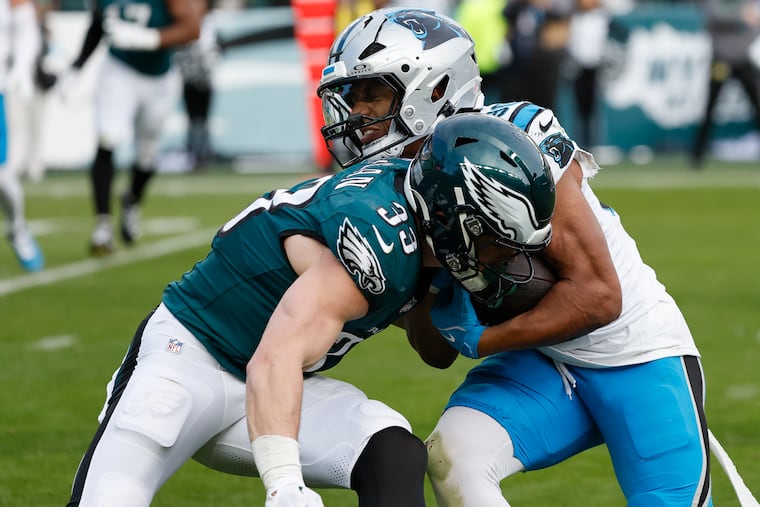
Superficial blood clots, like the one forcing Jalen Hurts to miss this week’s game against the Carolina Panthers, can form in response to injuries.
Doctors initially found the clump of blood in his calf during an ultrasound last Saturday, following the team’s flight to London.
It’s possible an earlier injury — Hurts had taken a cleat to the calf during the Eagles’ Week 4 loss to the Los Angeles Rams — could have contributed to the clot, said Andrea Lubitz, a vascular surgeon at Temple Health, who is not involved in his care.
» READ MORE: Eagles quarterback Jalen Hurts to miss Sunday’s game with a ‘superficial blood clot’ in calf, team announces
Superficial blood clots can form in response to damage and inflammation in the area.
Without more information, it’s unclear what treatment Hurts might receive or how long he will take to recover.
The Eagles quarterback had visited the training room after practice Thursday, Oct. 8, seeking care for his calf injury, four days after the cleating.
After detecting “movement in the small blood clot” on Wednesday night, the team ruled Hurts out. They did not provide a timetable for his return in Thursday’s announcement.
Lubitz said it’s difficult to assess Hurts’ outlook without knowing the location of his clot or what treatment he is receiving.
In simple cases, the condition resolves within a few weeks with conservative care. However, the danger is that the clot could spread to deeper veins, potentially causing a life-threatening condition.
“They are not giving us enough information to make a judgement,” said Lubitz.
Here’s what you need to know about the condition:
What is a superficial blood clot?
Superficial blood clots are clumps of blood that form in veins close to the skin surface.
They differ from another form of a blood clot known as deep vein thrombosis, a life-threatening condition that involves blood clots in veins deep within the body.
The legs have two primary vein systems: superficial and deep. The superficial veins connect to the deep system, and together they carry blood back to the heart.
Treatment for superficial blood clots depends on the clot’s location.
If the clot forms far away from the deep system, it could be treated conservatively: applying heat, elevating the legs, taking anti-inflammatory medicines, and sometimes wearing compression stockings.
Doctors become more concerned when a superficial clot is near the deep vein system because it could migrate into the deeper veins. From there, the clot could travel to the lungs, causing a pulmonary embolism — a life-threatening condition that blocks blood flow.
“With a superficial clot, the risk of that is relatively low,” Lubitz said.
Common risk factors for superficial blood clots include varicose veins, previous vein procedures, a history of blood clots, pregnancy, and estrogen therapy.
They can also arise due to injury.
“Veins are relatively fragile,” Lubitz said.
What treatment could Hurts receive?
The Eagles did not share what treatment Hurts would receive.
However, care would typically go one of two ways.
If his clot has gotten bigger and is closer to the deep system, the general recommendation is 45 days of blood-thinning medicines to prevent it from getting worse. People on blood-thinning medicines generally cannot play contact sports because the risk of bleeding is high, Lubitz said.
If it is far away, care would focus on symptom management, with a repeat ultrasound in a week. Symptoms tend to include pain, swelling, and tenderness in the area.
In their statement, the Eagles said they ruled out Hurts because of “movement in the small blood clot.”
“It’s hard for me to tell what they’re saying,” Lubitz said. “That’s not usually how this is described.”
She wondered whether the Eagles meant the clot had moved to another location or that it had increased in size.