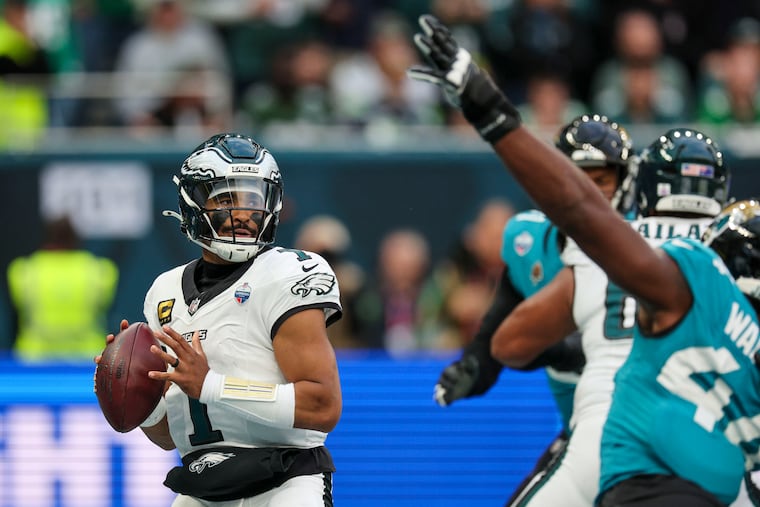
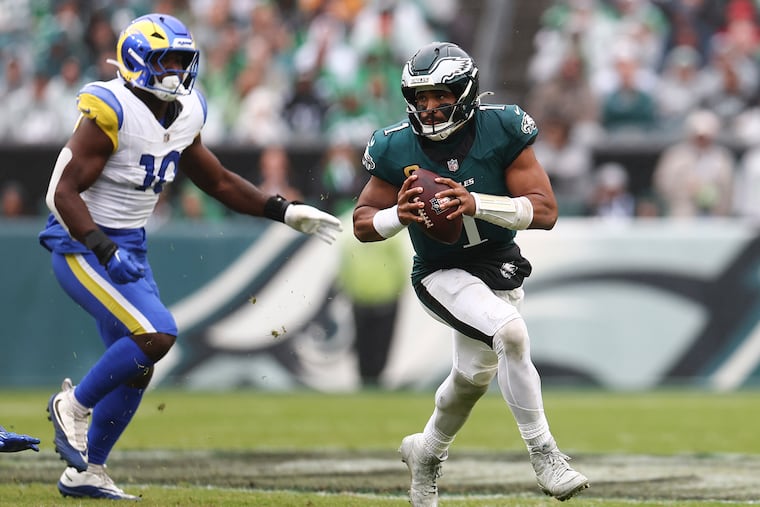
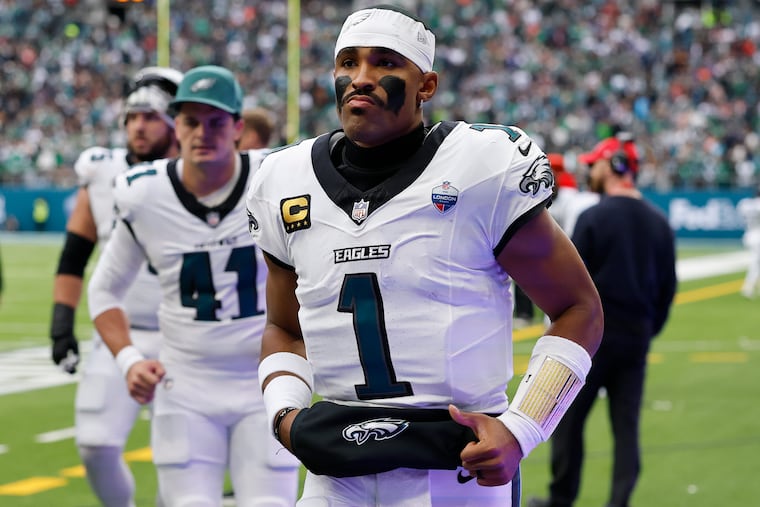
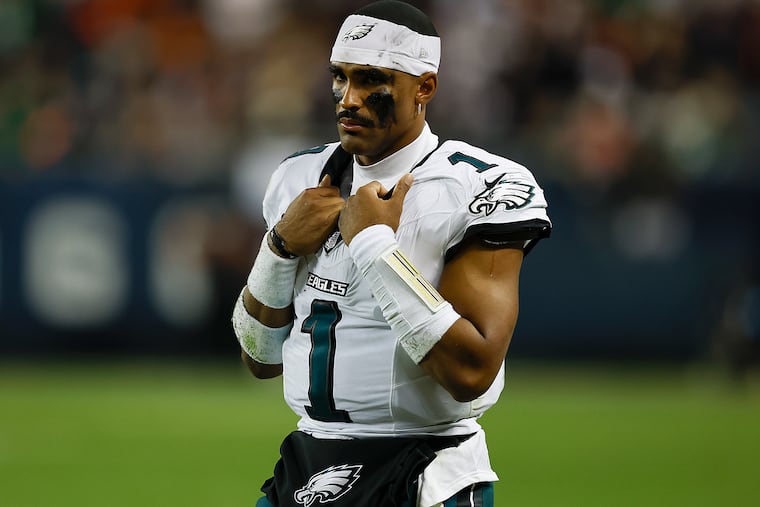
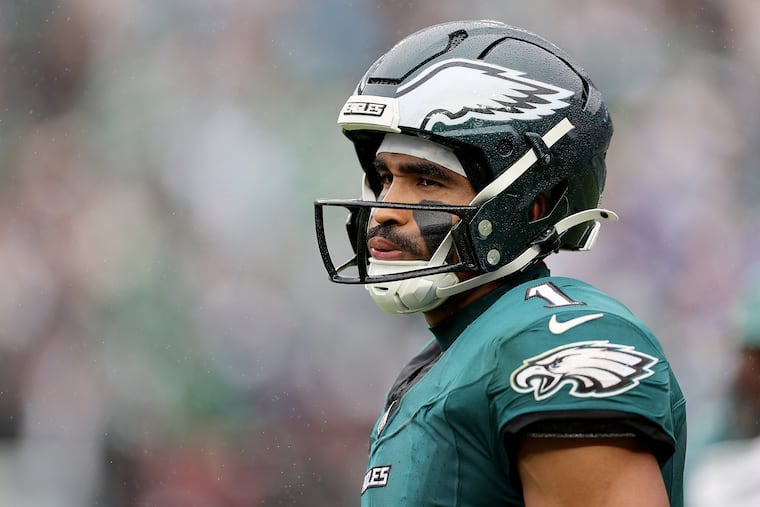
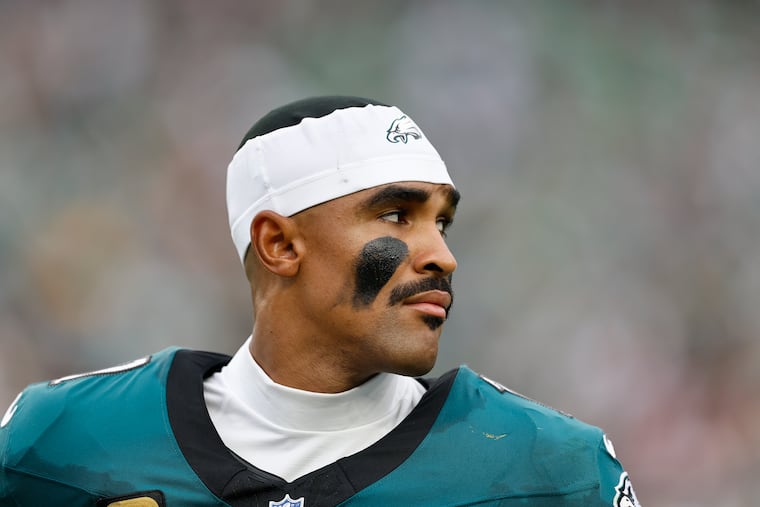
Jalen Hurts’ play is again under the microscope. His latest effort to evolve could determine his future.
The Eagles quarterback has a new offensive coordinator in Sean Mannion, and the need to bounce back from a disappointing 2025 season.
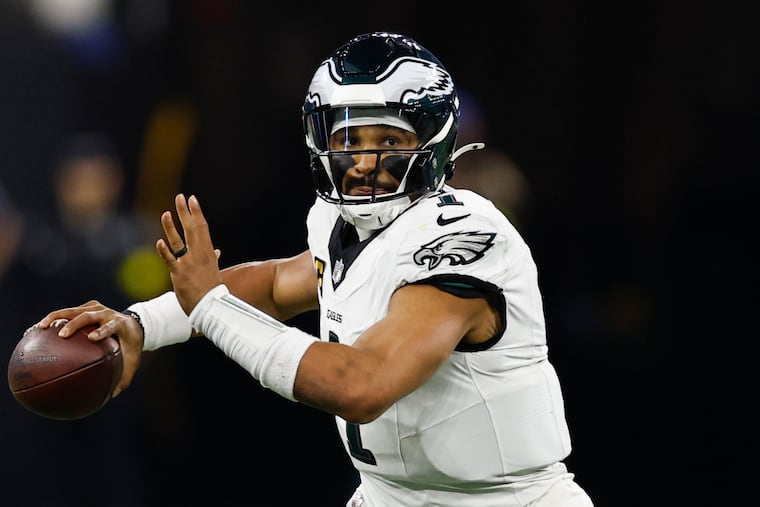
Jalen Hurts wanted more context. He wanted to know why a certain question was asked, or more pointedly, the narrative of the story that was clearly behind the asking.
Hurts, on rare occasions, will pull a reporter aside post-news conference and ask for clarification and even offer more information. This was partially that. But he also seemed to genuinely entertain the premise, and in doing so, slightly lifted his carefully maintained veil.
The Eagles quarterback tried earlier to answer the big-picture question about the concept of pressure and his excellence when the stakes were highest following an August practice during a dog day of training camp.
“It’s hard to think about any other thing than just improving every day,” Hurts said last month. “That pressure that you’re talking about, those opportunities that I relish in, they start now in these moments.”
The timing and the setting didn’t allow for depth, especially from someone who prefers to shun introspection. But Hurts must have sensed there was more to the premise. And he was correct. It wasn’t just in big games that he thrived. He’s had his best seasons when facing external doubts about his future.
And this season, so the theory goes, is another make-it-or-break-it moment for the quarterback.
Hurts nodded. He understood the construct. He may claim that he doesn’t read or listen to outside opinion, but he did cop to being aware of current storylines about him. It’s part of the job. And he’s heard this one before.
“No narratives are new,” Hurts said, “just recycled.”
In 2024, the Eagles were coming off a season with offensive regression that led to an early playoff exit and the coordinator getting fired. Hurts and Co. responded, of course, by winning a Super Bowl.
The circumstances are similar two Septembers later. Hurts will have another new play caller in Sean Mannion as coach Nick Sirianni searches for a constant that prevents the fluctuation that has led to annual turnover at the position.
But for the first time in the Sirianni-Hurts tenure, the scheme will be dramatically different. At least that’s the plan. And the quarterback won’t have A.J. Brown, his former No. 1 wide receiver and close friend, to throw to for the first time in five seasons.
The notion that Hurts is on the hot seat, though, comes more from various reports that his uncompromising ways and resistance to change has contributed to the team’s overall struggles, and that an unresolved contract situation doesn’t guarantee his return in 2027.
General manager Howie Roseman has decried the reports and denied the suggestion that the Eagles have put the 28-year-old on the clock by not restructuring his deal.
Hurts addressed the characterizations and the uncertainty over his future in June. But given all the variables and what they could amount to, he didn’t discredit the perception. He just said it wasn’t his reality.
“Pressure is an illusion,” Hurts said to The Inquirer. “Fear is an illusion.”
» READ MORE: The Cowboys aren’t any closer to contending. But are they closer to the Eagles?
More was said, but he preferred his cryptic response to stand alone. The conversation lasted less than 10 minutes. Its depiction here isn’t meant to suggest exclusivity or great insight into Hurts. But one-on-one opportunities have been fleeting over his six-plus years in Philadelphia.
In this case, it was as much the answers he gave as it was the questions he asked. Hurts is making an effort. He’s trying to let his guard down. It’s been evident in his pressers this summer, in the recent profile he did with GQ, and most importantly, inside the Jefferson Health Training Complex.
The Eagles seemingly never have to worry about Hurts’ work ethic or his behavior off the field. But as the franchise quarterback, there are interpersonal parts of the job that are almost requirements. Hurts isn’t naturally outgoing.
“Overall, he’s been better,” a team source said, “when it comes to communication and being around.”
It may be just a simple hello in the hallway, or hanging in the locker room longer, or talking about himself more openly. Hurts has organized summer workouts with skill position players before, but he had almost full attendance in the session he ran in Orlando this July.
No one desires for him to be inauthentically extroverted. Like his goatee that was shaved into a mustache for most of this offseason, Hurts has made outward tweaks. But he remains a figure mostly shrouded in mystery, and seems to relish it.
Asked to reveal more about a recent anecdote he’d relayed about his wife, Hurts said, “Maybe … if you’re nice to me.”
Adjustments and growth
The personality stuff is secondary to performance. Hurts, like many on offense, didn’t play up to expectations in 2025. He finished with his lowest expected points added per dropback since he became the full-time starter in 2021, and ranked a career-worst 18th in EPA among qualified quarterbacks.
The Eagles haven’t had a pass-heavy offense when at their best, though. And the inability to run with running back Saquon Barkley after a historic 2024 compounded the struggles through the air. But what confounded the most, perhaps, was Hurts being less of a factor on the ground.
Numbers hardly tell the full story. The offense was predictable, conservative, and failed to evolve and incorporate modern trends like having more motion. The end result: Kevin Patullo was fired after one season as offensive coordinator, Brown wanted out, and Sirianni hired a first-time play-caller in Mannion, who brings with him the trendy Kyle Shanahan-Sean McVay system.
Mannion is just the latest in a long line of coordinator changes Hurts has had to endure stretching back to college at Alabama and Oklahoma.
“I think you can appreciate the 11 different coordinators I’ve had,” he said last month in explaining the ups and downs of his career.
» READ MORE: Eagles lead NFL with eight players on ESPN’s Top 100 list for 2026; Jalen Hurts comes in at No. 97
But as receiver DeVonta Smith said after the playoff loss to the 49ers in January, and as Eagles defensive coordinator Vic Fangio noted last month, the offense hadn’t changed all that much since Sirianni became coach and Hurts his quarterback.
“A lot’s been made about him, all these coordinators he’s been with, but it’s basically been the same offense every year,” Fangio said. “This is different.”
Hurts has previously worked from under center. He’s thrown down the middle of the field. He’s had pure progression reads. But he’ll have to do those things at a much higher rate if marrying the run with the pass off play-action is the central principle of the new offense.
It may seem counterproductive to ask him to major in something he’s only minored in before. But Hurts has shown that he can execute all of the above. The question is how far is he willing to go, or for that matter, how far is the turnover-adverse Sirianni willing to let him go?
Hurts, by all accounts, has embraced the changes.
“He’s all-in on this system,” Eagles tackle Jordan Mailata said in July at the start of camp. “The way he’s commanding the huddle. The way he’s getting that ball out. The way he’s throwing it. … He’s all-in. It’s refreshing to see.”
The scheme could unlock a new version of Hurts as a passer. And having an offense where running is the focal point while not being as dependent on his involvement could limit the hits as he enters the next stage of his career.
But what happens if there are the expected speed bumps? Or even worse, potholes?
Hurts has previously resisted new elements, as he did early in former offensive coordinator Kellen Moore’s tenure two years ago. Moore had wanted to include more motion in his scheme, but the Eagles were still near bottom in the league in motion usage through the first four games of the 2024 season.
» READ MORE: The 53-man roster is here, but a big mystery remains. Can the Eagles be patient with Makai Lemon and Eli Stowers?
A 2-2 start that year in which Hurts turned the ball over seven times prompted offensive changes, the most significant of which was leaning into Barkley and the run game. But motion utilization — pre-snap and at the snap — increased as the season progressed. In April, ESPN published a story that detailed Hurts’ “strong preferences” — a reluctance to motion being one — that sources said had stunted the offense in 2025.
“I’m always open to growth. I’m always open to improving,” Hurts said when he was finally asked in June about the assertions. “I think a lot of it is, what do we put our time on task? What are we exhausting? What are we repping?”
While he ultimately didn’t refute the report — “Just let it live,” Hurts said — he did say he wasn’t responsible for the fateful “four verticals” call that ended the season against the 49ers, and a play that in its story ESPN implied Hurts directed.
While a source close to the situation confirmed that it was Hurts who suggested the play, two sources familiar with the events said it was only because Patullo had “froze” when going over the play sheet. Ultimately, Sirianni had final say.
If the outcome was successful, a statue would not have been erected like with the “Philly Special.” But there wouldn’t have been as much consternation about who was responsible: the player who came up with the idea, or the coach who decided it made sense.
Either way, the play-calling process had become more cumbersome under Patullo than it was under Moore. Some team sources have described Moore as a savant, capable of getting a call in early enough to give Hurts additional information until the cutoff time.
But Patullo was a first-time play caller, and thus a by-committee approach was used with Sirianni’s supervision. Mannion, also a first-timer, is expected to adopt a similar system with pass game coordinator Josh Grizzard, who has play-calling experience, and others feeding him necessary data.
Every NFL offensive coordinator has play-calling help. But the Eagles were 1.3 seconds slower out of the huddle last season and had the most snaps in the league (150) with one second or less left on the clock.
There weren’t any noticeable game management issues in the preseason, but Hurts has yet to play a game with Mannion at the controls. Mannion’s gameday whereabouts — he practiced calling plays from the field and in the booth in the preseason — have yet to be decided.
“I think the operation’s been good regardless of where he’s been,” Sirianni said.
Handling pressure on and off the field
While the getting-out-of-the-huddle issue can be mostly attributed to the play-calling process, the late snaps are probably more of a quarterback problem. Mannion has added more plays in which the offense breaks the huddle and hurries to the line for a quick snap.
But that tactic can be deployed only so often. Hurts still has to make checks at the line and change protection calls based upon his pre-snap reads of a defense. In terms of setting the protections, particularly vs. pressure looks, former Eagles center Jason Kelce took charge until he retired in 2023.
Hurts has made strides against the blitz over the past two seasons, in particular in finding his hot reads. But he struggled more last season with simulated pressures — in which defenses feign sending extra rushers — with the Eagles often errant in their protection assignments.
Mannion said the pre-snap calls will be made by either Hurts or the offensive line “dependent on the protection scheme,” Eagles center Cam Jurgens said. “It’s similar, but not the same,” in terms of how responsibilities are doled out.
Hurts faced a lot of unblocked pass rushers in two joint practices with the Patriots last month. It was a good test for Mannion’s unit because New England loves to disguise its looks and send simulated pressure at quarterbacks.
» READ MORE: Andy Dalton? Tanner McKee? Please. The Eagles lack a real backup quarterback. Unusual. Unsettling.
The Eagles offense was effective on the ground in the early portion of Day 1. But Hurts was hurried or sacked on multiple drops in the latter team drills. And on Day 2, he threw multiple interceptions, although there were positive moments through the air as well.
As important as the scrimmages were for the teams, Brown’s performance against his former team garnered as much attention. “He was the best player on both offenses,” an Eagles source said of the new Patriots receiver.
Brown said after the first workout on Aug. 19 that he hadn’t spoken to Hurts since he was traded on June 1. Both players were guests at Eagles receiver DeVonta Smith’s wedding just 12 days later.
But on his way to the locker room after the second practice, Brown jogged down to Hurts as he was throwing passes, and the two embraced. They asked about each other’s families, wished the other good luck in the coming season, and exchanged a few jokes, according to a source briefed on the interaction.
Both teams had wanted a made-for-the-cameras reconciliation and Brown, who had told NBC Sports at the time of the trade that he was no longer close to Hurts, agreed when an intermediary intervened.
In June, Hurts gave an ambiguous answer about being “focused on the collective” when asked about Brown’s description of their relationship. But when GQ pressed him on the subject of whether they were no longer as tight, Hurts said, “Clearly.”
Brown declined to address why he wanted to be traded. Several Eagles sources opined that there wasn’t more behind his exit than what was on the surface: He wanted to further cement his legacy as a Hall of Fame-caliber receiver and didn’t believe that was possible in Philly.
And while that implied that Hurts was at the core of his leaving, there were off-field reasons for why they drifted apart. Brown, for instance, had organized team bonding trips to an escape room and Top Golf, or get-togethers at the movies or his house. Hurts was among those who didn’t always attend such excursions.
Hurts, as quarterback, had other responsibilities. But there was a general feeling from some team leaders that he needed to be more engaged.
» READ MORE: Jalen Hurts isn’t sweating the Eagles’ continued search for an offensive identity: ‘It’ll come together’
In July, Hurts hosted many Eagles skill position players in Orlando for workouts at Central Florida’s Bounce House. But the players also golfed, had dinners, and socialized. When asked about the excursion at the start of camp, Hurts talked about “unity” and protecting the “intimacy of this team.”
Brown, who was often outwardly emotional, had expressed public frustrations via social media, something he later said he regretted.
The sphinxlike Hurts has preferred to let his actions on the field do most of the talking. And his accomplishments in just five seasons as the starter speak for themselves: 56 victories and a 71.8 winning percentage, five playoff appearances, two Super Bowl trips, and an MVP performance in beating the Chiefs in the title game just two seasons ago.
Hurts’ resumé should make it almost inconceivable that the Eagles would contemplate — no matter how this season unfolds — parting with him next offseason. And yet, his contract doesn’t make it a foregone conclusion.
Forecasting the future
Hurts is guaranteed $51.5 million for 2026, but less than half of his $51 million average annual salary ($22 million) is guaranteed in 2027. He has no guarantee in 2028, the final year of the five-year, $255 million extension he signed in April 2023.
Eagles owner Jeffrey Lurie, when asked about the deal in April at the league meetings, said Hurts was in the “middle of the new contract now.” But teams have given extensions to franchise quarterbacks with similarly structured contracts to create salary cap space.
Lurie was otherwise effusive praising Hurts. The owner pushed for Roseman to select the Oklahoma product in the second round of the 2020 draft. Hurts may not have a bigger fan in the building, and that’s notable when looking at his future.
The Eagles front office views his deal as winding down and expects optimum production — like any player under similar circumstances — but it’s hard to predict anything with the next offseason eons away in NFL terms.
“For me, I’m truly focused on being the best I can be right now,” Hurts said when asked about his contract in June. “That’s where my energy is.”
» READ MORE: A.J. Brown and the Patriots vs. Jalen Hurts and the Eagles is the perfect rivalry for our hot-take age
When camp opened a month later, Hurts appeared trimmer than previous years. Fangio and a few defensive players said he looked faster. Hurts said he felt the same and hadn’t altered his training regimen.
Last season, he finished with his lowest number of rushing attempts (105) and rushing yards (421) since becoming the starter in 2021. The Eagles wanted to curtail Hurts’ exposure to harm early on, but despite Patullo’s pledge that more carries were coming, Hurts was rarely a plus-one factor down the stretch. Hurts insisted that he was willing to run as much as he had previously, and has said as much about this season. But there will likely be fewer opportunities for designed runs with more plays starting from under center.
“I don’t think that’s something I can manage,” Hurts said last month. “That’s ultimately up to what we’re doing as an offense and how we put everything together. When you look back about 2020 and 2021 and those times we were a heavy [shotgun] team, ran a lot of inside zone, run a lot of [run-pass option], got to the edge a good bit, and defense was different, too. And the game has changed.
“That doesn’t mean you remove those elements, but again the base of the offense was run inside zone and that’s not typical for this West Coast-type of style.”
The outside zone is the base run play of the Shanahan-McVay offense, and its effectiveness sets up throws off naked bootlegs that are designed in part to be layups for the passing game. There is a horizontal stretching of defenses, but the play-action is also designed to create space for receivers downfield.
Backup quarterbacks Andy Dalton and Tanner McKee were under center on 38% of the snaps they took in the preseason. But it was a small sample and neither player has Hurts’ mobility and athleticism.
“The piece of him as an athlete in the running game is something unique,” Mannion said. “Those are elements we can lean into a little bit, as well.”
But with so much of the scheme predicated on marrying the run with the pass and keeping defenses on their toes by not giving away plays based on formation and technique, it will be difficult to shift the play-calling.
Sirianni hired the 34-year-old Mannion for his acumen, but also for his knowledge of this scheme.
Overall, Hurts was accurate and efficient in camp. But he also had rough moments and tossed eight interceptions. That’s seven more than he threw last summer, so practice doesn’t always correlate to regular-season performance.
But with more full-field progression reads than the coverage reads that were a larger part of the previous system, timing with his receivers will be pivotal. Hurts may have less to do pre-snap, but with many new faces, there will likely be a learning curve.
Mannion didn’t gloss over the interceptions from the joint practices. He pointed them out and didn’t excuse them as experimental throws. But there is some question as to whether Hurts will overpower a young coordinator when expressing his preferences.
There is a balance to strike in doing what’s best for the quarterback and what’s best for the entire group. The same could be said about a possible blending of the old with the new. For all the hand wringing about the offense last year — that was also affected by O-line injuries — the scheme had produced remarkable highs in the past.
“I think that’s a great question,” Hurts said when asked about carryover. “And it’s something that you keep in mind when you’ve had so much success. How will it look? You don’t really know. Do you want to win? Absolutely.
“So we’ve got to figure out who we are as a team. Obviously, coaches come in with a great mindset, great philosophy and putting everything together. It brings us a bit more structure. In the end, it’s about what’s going to go out there and be the best for our team.
“I know Sean will come up with the answer over time.”
‘I am who I am’
Time will show if the relative openness Hurts has shown to others will extend to the offensive changes. But if stoicism or hardheadedness were his worst crimes, he wouldn’t be unlike many high achievers.
Four years ago, Hurts agreed to participate in what has remained his lone sit-down interview with The Inquirer. The topic of the Eagles’ legacy of Black quarterbacks was one that appealed to him because he admired his predecessors and knew the bleak history of how African American men were treated in relation to the position.
“I think there’s levels to that, and I’ll just leave it at that,” Hurts said when asked if he felt Black quarterbacks still faced additional scrutiny.
A follow-up posed the question of whether he didn’t show more of his personality because of the history.
“As I grow and mature, that will evolve,” Hurts said then. “But I am who I am in terms of my character, how I was raised and where it comes from. But like I said, there’s levels to everything.”
Hurts isn’t any less an enigma than he was then or ever. He’s seemingly let outsiders in just a little. But it’s also his coolness that defines him and helps him maintain a fierce number of loyalists.
When Hurts told the story at the start of camp of how he offered the recently extended Jalen Carter the $5 bill his wife, Bryonna, puts in his backpack — “A little inside joke between her and I,” he said — it was one of the rare times he ever spoke anecdotally.
It also gave a glimpse, perhaps, of his private life. The Inquirer later asked for more detail. Hurts repeated what he said several times before when the reporter asked for additional access: “Maybe … if you’re nice to me.”
When the question was posed again, following the brief post-news conference interaction a few weeks later, Hurts laughed, then walked away.

The news keeps getting worse. Eagles quarterback Jalen Hurts will likely miss the rest of the 2026 season with a deep vein thrombosis blood clot, as well as bilateral pulmonary emboli. Moments after the story broke, The Inquirer’s Jeff McLane and Marcus Hayes reacted to the news, looking at what the diagnosis means for the Super Bowl MVP, how the Eagles handled the situation dating back to their trip to London, and whether backup Tanner McKee is ready to take the helm on a full-time basis. Listen here.
Listen to all episodes here or wherever you get your podcasts.