The Eagles could lead the NFL in dead salary cap money in 2027. Would a trade-deadline fire sale make things worse?
The struggling Eagles figure to be sellers at the deadline. But does their salary cap situation make that a practical possibility?
After their 27-10 loss to the Washington Commanders on Sunday night, the Eagles (2-6) now sit in last place in the NFC East. Their playoff window is all but slammed shut.
Does that mean a fire sale is looming ahead of the Nov. 10 trade deadline?
Like anything, it isn’t that simple. A confluence of factors determine what makes a trade worth executing, including the return, the cost of replacing that player, and the potential salary cap implications.
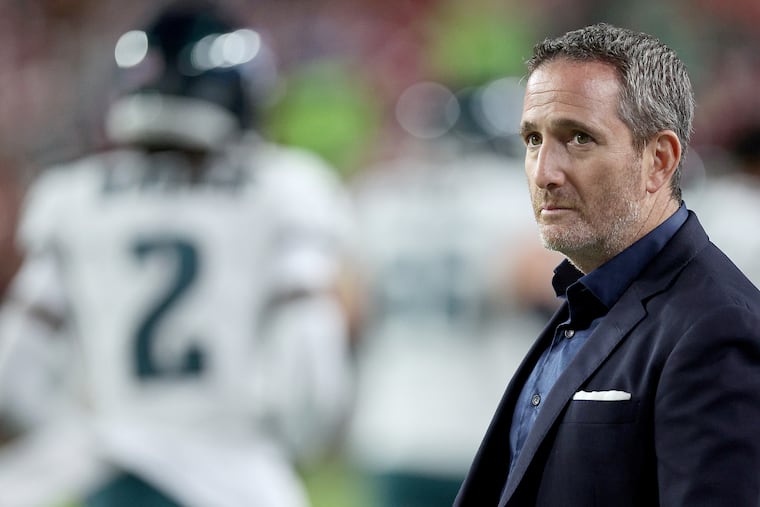
Regardless of whether the Eagles opt to buy or sell at the trade deadline, general manager Howie Roseman will likely keep the same objective in mind — sustained success into the future, believes former New York Jets general manager and current ESPN analyst Mike Tannenbaum, who once faced similar questions in his own front office role.
“I think any year, it’s a juxtaposition of what’s good for the organization, short-term and long-term, and obviously [the Eagles have] done a very good job of having sustained success,” Tannenbaum said. “So I think it’s just more of those continued evaluations of if and when there’s opportunities to either add a quality player for the long-term or get good return in the future. You always balance those competing thoughts.”
Mounting dead cap an issue?
“Out of sight, out of mind” isn’t necessarily an expression that applies to NFL players who are released or traded.
That concept is especially relevant to Roseman and the Eagles as the trade deadline looms. When players on veteran contracts depart the team, they can still leave salary cap charges over the years that follow, in the form of dead money. Major forms of dead money typically come from prorated bonuses spread out over the duration of contracts.
Those prorated bonuses are paid to players as lump sums up front, but instead of the full amount counting against the salary cap in a single year, teams can account for them over multiple years.
This allows teams to spend cash over cap — a player may be paid more in cash than is actually charged to the salary cap in any given year. The Eagles take this strategy a step further, adding voidable years onto veteran contracts to push those prorated cap hits into the future, beyond the years those players are actually under contract with the team.
The Eagles can do this because of owner Jeffrey Lurie’s willingness to spend, especially as it relates to rewarding homegrown stars with lucrative contracts. According to Over The Cap, the Eagles rank sixth in the league in total cash spending in 2026 at $364.2 million. Their cash-to-cap ratio is 1.63, the second-highest in the league this year.
But when a player is cut or traded before June 1, any prorated bonuses pushed out to the future will hit the present salary cap as dead money. A player traded at the deadline is considered a post-June 1 transaction, meaning any proration in future years accelerates on to the salary cap as dead money in the next league year.
For example, when the Eagles traded Cam Jurgens to the Baltimore Ravens on Oct. 7 in exchange for a 2028 second-round pick and a 2027 fifth-rounder, he remained on the books in 2027 in the form of a $14.9 million dead cap charge. A.J. Brown still counts against the cap, too, to the tune of $27.1 million. The Eagles waited to trade him to the New England Patriots until after June 1 earlier this year so they could split up his dead cap charge over two seasons, instead of taking it all on this year.
The Eagles already rank third in the league in dead money for 2027 at $43.7 million, according to Over The Cap. That estimation is incomplete, though. When Lane Johnson’s retirement is processed after June 2, his dead cap charge will be spread out over the next two years, with $16.6 million coming in 2027 and $26.3 million in 2028, per Over The Cap. That would currently put the Eagles at $60.3 million of dead money in 2027, which would lead the league.
That total for 2027 could grow even more in the coming days if Roseman decides to sell off certain veterans at the trade deadline.
ESPN reported Sunday that the Eagles will not trade Saquon Barkley at the trade deadline. Beyond his contributions on and off the field, though, there would be salary cap implications next year if the Eagles traded him before the deadline. According to Over The Cap, Barkley would leave a dead cap hit of $26.5 million in 2027 if traded, which is roughly $13.4 million more than his current cap charge for 2027 if he remained on the team.
Dallas Goedert would leave a $18.3 million dead cap charge in 2027 if traded, an $8.7 million increase over his currently scheduled cap hit. Zack Baun would have a $22.5 million dead cap hit next year if he’s moved, an increase of $10.6 million. Meanwhile, a trade of Landon Dickerson would leave a $12.1 million dead cap charge in 2027, resulting in a cap savings of $1.9 million.
A fire sale at the deadline could compound those dead cap charges next year, depending on who is traded. Even so, their total dead money must be considered within the context of the rising salary cap in that year. Since the NFL introduced the salary cap in 1994, it has risen every year except for one — the 2021 COVID-19 year.
The salary cap eclipsed $300 million for the first time in league history in 2026. Over The Cap projects a $327 million base salary cap in 2027, which would be an 8.6% increase over the 2026 cap of $301.2 million. The league typically sets the official base salary cap in late February ahead of the start of the new league year.
When the cap goes up, a team’s dead money takes up a smaller percentage of it. This is why Tannenbaum said he doesn’t believe the acceleration of dead money would necessarily prohibit a team from dealing a veteran at the deadline.
“If you trade a player unexpectedly and they have a larger acceleration than expected, it could impact the structure of another transaction,” Tannenbaum said. “But I just think the way the cap has grown, it’s just rare to hear or to put a scenario together where it’s going to prevent you from doing something fundamentally.”
Even those so-called unexpected trades don’t come out of left field. Tannenbaum explained that teams run through different scenarios of potential trades and how those prospective transactions would impact the structures of other player contracts.
“‘If we trade player X and we have to accelerate a payment, where is that coming from?’” Tannenbaum said. “If we [were] going to structure a different player on an extension, we always were looking at literally to the day of, like, OK, this scenario or that scenario.
“I just think the way the system has evolved, you typically have enough levers — the cap’s upward of $300 million now — that you could figure out solutions to most cap questions you have.”
Tannenbaum says he isn’t overly concerned about the Eagles’ annual dead money charges against their salary cap, so long as the leaguewide base salary cap continues to rise.
“Every year, you’ve heard of other teams, these doomsday scenarios, and then the cap goes up another $20, $30 million, and now all of a sudden, those dead money charges are accounted for,” Tannenbaum said. “I don’t think there’s any reason to think that the cap won’t continue to go up, and I think that has to be a big factor when you look at that analysis.”
Revisiting the Jurgens trade
There are other considerations at play when deciding if a trade helps a general manager such as Roseman achieve his goal of fielding a competitive roster on a yearly basis. For example, Roseman remarked in the aftermath of the Jurgens trade that the Eagles were getting “four players for one” in the deal.
The picks (including premium draft capital in a second-rounder) account for two of those players. Drew Kendall, who took over at center for Jurgens, accounts for another, a reflection of the importance Roseman places on having a viable replacement for the traded player (especially a replacement on a rookie contract).
Roseman can reallocate the money that was set to be due to Jurgens to a fourth player, so to speak, especially as talented players on rookie contracts become eligible for extensions.
“You have to look at, hey, if we move on from a player that maybe we can’t afford or can’t extend, and we can get a good premium pick, there’ll be a little short-term sacrifice, but long-term we’re going to feel really good about this decision,” Tannenbaum said.
But these trades don’t exist in a vacuum. Even if a trade makes sense on paper, Tannenbaum stressed the importance of considering the impact a move could have on the culture of a team. General managers must lean on others within the organization to compensate for their blind spots as it relates to roster building.
“I think it’s really important if you’re in the front office to sit there, talk to ownership, talk to your coaches, and say, ‘Hey, what am I missing here?’” Tannenbaum said. “Here’s great value to get multiple picks in the future, which is great for us. But what are we losing in the locker room? And if player A graduates, who’s replacing him, not only on the field, but from a leadership standpoint?”

The Eagles have problems. Eight games into the season, that much is sure. But which ones are symptomatic, versus the ones that are systemic? From the head coach to the personnel, from coordinators to the front office, The Inquirer’s Jeff McLane and David Murphy scrutinize the micro issues that point to some of the larger dilemmas the Eagles now face: should they start to pack it in, and who will be held accountable for the team’s shortcomings? Listen here.
Listen to all episodes here or wherever you get your podcasts.