Broad Street’s pricey new median planters take the Avenue of the Arts in the wrong direction
The gold-plated plan is a cautionary tale for the Parker administration as it prepares a revival strategy for Market Street.
Philadelphia claims it has the most walkable downtown of any big city in America — and that’s largely true.
Center City has some of the best small streets around, from the commercial stretches of Walnut and Chestnut to tree-lined residential blocks and storybook lanes of carriage houses.
It’s the neighborhood’s two monumental boulevards — Broad and Market — that Philadelphia can’t seem to get right.
For decades, the city has subjected those wide corridors to regular makeovers in the hope of attracting more pedestrians. We installed lush sidewalk planters and elaborate paving stones, then promptly neglected them. Large digital screens on Market East’s buildings were supposed to be Philadelphia’s answer to Times Square. Then, in 2015, we spent $14 million to line North Broad Street with what were supposed to be sculptural, stainless steel light masts. Today, most of those fixtures are broken.
Those past efforts are worth recalling now because attention — and money — is being focused on the same pair of chronically underperforming corridors.
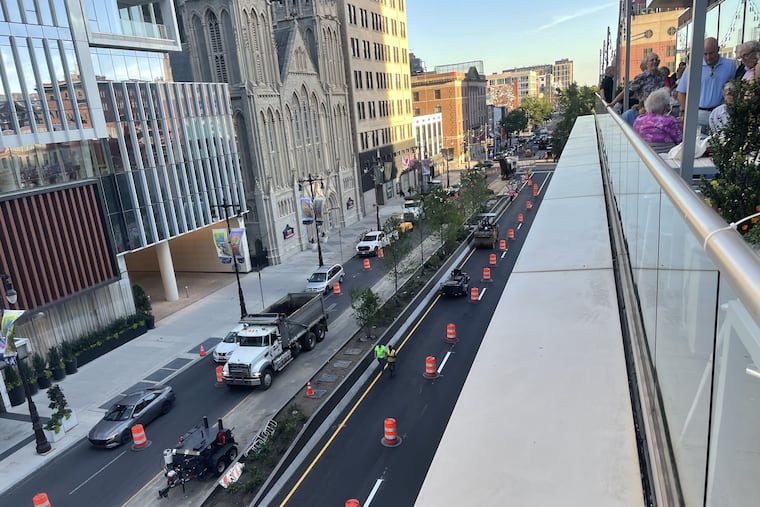
Mayor Cherelle L. Parker’s Market East Advisory Group, convened in the aftermath of the Sixers arena debacle, is expected to issue its recommendations in the next few weeks. Meanwhile, the nonprofit Avenue of the Arts has installed a 230-foot-long planter in the center median between Spruce and Pine, the block that is home to the Kimmel Center and developer Carl Dranoff’s Arthaus tower.
The four-foot-high structure, which resembles a deluxe Jersey barrier with trees sprouting from the top, is supposed to be the first step — a so-called beta block — in a $150 million, multiyear project to green South Broad Street from City Hall to Washington Avenue.
Please let it be the last.
After the spectacular failure of the North Broad light masts, you might think Philadelphia would have learned that prettying up the median on a wide avenue does nothing to encourage pedestrian activity. Despite spending a whopping $5 million on South Broad’s new linear planter — including $4 million from government sources — the only things shaded by those trees are the passing cars.
What the Avenue of the Arts really needs
Avenue of the Arts’ 10-year plan calls for more green features, but the emphasis on beautifying South Broad’s median strip suggests that the organization has misdiagnosed what’s wrong with the corridor.
The problem isn’t the lack of pretty plants; it’s the lack of daytime foot traffic.
Even if Avenue of the Arts somehow succeeded in installing the curbside planters shown in the plan’s renderings, that greenery alone will never be enough to tempt anyone to walk down Broad Street, especially when they can join the hordes of diners and shoppers one block away on 13th Street.
Because South Broad between City Hall and Spruce once served as Philadelphia’s Wall Street, it is not an easy street to fix. The stately limestone buildings occupied by the city’s financial powerhouses are magnificent works of architecture, but they have few ground-floor spaces that can be retrofitted for public uses.
South Broad has nevertheless made a lot of progress in recent years by building new theaters and turning old ones into apartments.
What the corridor desperately needs now are more daytime attractions. The transformation of several former University of the Arts properties — by Temple University, Lindsey Scannapieco’s company Scout, and Dwight City Group — will do far more to advance that goal than any overdesigned planter can.
Several Philadelphia urban planners, including the Design Advocacy Group, former Deputy Mayor Alan Greenberger, and urban design specialist Harris M. Steinberg, have criticized the median’s design. I would go further and say the basic concept demonstrates a fundamental misunderstanding of the role South Broad plays in Philadelphia’s civic life.
Avenue of the Arts has often cited New York’s Park Avenue, which is known for its planted median, as a model for Broad Street. But Park Avenue is a street that drifts off into the horizon, while South Broad terminates in the iconic view of City Hall tower.
Broad Street also serves as the urban room where energized sports fans converge to celebrate big wins and the Mummers perform their annual rituals. While the four-foot-high median may not completely compromise those Philadelphia traditions, it will certainly get in the way.
The push for greenery
The nonprofit’s thinking was strongly influenced by Dranoff, who serves as its CEO, and has argued for years that Broad Street needs more greenery to succeed as a residential street.
Widely regarded as Broad Street’s biggest booster, Dranoff has built several large apartment buildings on the avenue. His Arthaus condos, by New York’s KPF, are easily Philadelphia’s best high-rise residential design in years, yet sales got off to a slow start.
In 2022, just as Philadelphia was emerging from the pandemic, Avenue of the Arts convened a group of Broad Street stakeholders to solicit ideas for improving the corridor. The top recommendation? More greenery, Dranoff told me.
The only question was what form the new landscaping should take. Since the subway and concourse run below Broad Street, the sidewalks can’t accommodate the large openings that urban trees require. Market East struggles with the same conditions.
To get around the problem, both corridors have relied on large sidewalk planters, which can hold shrubs, flowers, and even small trees. You can still see a few surviving examples that the Avenue of the Arts nonprofit installed in the early 2000s, after South Broad began to evolve into Philadelphia’s theater district. Planters are a cheap and easy way to soften an urban street, and Broad Street’s 20-foot-wide sidewalks can easily accommodate them.
But rather than simply replace them with fresh pots and plantings, the Avenue’s consultants — Gensler’s Oliver Schaper and the OJB landscape studio — came up with a proposal to transform the corridor. Not only does the plan call for planted medians on every block, it recommends filling in the existing shoulder lanes with low box planters capable of supporting trees.
How ironic that the city and the Pennsylvania Department of Transportation have agreed to these shoulder plantings.
For years, Philadelphians have been told that they can’t have desperately needed bike lanes on Broad Street because those shoulders were needed for drop-offs and parking. That design, the Bicycle Coalition’s John Boyle told me, is a “missed opportunity to make Broad Street safe for bicyclists and pedestrians.”
Not all the ideas in the plan are bad. The traffic-calming proposals, including sidewalk bump-outs at the corners, would make it easier for pedestrians to cross. Unfortunately, the designers didn’t know where to stop. Even if money was no object for Philadelphia, South Broad just doesn’t need all this stuff.
Several South Broad property owners told me that Avenue of the Arts can barely care for the existing sidewalk planters now, so how will it maintain these enormous additions?
An ambitious project for a small organization
Avenue of the Arts is a small organization with a modest budget. Unlike the Center City District, it can’t collect a levy from property owners for its activities, which means it relies on government support and private fundraising. As recently as 2024, it was running a deficit, although it has since returned to the black.
Even its former director, Laura Burkhardt, questions whether the group has the capacity to undertake such an ambitious project.
“Who starts a $150 million plan like that with just one staff person?” she said. “The organization itself doesn’t have the ability to execute a master plan.”
Indeed, after interviewing Dranoff and the design team, I left with the suspicion that this initiative may never produce anything more than the existing planted median in front of Arthaus.
While the Avenue of the Arts estimates that it will cost $10 million to construct the curbside plants on this one “beta block,” the nonprofit has raised just $1.5 million so far, according to Dranoff. Those planters “will probably take two more years to complete,” he told me, optimistically.
If the Avenue of the Arts is serious about increasing foot traffic on South Broad, it should scrap its gold-plated streetscape fantasy and take a page from the city’s other struggling corridor, Market East. Last summer’s Meantime retail pop-up was both the cheapest and most effective strategy in the city’s long history of revitalization efforts.
Several existing Broad Street venues are already working to attract more casual foot traffic. Both the Kimmel and the Wilma Theater have installed ground-floor cafes. Now the Clef Club, at Fitzwater Street, is opening up its facade with large windows. Stoop Pigeon, a women’s sports cafe that will open soon at the corner of Pine Street, promises to be a big draw.
These are all strategies that have been proven effective. The Avenue of the Arts should just refresh its old sidewalk planters. Water the plants regularly, replace the dead flowers — then call it a day.