Temple enrolled a record number of first-year students in 2025. But it lost nearly a quarter of them
Many colleges are facing greater challenges holding on to students, but dropouts say schools could do more to address their needs.
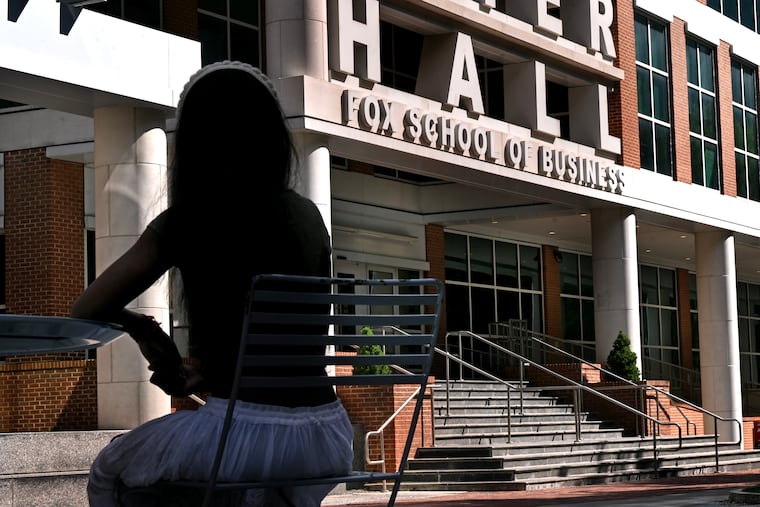
The pitches from Temple University came almost daily.
“You belong at Temple,” one email insisted. Another said, “Your future starts at Temple.”
Day, who asked that her last name not be used to protect her privacy, sifted through the barrage of emails as a Middletown, Del., high school senior graduating in 2024. She was ultimately persuaded, and she enrolled that fall.
It represented another successful recruitment effort by Temple, whose leaders have sought to reverse years of declining enrollment that has hurt the finances of schools around Philadelphia and across the country. The strategy to target more people like Day — first-generation college students from lower-income families — worked, and by 2025, Temple had a record-breaking class of nearly 5,400 freshmen.
But a year later, more than 1,200 students from that class did not return for their sophomore year. The retention rate was 13 percentage points lower than it was nearly a decade ago, when the school routinely held on to about 90% of freshmen. And the five-percentage-point drop this fall was the biggest one-year decline in well over a decade, even during the pandemic.
For the first time since at least 2013, Temple’s 77% retention rate of first-year students fell below the most recently available national average at four-year public universities, which stood at 79.4% last fall, according to the National Student Clearinghouse.
Temple’s freshman enrollment spike has not just boosted tuition revenue, it has also created a path to a college degree for students, especially those from Philadelphia, who may have been denied such an opportunity in the past. But the school’s steep retention decline — a trend many area colleges are grappling with — has left some of those same students burdened with debt and questioning whether Temple could have done more to support their academic endeavors.
Day, who had been excited to attend college in North Philadelphia, where she grew up before moving to Delaware, dropped out last December after just three semesters at Temple. She said she struggled with the workload and wound up on academic probation, with mounting debt and no family support, before becoming so frustrated that she decided to leave.
“Temple does have a lot of resources, and they do have a good community,” she said. “But they assign too much homework, too many things all at once from a lot of classes and just expect students to come in and be OK, even though some of them have jobs and families to take care of.”
About a dozen Temple professors and other current and former employees said in interviews that the school’s leadership neglected to establish resources to support students with greater needs as its former enrollment chief recruited more students who may not have been ready for college-level work. A decade ago, Temple accepted just over half of its applicants. Last fall, it admitted more than 83%.
Jay Lockenour, a history professor at Temple for 30 years, said while he supports giving more students educational opportunities, “admitting everybody isn’t necessarily the answer. Just taking their money and their financial aid, that feels kind of dishonest. It feels very dishonest.”
Jessica Babcock, an associate professor of instruction who directs the developmental math program for students who need work on basic Algebra skills, said Temple made significant changes to its enrollment strategy “without full consideration of the impact” it would have.
“When you focus on access without also pairing it with equity, we run into a very big problem both for faculty, for students, and for all those at the institution,” she said.
In an August interview, Temple president John Fry acknowledged that the university had not adequately addressed some of the dynamics that cause students to drop out.
“What I found is that the institution was not prioritizing student success and retention in the way in which it should, nor was it set up organizationally to be successful in the first place,” said Fry, who became president in November 2024.
» READ MORE: Amid a challenging time nationally, John Fry is inaugurated as Temple’s 15th president with much hope and optimism
Temple shared data with The Inquirer that showed there was a 1.7 percentage point increase last academic year in students who withdrew from their classes, failed, or received a D grade.
Fry said he’s made student retention the priority for this academic year. A strategic plan, unveiled in January, sets student success as its cornerstone, and Temple has consulted with the National Institute for Student Success at Georgia State University, which has received international acclaim for its retention improvements. Georgia State uses data to target struggling students early and its advisers reach out to students within 24 hours if a problem is flagged, even if it’s a minor one. The university’s improved retention has brought it an additional $75 million to $80 million in revenue annually, according to executive director Timothy M. Renick.
NISS is scheduled to issue recommendations for Temple in a report due Monday. Fry said in the meantime, the university hired a new enrollment chief and a new provost. Temple also is targeting more grants to retain students, launched an effort to better address essential needs, like food and housing insecurity, and instituted a new policy that freshmen must live on campus beginning in fall 2027 to better connect students to campus resources.
“I want a fresh look, because obviously our numbers are not going in the right direction, and that means we have to change,” Fry said. “This is literally all hands on deck for this.”
Retaining students is a major challenge for many colleges nationally as they adjust their programming to properly support more first-generation, low-income students with increasing needs. Students are dropping out for myriad reasons, including lack of money that in some cases forces them to juggle studies and jobs. But they are also coming in less academically prepared, especially in math, in part because of lingering effects of the pandemic. And more students are struggling with mental health challenges, as rates of anxiety and depression among young people climb.
For Day, who said she has attention deficit hyperactivity disorder and complex Post-Traumatic Stress Disorder from homelessness and abuse she experienced in her childhood, the struggle continues.
She shares an apartment near the university with a roommate who also dropped out of Temple, unsure how she will pay a monthly $500 student loan bill while working as a catering server.
“I have a lot of debt,” she said. “I’ve been trying to look up ways to get around it, but there doesn’t seem to be any way around it. All these loans are on my back by myself.”
A decline in student performance
In January 2024, nine months after Jose Aviles became Temple’s vice provost for enrollment management, the university launched Temple Promise amid an enrollment decline that had slid by roughly a quarter since 2017. The program offered last dollar scholarship aid to make tuition and fees free for low-income families from Philadelphia, and it drew praise from Philadelphia Mayor Cherelle L. Parker, Gov. Josh Shapiro, and Philadelphia schools superintendent Tony B. Watlington Sr.
The university also set out to recruit more out-of-state, first-generation college students from lower-income families.
Both of these efforts to boost enrollment were a success. Between 2022 and 2025, Temple’s share of students from Philadelphia grew from about 15% to nearly 25%, and its overall population of first-generation students increased from 34% to 48%.
Fry said that when he arrived as Temple president in the fall of 2024, he liked what he saw with the enrollment improvement and told Aviles, “let’s keep going.” He said he encouraged Aviles to recruit even more first-generation students from low-income families who would qualify for federal Pell Grants, an initiative in line with Temple’s mission.
The work to recruit continued.
A Philadelphia public school guidance counselor recalled how a Temple team came in “waving money” to attract students who had planned to start at Community College of Philadelphia — and whom the counselor said would have been better served beginning their college careers there. Some of those students liked the pitch and ended up at Temple but later dropped out, the counselor, who did not want to be identified for fear of jeopardizing relationships with Temple, said.
Temple professors said in interviews that after the freshman enrollment spike, they saw a subsequent decline in performance, with more students over the next couple of years withdrawing from classes, failing, or getting D’s.
Lockenour, the history professor, said 24 students — 16% — either withdrew from or failed his general education class on War and Peace in spring 2026. That’s a higher percentage than in each of the last several years, he said.
Lori Shorr, an associate professor in the College of Education and Human Development, said she had lower grades in her undergraduate class last academic year than she has ever had.
“A lot aren’t attending or coming halfway through the class,” she said. “And when they are there, they aren’t really there. They seem disconnected.”
Babcock said the developmental math program scrambled in July 2025 to add enough capacity to help students brush up on basic skills. A decade ago, the developmental program served about 400 students. Last year, there were 1,200 students, she said.
And some students were clearly struggling in those classes, she said.
“It just feels crummy to stand in front of students who are looking at you after having been told they can get this degree in X number of years when you know that they don’t understand a word you’re saying,” Babcock said. “You feel guilty and you feel sad.”
Temple spokesperson Steve Orbanek said the school is taking steps to address the increase in D’s, F’s, and course withdrawals.
“We take that increase seriously and are examining the data more closely to understand where it occurred — including by course level, academic discipline, student population and whether students were in their first year or continuing their studies,” he said.
Orbanek acknowledged that a “small group” of students also received academic scholarships that required them to maintain a 3.0 GPA after four semesters, even though their high school GPAs were as low as 2.75. Those students were given support to bring up their GPAs, if needed, but the university is reviewing its approach to merit aid, criteria, and requirements for maintaining the award, he said.
‘Ethically dubious’
Aviles, who grew up in poverty in New Jersey and was a first-generation college student himself, left Temple in November 2025 to lead enrollment at Rutgers. He defended his tenure at Temple and said he was able to expand access, opportunity, and affordability for more students.
“Our strategy was always about focusing our work on identifying students that we believed had the ability to succeed at Temple,” he said. “We worked hard to provide pathways to talented students who otherwise might not have had opportunities, central to Temple’s mission.”
He also disputed the contention that Temple failed to add institutional support for the students it had recruited. He noted that while he was there, Temple hired an assistant vice president to specifically focus on student success, improved student enrollment services, invested in a new student success management technology platform, and established a retention grant initiative to help keep students enrolled.
Still, those measures failed to prevent a steep retention decline.
Steve Newman, an associate professor of English at Temple, said the financial projections from bringing in record large classes turned out to be “just a mirage.”
“It’s ethically dubious to accept students to a university in a way that it will be more likely that they will not be able to thrive,” Newman said. “It’s problematic in every respect, and it has been a source of real frustration and pain for faculty.”
Temple has increased its financial aid budget 75% since 2023, which Newman said is “a good thing if we are opening access to Temple to students who otherwise can’t afford it. But if you can’t retain them, everything falls apart.”
Newman said he is confident that Fry and his new team are aware of the problems, working to address them and making efforts to include the faculty.
‘I was totally on my own’
Five former students told The Inquirer that Temple did not do enough to help them before they dropped out, and then neglected to try to bring them back. When the university did reach out, it was about paying a bill or to ask if they were returning to campus housing.
“I was totally on my own,” said Briana Duka, who said she left Temple in 2023 with no degree and more than $30,000 in debt. “During the semester, I had professors say, ‘Hey, what’s happening?’ but it stopped there. There was no follow-up.”
Duka, a first-generation college student from Allentown whose parents are immigrants, said she dropped out because financial concerns meant she needed to work to afford school, and that affected her grades. She said her GPA was 2.6 when she left.
Duka took a year off from school and then enrolled at CCP, where she said her grades are strong and her financial aid package means she’s not paying tuition.
Philadelphia resident Maya Lipscomb’s excitement at attending Temple in fall 2025 quickly turned to dread when she found she couldn’t afford to pay the bill, even though she received substantial federal and institutional financial aid. She quit after just one semester.
Lipscomb said no one offered help during that first semester other than to ask when she would be paying her bill.
“Nothing about the advising situation is anything near personal,” she said. “It’s like you’re waiting in a queue and they talk to you for five seconds.”
Lipscomb enrolled at CCP for the 2026 spring semester and this fall, she entered Penn State Abington, which she said will cost her about $1,000 less than Temple. She is studying neuroscience.
“I don’t want to be discouraged from doing something I would love to do for the rest of my life,” she said.
Day, the student whose current roommate also dropped out, said she did well in high school, almost achieving a 4.0. She lived with her grandmother, who told her to get good grades so she could attend college.
But she had to pay for her own education, she said. She worked at her catering job three days a week until 2 a.m. and struggled to keep up with her studies in Temple’s Fox School of Business.
Because of her disabilities, Temple provided her with accommodations, including extra time to take her exams in a testing center, but it wasn’t enough, she said
Jodi Bailey Accavallo, Temple’s vice president for student affairs, said Temple does reach out to students who quit and holds “non-returner” meetings to talk through the situation.
“To say that we don’t reach out is not true because I actually adjusted the questions last year to make sure that they were more inclusive of issues why students might not be returning and making sure we close the loop on how they would be responded to if they want outreach,” she said.
Retention woes hinder other local colleges
Other colleges across the region are facing similar challenges with both enrollment and retention.
And the challenge is likely to grow as the population of high school students shrinks, a so-called demographic cliff beginning this year.
At La Salle University, a private Catholic school in Philadelphia, about a third of the freshmen who enrolled in fall 2024 did not return a year later — a retention rate below the national average of 76.4% for private nonprofit four-year colleges, according to the National Student Clearinghouse.
Last October, Greg Nayor, La Salle’s senior vice president of university strategy, said La Salle’s retention rate had fallen seven percentage points — from 73% in 2024 — but was on track to do better this year after adding new programs, such as a central academic resource center in the library.
La Salle officials declined to be interviewed for this article and did not respond to questions about its retention rate for this fall or its current enrollment.
Other private local colleges grappling with retention declines include Ursinus, Chestnut Hill, and Eastern University. At Ursinus, a small liberal arts college in Collegeville, retention fell from 87% in 2024 to 77% last fall. Meanwhile, enrollment has declined nearly 10% since fall 2023, to 1,347 this fall.
Katie O’Brien, Ursinus’ senior director and chief retention officer, said the college has improved its first-year advising “to identify students who may benefit from earlier support and by expanding opportunities for students to build meaningful connections with peers, faculty, and staff.” Those changes helped increase retention by 2.3 percentage points, to nearly 80% this fall, O’Brien said.
Chestnut Hill College, which had a 62% retention rate in 2024, increased to 74% in 2025. Preliminary data show the school will have a similar rate this fall, said Robert Bogdon, executive director of strategic marketing and communication. He said the lower retention rate was due to “unexpected financial gaps and commuter adjustments,” as well as lingering pandemic factors.
“We found that many incoming freshmen spent a major part of their high school years learning remotely,” he said. “As a result, they missed out on crucial, in-person academic milestones — like writing an initial research paper with citations or engaging in face-to-face classroom debates. These gaps made the transition to higher education much tougher.”
The school more quickly identifies students who need help, and every student is paired with a “student success adviser,” he said.
Eastern University had fallen to a 65% rate for first-time, full-time students in 2024, but increased to 68% last fall, said spokesperson Erin Wetten. The university is targeting more financial aid to students with high need and has hired a new employee to focus on the first-year experience, Wetten said.
A retention reckoning
Georgia State University’s retention reckoning came about 15 years ago.
The Atlanta school’s demographics shifted from being largely composed of white, working professionals to low-income students of color. Many of these new students were the first in their families to attend college and were fresh out of high school.
“Our graduation rates were really struggling,” said Renick, the Georgia State administrator. “Our retention rates were really struggling, as you’re seeing with some of the schools in Philadelphia.”
Georgia State used data to pinpoint where students were struggling and why they were failing to persist through to graduation. School officials also helped students with tasks that set them up for success before classes even started, such as getting required immunizations, finishing financial aid applications, or selecting a major.
They tracked every student, every day, for risk factors: Are they registering for the right classes? Are they engaged in the course? How often are they logging in to classroom platforms?
“We’re proactively reaching out to the student if we see a problem,” Renick said. “We’re not waiting halfway through the semester to tell a student, ‘You signed up for the wrong course.’ As soon as they register for the wrong course, we’re immediately reaching out to the student.”
Last school year alone, Georgia State had 106,000 instances where advisers reached out to the school’s 40,000 students proactively, according to Renick.
“It makes a huge difference for vulnerable students,” Renick said.
The school also gives “Panther Retention grants” — micro-grants for students who are close to graduation but who have run out of eligibility for their aid programs. The grants typically give students just enough money to finish an extra semester or two to earn a degree.
Those efforts have improved the school’s retention and graduation rates. Georgia State is now graduating 3,500 more undergraduates every year than it did before it made the changes, Renick said.
Sometimes, faculty are skeptical about such a labor-intensive advising model, Renick said. And while it doesn’t work for every student, he said NISS partner schools typically see graduation and retention rates at 2.5 times greater rates than the national average.
There is also a financial incentive behind adopting the program.
“We’re investing maybe $8 million to hold on to $80 million of additional revenues,” Renick said.
In Philadelphia, both Temple and Widener are working with NISS to achieve the kind of results Renick says is possible. Renick declined to discuss specifics about either university.
Fry said he is eager to get the report on Temple, which Renick is due to present to about 200 faculty, staff and administrators Monday. Fry said he expects the results will generate a campus-wide discussion on what comes next.
But he cautioned that improvements will take time.
“It’s a 10-year strategic plan for a reason,” he said. “It takes a long time to move these places in the right kind of direction.”