Haverford College taps Tulane University dean as its new president: ‘Looking for the next chapter’
Since 2018. Brian T. Edwards has been the dean of Tulane’s school of liberal arts, its largest of nine schools. He's a Middle East and North African Studies scholar.
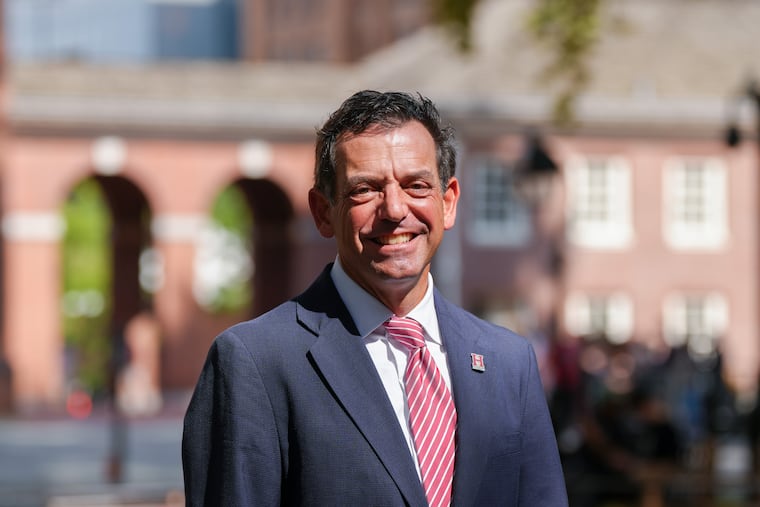
A Tulane University dean and Middle East and North African studies scholar will become the new president of Haverford College, the school announced Monday.
Brian T. Edwards, dean of Tulane’s school of liberal arts since 2018, will replace Wendy Raymond, who announced nearly a year ago she would step down in June 2027.
Edwards will start July 1 at the small, highly selective Main Line college that enrolls about 1,470 students.
His appointment comes as Haverford continues to face controversy over its handling of antisemitism complaints. The school in August reached a settlement with a Jewish group suing the college over its handling of antisemitism allegations, prompting an outcry from a group of alumni and students calling on Haverford to “preserve the rights to free speech and academic freedom.”
The lawsuit was filed in May 2024 as tensions mounted on many college campuses, including Haverford, in the wake of the Israel-Gaza war, following Hamas’ 2023 attack on Israel. Raymond last year faced intense grilling by a Republican-led congressional committee probing antisemitism complaints on college campuses.
And Guangtian Ha, an assistant professor of religion at Haverford, was arrested earlier this month and accused of sending antisemitic threats to a colleague.
Edwards, 58, said his approach to the issue will be “listening and respecting voices and making safe spaces for students, faculty and staff to speak to one another and to listen to one another.”
“These are fractious times, where people have become polarized on a whole lot of issues,” he said in an interview. “I often find that some students in general in the United States ... are just increasingly nervous about speaking and learning and hearing each other... Listening to one another, being able to change your mind about something, that is actually what education is.”
Edwards said he’s optimistic about Haverford’s future and has heard the same from those on campus.
“I’m incredibly grateful to have this opportunity at this particular moment, because I’m sure that Haverford - and I’ve sensed it - is optimistic, too, and is looking for a next chapter,” he said.
Michael B. Kim, chair of Haverford’s board of trustees, said in a statement that Edwards is “the ideal person to lead Haverford.”
“He has the experience and the deep commitment to the liberal arts we were looking for, but what really sets him apart is how well he understands what this place is all about: trust in our students, a commitment to ethical leadership, and the value we place on listening to one another,” Kim said.
Edwards said the need has never been greater for liberal arts graduates who can provide ethical leadership through difficult challenges and in an ever changing career landscape.
“I stand in front of the first year students at Tulane ... and I say, four years from now, most of you will be applying for jobs or career paths that don’t exist right now,” he said. “I feel comfortable and confident that the kind of broad liberal arts education that we provide to students is exactly what they should be doing.”
He also said fundraising will be a priority. Haverford in 2024 set the goal of increasing its endowment, which has lagged behind some of its peers, to $1 billion by 2030. The endowment stood at $869 million as of Sept. 30.
“I am very ambitious for building Haverford’s endowment to where it needs to be,” Edwards said. “There are already ambitious goals, but we’re already talking about even more ambitious goals, and I’m very confident that we’ll reach them.”
Growing the endowment will allow the college to provide more financial aid, he said. Haverford is among 15 colleges nationally where total costs including tuition, fees, room and board, books and transportation top $100,000, according to The Princeton Review, though many families receive aid and don’t pay that sticker price.
“For a lot of people, going to Haverford is much cheaper than going to their state school because of the financial aid,” Edwards said, noting that the school needs to better communicate that.
Before Tulane, Edwards was a professor of Middle East Studies, English and Comparative Literary Studies at Northwestern University for 18 years. He was also the founding director of the Program in Middle East and North African Studies (MENA).
Born in Brooklyn, Edwards grew up in Connecticut, the son of a middle school principal and information consultant.
He graduated magna cum laude from Yale University with a bachelor’s degree in English and also got his doctorate from Yale in American Studies. He has written about literature, film, and new media from Morocco, Egypt and Iran and has spent time there doing research.
“Right now I’m finishing an essay ... on this Singapore artist who works on the water and I go and see him and we travel on the water,” he said.
His wife Kate Baldwin, a professor of English, communication and gender and sexuality studies at Tulane, also will be moving to Haverford, as a visiting professor. The couple has four children ranging from ages 14 to 27.
He enjoys tennis and running and looks forward to cheering on the Philadelphia Phillies; New Orleans where Tulane is based doesn’t have a baseball team.
Edwards said he plans to start meeting and listening to a lot of folks in the Haverford community this weekend, which is “family and friends weekend” at the college.