Measles is spreading in Chester County, but many schools aren’t talking about their risk
As the nation's worst measles outbreak spreads, the West Chester Area School District is among those facing declining vaccination rates — and challenges in preparing.
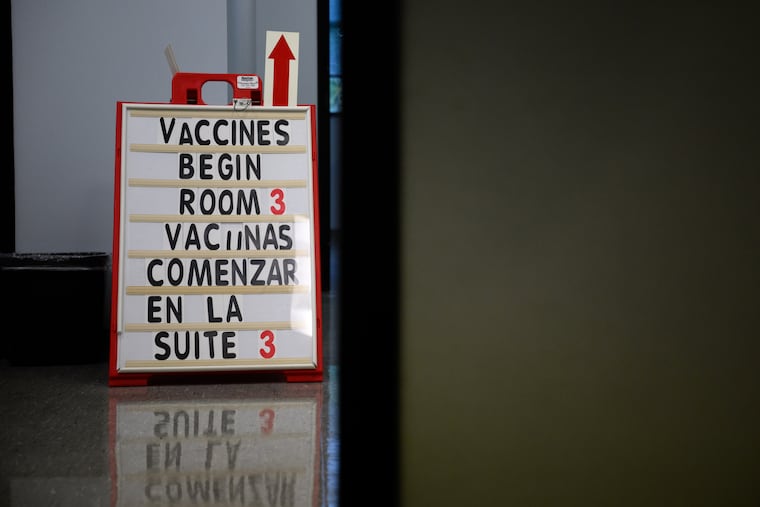
Lynn April has seen chatter on social media from parents in her community, expressing hesitancy about giving their children vaccines.
But she was shocked to hear that numerous elementary schools in the West Chester Area School District had seen crucial immunization rates fall, as a vaccine-preventable measles outbreak expands into Chester County.
“I would think the majority of parents I am associated with would also find that pretty horrifying,” said April, who has a third grader and a fifth grader at East Goshen Elementary.
The suburban district reflects a trend worrying health experts: Fewer families are choosing to vaccinate their kids. In West Chester, five of the district’s 11 elementary schools reported kindergarten measles, mumps, and rubella vaccination rates last school year below 95% — the threshold long considered necessary to ensure community protection.
One school, Penn Wood Elementary, appeared especially high risk, with only 87.5% vaccinated. Three private schools in or on the border of the district also reported concerningly low kindergarten MMR vaccination rates.
Yet school leaders in West Chester have not issued community messages highlighting the risk of the current measles outbreak. Nor are they sharing school-by-school vaccination data that indicate risky pockets within a district of about 12,000 students that touts an overall high vaccination rate.
West Chester Superintendent David Christopher questioned whether his community remains as exposed as state data collected last school year suggest. District nurses have called families that didn’t have vaccination records on file, Christopher said, and accounting for all grade levels, every school campus has a vaccination rate above 95%.
“We’re really talking about a pretty small percentage of students in the district,” Christopher said in an interview.
Even small declines in vaccination rates within a grade level, however, can increase community risk, health experts said.
With the nation’s largest measles outbreak in decades spreading across the state, René Najera, director of public health at the College of Physicians of Philadelphia, says a high vaccination rate no longer creates a comfort zone.
“It’s some comfort, but it’s not enough, especially in an epidemic situation,” Najera said. “You could have a population with 96% vaccinated, and still have a roaring infection go through.”
Christopher said he’s aware the ongoing measles outbreak could bring significant disruption: Earlier this month, a reported measles case led Oxford Area High School to shut down for a day to verify vaccination records for staff members.
“The nature of it — you could have one student in a building, and the entire building exposed — is concerning,” Christopher said.
‘Not our intention to pressure families’
Across the Philadelphia region, vaccination rates have been dropping, with at least 40% of area schools reporting kindergarten measles vaccination rates in 2025 below the threshold for what scientists call “herd immunity.”
Kindergarten vaccination rates are considered a bellwether for a community’s attitudes toward vaccination, as parents are deciding whether to get the shots required by law to attend school.
And increasingly, families are refusing vaccines. Pennsylvania has some of the loosest vaccine exemption policies in the nation, broadly allowing families to pass on immunizations required for school entry by claiming religious, philosophical, or medical objections.
At West Chester’s Penn Wood Elementary, MMR vaccination rates among kindergartners fell 8 percentage points last year, with 56 out of 64 kindergartners vaccinated.
Five students had philosophical exemptions to the vaccine, according to state data. (Another four were “noncompliant but attending,” a term the state uses for children who haven’t submitted exemption records but are in school.)
At Westtown-Thornbury, MMR vaccinations dropped from 100% of kindergartners two years ago to under 92% last year — seemingly because of seven students claiming religious exemptions to vaccination.
Sue Gramling, the president of Westtown-Thornbury’s parent-teacher organization, declined to comment about the school’s rate, saying in a message that she didn’t want to speak on behalf of the PTO “since this is such a hot topic right now.”
Two other West Chester elementaries with kindergarten MMR rates below the 95% threshold, Glen Acres and East Goshen, also recorded declines in the past year.
Christopher said those rates are dated. Nurses later called families who hadn’t submitted vaccination paperwork, more provided records, and some additional students have been vaccinated, he said.
Asked whether nurses had called families who opted out through legal exemptions, Christopher said in an email that “the connections have been to ensure that families are educated to make informed decisions about vaccines.”
“We understand that there are a variety of reasons that families may make this decision, and it is not our intention to pressure families, but to make sure they are informed,” he said.
As community organizations, schools have a responsibility to help disseminate information that affects their students and staff, said Holley Wilkin, an associate professor of communications at Georgia State University who specializes in health communication.
“With something like measles, it’s affecting their students and they should be playing that role,” she said.
To help communities understand their risk, Pennsylvania’s health department published school-level vaccination data this summer for the first time.
» READ MORE: More Philly-area classrooms are seeing lower measles vaccination rates. How protected is your school?
Tension in communications
Public health officials have warned since the summer that measles is actively circulating along Chester County’s western border with Lancaster County, the center of the state’s current outbreak.
But schools appear reluctant to talk about measles planning. Of 12 Chester County school districts contacted by The Inquirer about their preparations, only West Chester agreed to an interview.
In the Downingtown Area School District — where two schools last year reported kindergarten MMR vaccination rates last year below herd immunity levels — spokesperson Jenn Shealy said the district had communicated with staff about possible quarantines.
“Our nurses have also individually reached out to the small number of families of students for whom we do not have current vaccination records,” Shealy said in an email.
The Kennett Consolidated School District has “communicated with families and staff that immunizations for measles are a protective measure for all,” spokesperson Lisa Palmarini said in an email.
Some area school leaders who faced backlash over pandemic restrictions acknowledged tension around communicating about measles.
Marc Bertrando, superintendent of the Garnet Valley School District in Delaware County, said he wanted to make sure the district communicated with medically fragile students about the outbreak. But he didn’t want to be seen as dictating medical decisions.
“We’re just going to stick to, ‘Everybody makes their own health choices, but these are the facts,’” Bertrando said in an interview last month.
Wilkin, the communications expert, said schools that ignore their role as public health messengers also run the risk of angering parents of children who can’t be vaccinated — and rely on so-called herd immunity to keep them safe.
“There’s going to be potentially some parents upset at you no matter which way you go,” she said.
Questions around preparation
In the event of a measles case reported in a school building, Chester County health officials say all exposed students and staff who can’t prove vaccination will have to stay home for 21 days.
West Chester has created a secure portal for staff to upload vaccination records, Christopher said.
“The hard part is just finding those records,” Christopher said. He said the “vast majority” of staff had been vaccinated, but couldn’t provide an estimate of how many staff had provided documentation.
The president of the district’s teachers union, Michele Curay-Cramer, declined to comment on measles preparations.
April, the East Goshen elementary parent, was surprised to hear about possible 21-day quarantines. “That’s a long time to have a teacher out,” she said.
In the Oxford Area School District, the decision to shut down the high school Oct. 9 also surprised community members. Some said they wanted more information about why the district had closed the school but not called off a high school football game.
“I’m a bit taken aback,” said Joe Maida, whose 5-year-old granddaughter attends a district elementary school. But “I’m not giving it much energy.”
Christopher said he isn’t sure how many resources to devote to preparing for an outbreak that may not deeply impact his district.
But “if we’re fully unprepared, there will be questions,” he said.
Inquirer staff writers Lizzie Mulvey, Brooke Schultz, and Aubrey Whelan contributed to this article.

-
Your questions about Pennsylvania’s measles outbreak, answered
-
New vaccination data show hundreds of Philly-area schools vulnerable to a measles outbreak
-
Chester County has more measles cases than most entire states in the country
-
Pa. measles outbreak is nation’s worst, echoing deadly 1991 Philadelphia epidemic