Kensington High School teachers brace for a challenging year amid asbestos remediation measures
A lack of proper oversight and management “is an ongoing problem,” the Philadelphia Federation of Teachers' longtime environmental expert said.
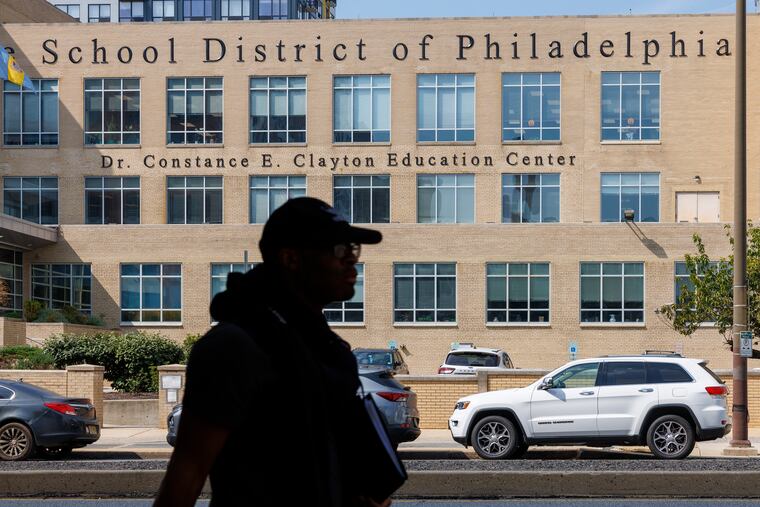
Summer break ended Monday for 9,000 Philadelphia School District teachers, counselors, nurses, and other school staff.
But instead of heading back to their own building, 90 Kensington High educators and support staff were rerouted to a school more than seven miles away — the former Austin Meehan Middle School in the Northeast — because of concerns over an HVAC project that led to damaged asbestos in the Kensington facility.
Staff and students are expected to remain at Meehan for the rest of the calendar year while an asbestos remediation project is completed.
Philadelphia Federation of Teachers officials expressed frustration Monday over the way the district initially handled the project, the inconvenience to staff and students, and the potential for further complications.
“People are angry,” said Arthur Steinberg, PFT president. “They’re upset.”
PFT staff were on hand Monday at Meehan, he said, answering staff questions: “Unfortunately for the staff and kids and the community, it’s going to be a chaotic year.”
‘It did not get followed’
The Kensington closure comes a year after the district was criminally charged over its past handling of asbestos management at city schools. After a yearslong secret probe, the school board signed off in June 2025 on a deferred prosecution agreement that comes with strict federal scrutiny of its environmental management.
Philadelphia was the first school district in the U.S. that faced criminal charges for environmental violations.
Steinberg and Jerry Roseman, the PFT’s longtime director of environmental science, said at a news conference Monday that the trouble at Kensington High traced back to mid-July.
Workers were installing a new heating and cooling system at Kensington, a 100-year-old school on East Cumberland Street, when a contractor inadvertently disturbed some asbestos.
The asbestos was then removed “in a non-regulated way by someone who’s not certified to remove asbestos,” Steinberg said. “They then traipsed it all over the building.”
Steinberg said the district initially told the PFT the damage was limited and could be completed in time for teachers to return to Kensington High by Monday.
“We thought that was unrealistic all along, and insisted that certain protocols be put in place before they decide to open,” Steinberg said. “Lo and behold, we get to maybe the end of last week. Guess what? It’s not going to open, you know, they don’t have time to abate the asbestos properly, clean it, test the air, and then complete the renovation that was going on.”
The district has agreed to remove all remaining asbestos inside the Kensington building, and developed a remediation plan in conjunction with Roseman, the PFT’s environmental expert, Steinberg said. It has also agreed to additional environmental oversight.
“In light of the publicity that they’ve received, they agreed to remove it all, which means it will be safer when folks go back in,” Steinberg said.
Asbestos, commonly used in building projects for most of the 20th century, is considered safe when undisturbed. But when it is damaged, asbestos can be toxic, releasing microscopic fibers that may cause lung disease and cancer.
Steinberg and Roseman said the Kensington mishap underscores an ongoing problem: The district has a vast stock of aging buildings, many of which have environmental issues.
“There was a plan” to deal with known areas of asbestos, Roseman said, and “it did not get followed.
A lack of proper oversight and management “is an ongoing problem,” Roseman said, “and as the [district’s $3 billion facilities master plan] gets put in place, this is one of our concerns.”
Naima DeBrest, a district spokesperson, said the Kensington situation differs from instances when schools have been closed because of observed asbestos damage.
“In this case, a third-party contractor is suspected of improperly removing asbestos containing material during demolition, which was being conducted in support of a school upgrade project,” DeBrest said in a statement. “The district immediately and transparently prioritized the health and safety of workers and stopped the project to assess the scope of the potential lapses. The subcontractor was removed from the job and has no other work with the district.”
‘A disruption for everybody’
José Lebrón, Kensington’s veteran principal, said in a letter sent to families this weekend that school and district staff have been “working around the clock to create a safe, vibrant, and welcoming space where our students can thrive from day one.”
Meehan is a closed district building often used to house school communities that need a temporary home.
Necessary educational materials are being brought from Kensington to Meehan, officials said, and when school opens next Monday, the district will provide shuttle service to Meehan.
For some staffers who had expected to drive to work in Kensington, commuting to the Northeast creates challenges around childcare, public transit, and commute times, Steinberg said.
“Make no mistake about it, it’s a disruption for everybody,” he said. “It’s not an ideal situation, to say the least.”
Oz Hill, the district’s deputy superintendent for operations, said in a letter to Kensington staff and families that “other options closer to Kensington were considered, but did not meet the space or accessibility needs for Kensington’s more than 400 students and 90 staff.”