Senate passes major permitting bill to speed up energy projects
The legislation was contentious with environmentalists, who said that many of its changes would limit the ability of communities to use lawsuits to fight polluting facilities.
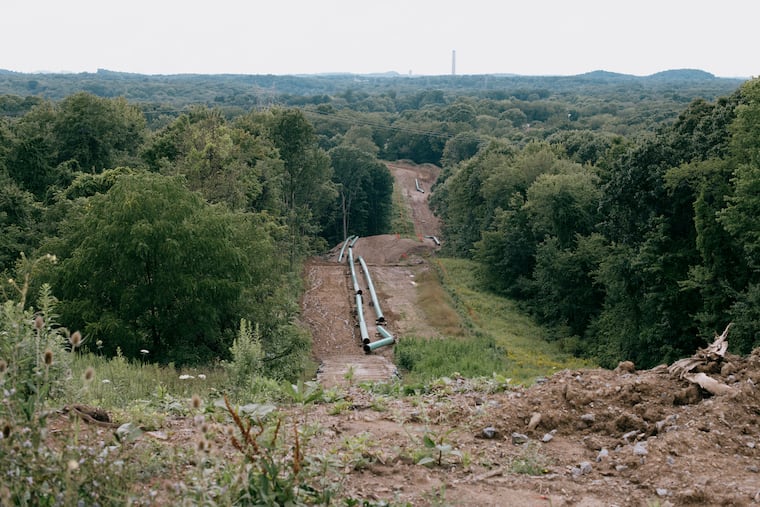
WASHINGTON — The Senate on Thursday passed sweeping legislation to overhaul federal permitting rules in an effort to make it easier to build all sorts of large projects in the United States, from gas pipelines to railway expansions.
The bill, which was approved by a 62-33 vote, would amend or pare back several landmark environmental laws to allow for faster federal approvals of long-distance power lines, wind and solar farms, gas-fired power plants, broadband, housing, and more.
Overall, the legislation represents the biggest change to environmental law in a generation, experts said.
Nearly every Republican senator voted for the bill, which had the enthusiastic support of the Trump administration, business groups, energy developers, and labor unions.
But most Democrats were opposed, and only 15 senators who caucus with the party voted for the measure. The legislation was contentious with environmentalists, who said that many of its changes would limit the ability of communities to use lawsuits to fight polluting facilities, as well as with many Native American tribes.
The legislation must now pass the Republican-controlled House, where its fate is uncertain. Lawmakers won’t be in Washington next week, and they face a tight timeline to fund the government and consider a variety of other bills before the new Congress takes office in early January. President Donald Trump has indicated that he would sign the permitting overhaul into law if it reaches his desk.
The bill was put together after months of closed-door negotiations between two Republican senators, Mike Lee of Utah and Shelley Moore Capito of West Virginia, and two Democratic senators, Sheldon Whitehouse of Rhode Island and Martin Heinrich of New Mexico.
The legislation was partly a response to long-standing complaints from businesses that building virtually anything in the United States has become too difficult. One giant wind farm and power line in New Mexico took nearly 20 years to complete after numerous lawsuits and route changes. Regulatory challenges delayed a 303-mile natural gas pipeline through Virginia and West Virginia for a decade.
The challenge has become more acute in recent years as the country has struggled to build enough power sources to keep up with soaring electricity demand, especially for artificial intelligence data centers.
While Republicans have long favored cutting environmental rules that can inhibit industrial development, a growing number of Democrats like Whitehouse have also recently come to support streamlining federal permitting. Some argue that it will be extraordinarily difficult to reduce planet-warming emissions and tackle climate change without building many more long-distance power lines and large solar arrays.
At the same time, many Democrats are weighing affordability concerns after making huge gains in the midterms by channeling voter anger at rising prices. Electricity prices in the United States have increased by roughly one-third since 2019, and some studies indicated that the permitting bill could help lower costs by a few percentage points by making it easier to expand energy supplies.
Even so, the bill faced a significant backlash. Major green groups like the Sierra Club and the Natural Resources Defense Council opposed it, as did 17 Democratic state attorneys general. Critics warned of a barrage of potential environmental harms, including a spate of new gas-powered data centers or new mining in sensitive habitats.
In the final days before passage, the bill received significant pushback from Native American tribes that criticized the bill’s alterations to the National Historic Preservation Act. That 60-year-old law lays out how the federal government should consult with tribes on projects that could affect areas of cultural significance. The bill seeks to narrow and speed up some of those processes in ways that tribal groups said would leave them with less input into new industrial developments.
The bill would curtail landmark environmental laws that have guided courts and policymakers for decades.
For example, the 1970 National Environmental Policy Act, or NEPA, requires many projects with federal involvement to go through lengthy reviews that document their potential impacts on air and water. The bill would exempt certain projects, such as expansions of pipelines or power lines along existing routes, from these reviews. It would also set tighter deadlines and restrict the ability of environmental groups and communities to sue under NEPA.
Notably, the bill would prevent courts from halting a project if they found an environmental review inadequate. Judges could only order federal agencies to update reviews while construction proceeds. Industry groups had pushed for that provision, but some environmentalists fear it could render NEPA toothless by removing a key enforcement mechanism.
The bill makes other major changes, such as limiting states’ ability to object to gas pipelines under the Clean Water Act and providing ways for state governments to oversee endangered species reviews.
Other provisions aim to prevent presidents from rescinding permits for already approved developments or blocking projects they don’t like, something both parties pushed for in response to Trump’s efforts to obstruct wind and solar developments and the Biden administration’s efforts to stifle oil drilling on public lands.
Yet some legal experts warned that these “project certainty” provisions were ambiguously written and could create unintended consequences, such as potentially preventing future administrations from issuing new pollution restrictions.
One of the most far-reaching sections in the bill aims to expand the electric grid by pushing utilities to plan more long-distance power lines and giving the federal government greater authority to site transmission across state lines. The United States has built very few long-distance power lines in recent years, in part because of permitting obstacles, and supporters say a bigger grid could potentially help the country use far more wind and solar power while lowering costs and averting blackouts.
In a nod to the growing backlash over data centers, the bill’s authors also inserted a provision that would charge the energy-hungry facilities far more for electricity. One study estimated that these provisions could potentially save tens of billions of dollars over the next decade for households and other ratepayers. Yet the bill is also expected to benefit the AI boom by making it easier to build power plants, pipelines, and transmission to serve new data centers.
This article originally appeared in the New York Times.