A Kensington elementary school parent has filed a discrimination complaint over Philly’s school-closing plan
Changes to Moffet are a closure without being called one, a new complaint says, depriving the community of the same protections and community engagement the other 18 proposed closures have.
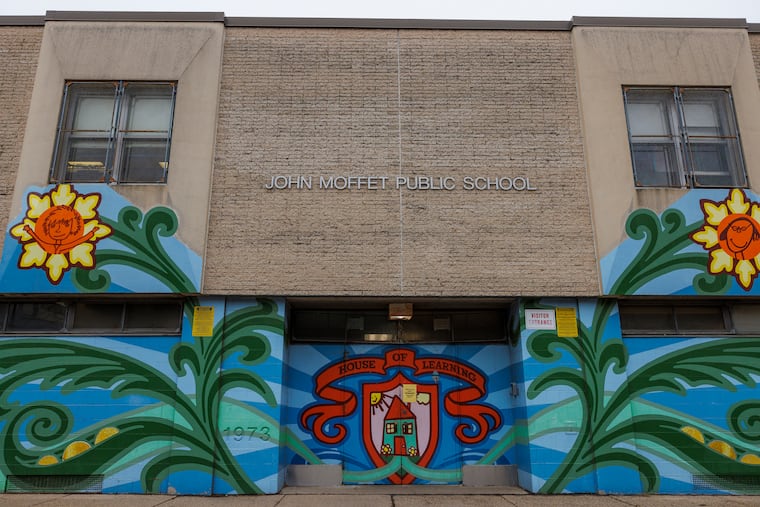
The Philadelphia School District is facing a state educational discrimination complaint over one proposal in its controversial facilities master plan.
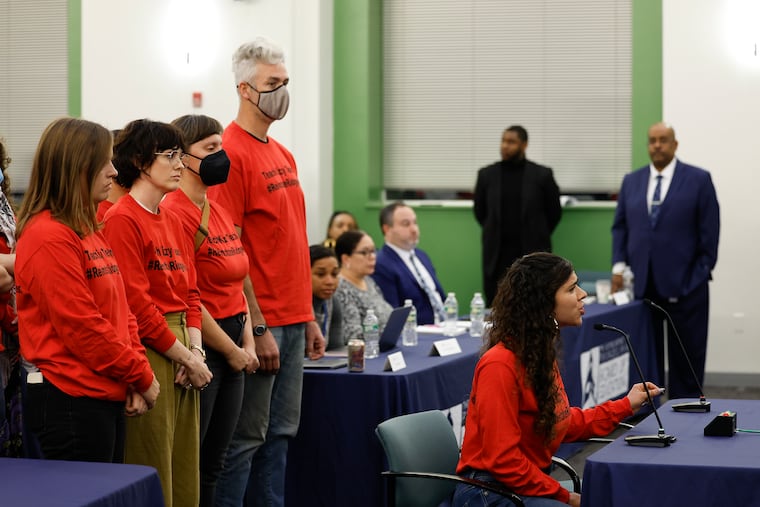
A Moffet Elementary parent has formally accused the district of unfairly foisting a school closure on the South Kensington school, despite it not being on the list of 18 schools facing shutdown.
Parent Andrea Minarik, on behalf of the Moffet community, asked for an immediate Pennsylvania Human Relations Commission investigation “on the grounds that the district’s proposed treatment of Moffet constitutes discriminatory, inequitable treatment of a school community that is overwhelmingly low-income, Latino and Muslim.”
Moffet, a K-5 school, does not appear on the closing list in the district’s facilities plan. But the district wants to merge the catchments of Moffet and Hackett, another K-5 a mile away in Kensington, with Hackett serving as an elementary school and Moffet as a middle school.
“John Moffet Elementary has been subjected to a de facto closure — the elimination of its K-5 program and conversion to a middle school through a forced merger with Horatio B. Hackett School — without being afforded the same procedural protections, community engagement process, or formal board vote required for the 18 schools officially on the closure list," reads the complaint, filed Monday.

Wholesale changes are coming to the Philadelphia School District, with the school board passing a $3 billion facilties plan that aims to close 17 schools permanently, and renovate 169.
Superintendent Tony B. Watlington Sr. presented the plan to the school board Feb. 26 and it immediately faced strong opposition. After some amendments, the board passed the plan April 30. Here's what we do and don't know about it.
And to see the proposed list school closures and check how your school could be impacted, use our interactive charts.
Each of the schools proposed for closure has its own story. Find them all here.
Minarik asked for an investigation and wants the Human Relations Commission to require the district to give Moffet the same treatment as other schools on the closure list, including public hearings. She also asked the commission to issue a finding that Moffet was treated inequitably.
District spokesperson Monique Braxton said the school system had not yet received the complaint but “remained steadfast in its commitment to produce a plan that centers educational equity and opportunity” across all neighborhoods.
The Human Relations Commission now has 30 days to send the complaint to the district, which has 30 more days from receipt of the complaint to respond. Possible outcomes include mediation, an investigation, a settlement, and a possible court review. The case could also be dismissed and proceed no further.
The school board has not said when it will vote on the facilities plan, which includes the closures, six co-locations, and 159 modernization projects, as well as the Moffet and Hackett changes, but action is expected this spring.
Superintendent Tony B. Watlington Sr. has said action is needed to address the district’s enormous facilities needs and the cash-strapped school system’s inability to fund adequate educational and extra-curricular opportunities in a system that has 70,000 empty seats and more than 300 buildings. It’s attempting to improve outcomes for students across the district, officials said.
A community push for Moffet; a Hackett parent speaks out
The complaint is the latest move in the Moffet community’s concerted public battle over the district’s plan for the school.
Community members, including a large group of parents and some politicians, say the change will harm the community by leaving South Kensington without an elementary school and making students from predominately Black and brown and low-income families walk long distances to and from school.
They also say it would jeopardize the education of a large group of students who require special education services.
Parents, speaking out at recent school board meetings, have pressed the district on the changes, underscoring their community’s demographics and Hackett’s. Moffet, in booming South Kensington, has 219 students, most of whom are children of color; Hackett is 56% white.
Moffet kids, parent Katy Hoffman-Williamson said at a recent school board hearing on the facilities plan, “are being punished by this plan. They’re being kicked out of their school, their safe space, in order for a majority white school in an entirely different neighborhood to gain a more palatable middle school that they may go to as an option. How can you live with that?”
While Hackett families have largely remained publicly quiet on the plan, MaryKris Thacher, a Hackett parent, told the school board at that town hall meeting that she supported the Moffet-as-middle-school plan.
“I recognize that these decisions are difficult and challenging, but this plan also presents an important opportunity to strengthen the educational pathway for students in our neighborhood,” Thacher said. “Right now, many families in the Fishtown, Greater Kensington neighborhoods feel that when their children reach middle school age, they need to leave the neighborhood or sometimes leave Philadelphia entirely.”
Locating a “strong educational option” in the neighborhood is a desired outcome, Thacher said.
Both Moffet and Hackett students currently feed to Penn Treaty, a 6-12 in Fishtown, for middle school. But Penn Treaty is also on the district’s closure list; it serves a population that is largely Black and low-income and comes from other parts of the city. The majority of families who live in the neighborhood do not send their children to Penn Treaty.
“Families like mine want to stay in the Fishtown, Kensington area and continue investing in Philadelphia’s public schools,” Thacher told the board. “When strong neighborhood pathways exist, families stay, communities grow stronger, and our public schools retain the students and support they need to thrive.”
Funding cuts for Moffet
Moffet parents are also upset about the district’s budget proposal for next school year.
The 18 schools targeted for closure are immune from the significant school budget cuts now being pressed upon non-closing schools to help close a $300 million budget gap, but Moffet, which is not on the closure list, must make cuts like other schools.
It’s a double whammy, said parents, because Moffet is already slated to lose teachers next year because of declining enrollment. Hoffman-Williamson said fewer out-of-catchment students are seeking to enroll since the district announced the proposed changes to the school’s structure, which would take effect in 2027.