When Mark Twain’s autobiography highlighted his time at The Inquirer
The celebrated author instructed his next of kin to wait until 100 years after his death to publish his story.
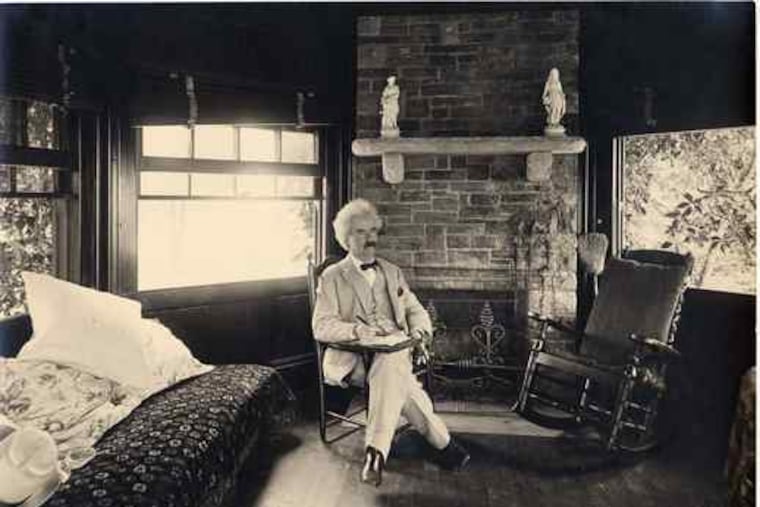
Before rising into a national icon, Mark Twain was an Inquirer.
Samuel Langhorne Clemens started working for newspapers at the ripe age of 12, prematurely entering the workforce in the late 1840s following the untimely death of his father.
Clemens’ journey started in his home state, at the Missouri Courier, where he worked as a printer’s apprentice before serving as a typesetter and editorial assistant for the Western Union paper, owned by his brother Orion.
He would then pass through St. Louis, en route to New York and Philadelphia.
Now, he wasn’t in Philadelphia for long. But considering he is one of the United States’ most famous writers, it counts as street cred: We knew him before he was cool.
The newspaperman
In the early 1900s, the man now known as Twain set about writing his life story.
His method of doing so was as odd as it was revolutionary: “Start it at no particular time of your life; wander at your free will all over your life.”
The celebrated author instructed his next of kin to wait until 100 years after his death to publish the story in full. So on Nov. 15, 2010, the University of California Press published the first of three rather robust volumes that together constitute the stream-of-consciousness-style Autobiography of Mark Twain — retaining its signature chaotic prose just as the author had intended.
In that first volume, Twain looked back at his brief time working as a substitute typesetter for The Inquirer in 1853-54, when he was all of 17 years old.
His role was to help set the printing plates. Back then, each letter and each punctuation mark from every article had to be individually set in metal before the plates could start stamping out broadsheets.
But his remarks in the book were brief: “By and by I went to Philadelphia and worked there some months as a ‘sub’ on the Inquirer and the Public Ledger.”
And he left out the best part.
The Philadelphian
While working for The Inquirer, Clemens wrote a letter to his brother, in which he revealed an astute and accurate preference.
“Unlike New York,” he wrote, “I like this Philadelphia amazingly, and the people in it.”
He added: “I will try to write for the paper occasionally, but I fear my letters will be very uninteresting, for this incessant night work dulls one’s ideas amazingly. ... I believe I am the only person in the Inquirer office that does not drink.”
Despite his ambition, the byline Samuel Clemens would never appear in print.
In the subsequent 50 years, though, Mark Twain’s prose would grace the newspaper’s pages in the form of reprinted excerpts from his essays and speeches.
But by then most of the country had joined the bandwagon.