After a midterm shellacking, where do Pennsylvania Republicans go from here?
One Pennsylvania GOP official said the party might be best suited to consider a “2030 strategy,” looking to the next governor's race and midterms, rather than one focused only on 2028.
As the drumbeat of bad news for Republicans grew louder on election night, U.S. Rep. Brian Fitzpatrick called to apologize.
Jim Worthington, the owner of the Newtown Athletic Club and a prominent GOP booster in Pennsylvania, had supported Fitzpatrick for a decade as he won time after time in their purple suburban Philadelphia district. Worthington also backed President Donald Trump over that time — hosting campaign rallies and raising money for the president even as Fitzpatrick, a moderate Republican, repeatedly survived reelection by distancing himself from the leader of their party.
Now, though, it was clear Fitzpatrick was calling amid a “bloodbath.” Republicans had lost up and down the ballot in the nation’s biggest midterms rout in a half-century, and Pennsylvania was no exception. Fitzpatrick knew his time in office would be over and he wanted to tell Worthington personally that he was sorry, that there was more he still wanted to get done for Bucks County and now wouldn’t be able to.
» READ MORE: Bob Harvie’s win over Brian Fitzpatrick was fueled by Bucks County’s younger, lower-income, and Hispanic voters
Worthington, recalling the conversation from election night, said he’s come to blame the widespread losses on both state and federal Republicans. And, he said, it’s put him at a “crossroads” that could determine whether he keeps helping their efforts in the future.
“I’m not going to beat my head against the wall and not make a difference; raising a lot of money, spending time and losing,” Worthington said last week. “I could conceivably be stepping away, particularly when you see that people on both sides of these parties, Democratic and Republican, are in it for the wrong reasons, making fortunes, scamming the system and being grifters. I’m just doing this because I want my country to be better.”
As the dust settles and Democrats prepare to take back some level of power in Washington and full control of Harrisburg, how Pennsylvania Republicans — and Republicans across the country — handle the beginning of the post-Trump era has become a burning question.
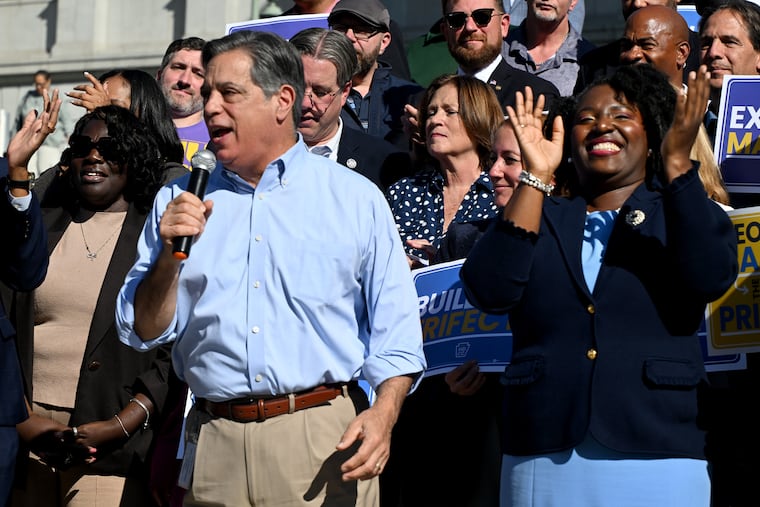
» READ MORE: Who will be in charge of Pennsylvania’s new Democratic trifecta? The leaders come from Philly, Montco, and across Pa.
The party, by some measures, is at its lowest point in the Keystone State in decades. In January, the GOP will sit in the minority in the state legislature for the first time since 1993, hold just six of the state’s 17 congressional seats and lost four consecutive races for governor, including Gov. Josh Shapiro’s sizable 22-point win over Republican Stacy Garrity this year.
And after a decade in which Trump twice won the critical swing state and remade the GOP in his image, his cratering popularity and final years in office have made some Republicans eager to move on.
“It needs to send a message to the party and President Trump, too, that MAGA is not bigger than the Republican Party,” said one Pennsylvania Republican Party official, who requested anonymity to freely discuss intra-party conversations. “We’ve all learned a hard lesson that it isn’t. Many of us have believed that for a long time.”
» READ MORE: What went wrong for Republican Stacy Garrity’s campaign for Pennsylvania governor
The party official said Republicans who want to win general elections moving forward must recognize the “deadly, devastating, negative effect” of continuing to tie themselves solely to Trump, including in the nomination process for a 2028 presidential candidate and other races in Pennsylvania. That may be easier said than done.
“The anti-Trump sentiment that controlled the day in ‘26 will not fully dissipate by ‘28,” the official said, adding that Pennsylvania Republicans might be best suited to consider a “2030 strategy” rather than one focused only on 2028.
Such a move would set the party’s sights more on the next gubernatorial race and presidential midterms in four years. It’s not impossible to rebound in two years — especially if the national mood shifts, if Democrats overreach in their new power and if Republicans recruit strong candidates for everything from state House to U.S. Senate, when Democrat John Fetterman’s seat is up for election, the official said. But it will be challenging.
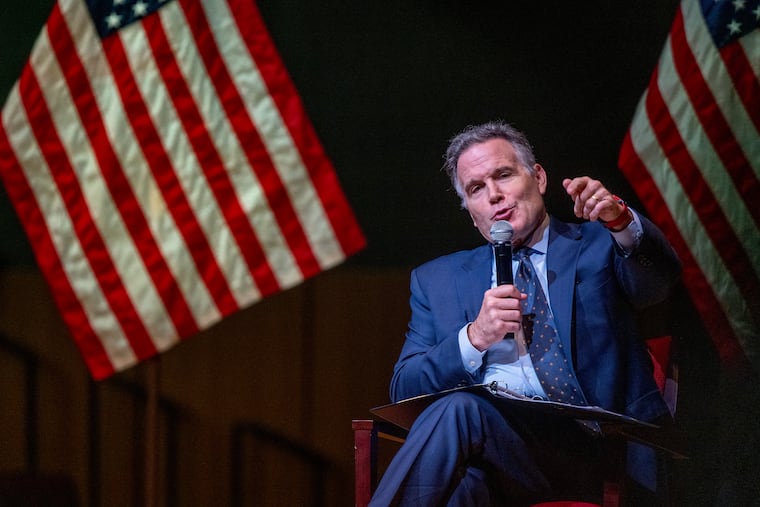
“We got thumped,” said U.S. Sen. Dave McCormick, Pennsylvania’s top elected Republican who could play a key role in rebuilding the party in the coming years.
McCormick told reporters this week that Republicans ran on a “really great track record” of border control, a reduction in violent crime and fentanyl deaths, tax cuts and school choice.
But he said they also didn’t talk enough about the cost-of-living pains that voters were expressing around gas, healthcare and housing — or about perceptions of corruption in Washington, like when lawmakers trade stocks tied to issues they legislate.
McCormick defeated longtime Democratic U.S. Sen. Bob Casey in 2024, when Republicans wins, including Trump’s, were propelled partly by economic concerns. A former hedge fund leader whose wife, Dina Powell McCormick, is the president of Meta, McCormick is one of the wealthiest members of Congress and said he supports legislation to ban stock trading by lawmakers. He said the public has concerns about both insider trading and the cryptocurrency market — which he also has investments in — and Republicans need to “build back confidence” that voters should have in them.
“Lesson one is: More focus, more attention, on giving them confidence that we heard you and we have a plan to deal with that,” McCormick said. “I don’t think the voters expect us to fix everything right away. But I don’t think they felt like we were focused enough on the things that they were feeling were most important.”
‘What did we do wrong?’
Long gone are the days where Philadelphia is a blue dot in a sea of red counties. In 2027, there will no longer be any Republican representing Delaware, Chester, and Montgomery Counties in the state Capitol, in what were once GOP strongholds.
State Rep. Craig Williams, one of the few remaining Republicans representing the Philadelphia collar counties in Harrisburg, was among the more than a dozen GOP state lawmakers who lost reelection. He was ousted by Democratic Rep.-elect Elizabeth Moro, a local small-business owner and real-estate broker, who challenged him unsuccessfully in 2024.
“I don’t think it had anything to do with the work we were doing in the 160th District,” Williams said, who represents parts of Chester and Delaware Counties. “This election was entirely about affordability and a national sense that our party hasn’t done enough to address it, and I tend to agree with them.”
Williams said he’s unsure what he’ll be doing come January, but hopes that Republicans work with the Democrats while in the minority. The former federal prosecutor and retired U.S. Marine Corps colonel said it’s unlikely he runs again.
“I have to say, all credit to the Democrats. They found the right message,” Williams added. “It falls to Republicans to decide how they want to respond… If we’re not awake, then we’re going to be facing these same problems in the future. Right now we should do whatever we can to help everyday Americans.”
In Washington, U.S. Rep. Glenn “GT” Thompson (R., Pa.) said the party, in some ways, has been here before.
The Centre County Republican is the longest-serving House member from Pennsylvania. He won his first election in his sprawling and heavily conservative Central Pennsylvania district in 2008, the last high-water mark for Democrats. Republicans responded after the first two years of President Barack Obama’s administration by winning across the board in the 2010 midterms, allowing them to put up roadblocks for the rest of Obama’s term and their eventual success in the Trump years.
“There’s a lot of people that love to declare the end of either party after an election. That’s just not true. I think 2009-2010 proved that,” Thompson said in an interview Thursday on Capitol Hill.
Thompson compared the massive swing this year to the post-Watergate era when Democrats swept into office after President Richard Nixon’s scandalous collapse. But, like others who have made the comparison in recent weeks, he attributes it not to corruption but to the economic pressures that voters felt Republicans weren’t doing enough to address.
» READ MORE: Affordability is on voters’ minds in Pa. swing districts as the cost of gas and groceries skyrockets
Thompson said the war in Iran’s impact on fuel prices and Trump’s widespread tariffs, though well-intentioned, played a role. So did the president’s immigration agenda, which Thompson and other Republicans see as largely necessary but have looked to tweak through bills like the Securing Agriculture’s Workforce Act. Thompson, who chairs the House Committee on Agriculture, sponsored the bill to expand seasonal harvester visas — a move that agriculture leaders in Pennsylvania have hailed amid frustrations with Trump’s agenda.
“Do I think that that would have made a difference in this election, if the administration and leadership would have embraced this five months ago? Yeah, I think it would have, actually,” Thompson said. “Because it is one of the things in rural America.”
» READ MORE: Farm industry leader explains why ‘very red’ Pa. farmers voted for Democrats
Worthington said Trump’s success in areas like immigration were overshadowed by his failure to address “kitchen-table issues.” And at the state level, he said he blames the Pennsylvania Republican Party, of which he’s a committee member, for continuing to rely on outside groups to run its mail-ballot strategy as Democrats continue to vote by significantly higher rates.
Garrity, meanwhile, at the top of the GOP ticket didn’t draw the kind of voter enthusiasm needed to defeat Shapiro, whose popularity and vast financial resources were credited with helping Democrats win up and down the ballot.
The Pennsylvania Republican Party, for its part, said it ran “great candidates up and down the ballot” and attributed the GOP’s losses in the state to the blue-wave election that impacted even deep-red states like Texas and Mississippi, spokesperson James Markley said in a statement.
Pennsylvania Republicans this election built an expansive early voting and mail ballot chase program in which they reached out to voters to get them to turn in their mail ballots, and for the first time had a higher return rate than Democrats, Markley added. Republicans returned 87.5% of their requested mail ballots for a total of 285,397, according to Department of State data. Democrats returned 85.2% of their requested mail ballots, or 734,477.
“The Democrats ran on affordability, but are already pivoting to job-crushing policies and an agenda that will drive Pennsylvania and our country into the ground,” he said in a statement. “The Republican Party of Pennsylvania is taking the necessary steps today to ensure our strength and preparedness for the road ahead.”
Both parties, from Harrisburg to Washington, are set to face their share of challenges moving forward.
Democrats are entering the majority in Congress with warring factions of progressives and moderates. Republicans have largely seen their ranks purged of candidates who oppose Trump but are now considering different leaders heading into the president’s final years in office.
McCormick, for one, had urged his Senate Republican colleagues after the election to hold off on their internal leadership elections, saying there should be a thorough review of what went wrong before they picked who would guide them through the aftermath. That move — which a few other senators also joined — came up short, with Republicans picking Senate Majority Leader John Thune to continue as their leader in the minority next year.
This week, McCormick said the “accountability” conversation needs to happen at all levels.
“In business and the military and elsewhere, you start with accountability,” McCormick said, referencing his own personal background. “It’s from the commander-in-chief, to the leadership in the Senate and the House, to individual senators like me. What did I miss? What did we do wrong?”
Staff writer Michelle Baruchman contributed to this article.