Blood, flags, and fear: 25 years later, looking back on how Philadelphians reacted to 9/11
In the immediate aftermath of the attacks, Philadelphia was focused on survival, and worried the birthplace of the nation could be the next target.
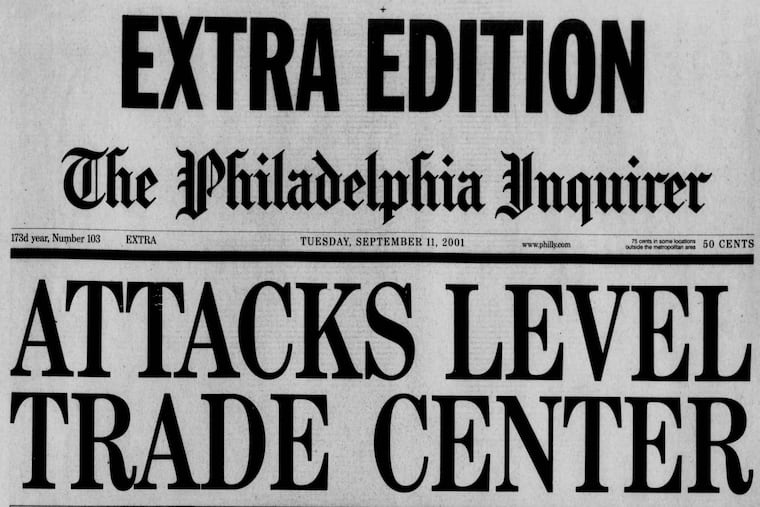
As the sun set on Philadelphia on Sept. 11, 2001, the city, like the nation, was in shock. Its citizens raged and wept, confronted with unprecedented acts of violence in New York City; Washington, D.C.; and Shanksville, Pa.
It wouldn’t be known for quite some time, but the attacks that rocked the East Coast that day took about 3,000 lives. Among them were dozens of people with local connections, including several crew members on the doomed flights.
But in the immediate aftermath of the 9/11 attacks, Philadelphia was focused on survival, and worried that the birthplace of the nation could be the next target. We evacuated, took refuge in religion, worried for the future, gave our blood and time to help, and focused our anger and confusion on our neighbors.
Now, 25 years later, the impacts of 9/11 continue to reverberate. And though society continued on, in the first few days after the tragedy, it seemed as if it could not.
Here is how The Inquirer and Daily News covered it:
https://www.newspapers.com/article/the-philadelphia-inquirer/205152877/
Article from Sep 12, 2001 The Philadelphia Inquirer (Philadelphia, Pennsylvania)
Panic in Center City
In the wake of the attacks, panic set in on Philadelphia. Fears the city could be the next target spread quickly, prompting the closure of city government offices, federal buildings, businesses, schools, and historic landmarks by noon.
“We are taking every reasonable precaution to ensure the safety of our citizens,” Mayor John F. Street said at a late morning news conference.
Thousands of people began a frantic commute home, gridlocking Center City’s streets and sidewalks. An estimated 50,000 SEPTA Regional Rail passengers were likewise stuck, with several lines suspended. Like all airports nationwide, Philadelphia International Airport was shut down.
By midafternoon, Center City was essentially a ghost town. Subway lines were all but deserted. Streets were eerily still and empty of cars. Philadelphia’s high-rises largely sat devoid of workers. And as the day wore on, the trauma continued to set in.
“I feel more shocked today,” said Southampton resident Paul Brown, 81, who survived the attacks on Pearl Harbor 60 years before. “I’m despondent, bewildered, and confused.”
https://www.newspapers.com/article/philadelphia-daily-news/205152937/
Article from Sep 12, 2001 Philadelphia Daily News (Philadelphia, Pennsylvania)
Blood and flags
Almost immediately, horror and sadness turned to anger. Though the enemy was not yet clear or confirmed, there were loud calls for retribution — including from the Daily News.
In its Sept. 12 issue, under a cover that read “Blood for Blood,” in an editorial headlined “Now, It’s Our Turn,” the People Paper wrote: “Revenge. Hold on to that thought. Go to bed thinking it. Wake up chanting it. Because nothing less than revenge is called for today.”
Others were more charitable, donating blood to help victims who may have survived. Thousands of people, in fact, streamed into blood donation centers to such a degree that the facilities were overwhelmed. Officials asked that anyone thinking of donating to wait to ease the crush.
“I feel pretty helpless, and I just wanted to do something,” said Andy Hartlove, 45, of Exton. “Giving blood seemed to be the only thing I could do.”
Then, there were the flags. So many people bought them to show their support that stores — specialty shops to big box stores alike — sold out completely, and manufacturers began running overtime shifts to make more.
“Nothing’s going to make anybody feel all that better, but it makes everyone united,” said Jim Whitehead, 22, who worked at National Flag & Banner.
https://www.newspapers.com/article/philadelphia-daily-news/205153079/
Article from Sep 17, 2001 Philadelphia Daily News (Philadelphia, Pennsylvania)
A turn to God
Faced with such monumental violence, many Philadelphians turned to the only being who they felt could provide answers: God.
Though schools, businesses, and government buildings shut down, many sanctuaries and religious institutions remained open. The city even organized an interfaith prayer service held at Dilworth Plaza on Sept. 13, which thousands attended.
Many religious leaders reported swellings of their congregations not seen since the bombing of Pearl Harbor. Religion, it seemed, was poised to regain a more prominent place in American lives.
“People realize when all is said and done that faith in God is the only thing that somebody else cannot take away from them,” said Msgr. John T. Conway, Archdiocese of Philadelphia vicar.
Many religious leaders took the opportunity to encourage reconciliation instead of revenge. Imam Shamsud-Din Ali, formerly of the Philadelphia Masjid, even encouraged worshipers to pray for the attacks’ perpetrators, noting that in order to perpetrate such a violent act, they must have been badly injured and were in need of God’s mercy.
The Jewish holiday of Rosh Hashanah arrived as the first religious holiday after the attacks. Paul Bender, the leader of Congregation Ner Tamid in Cherry Hill, sounded a shofar — a ram’s horn blown to sound the start of the Jewish New Year — at a ceremony, likening it to the sounds of wailing of those who lost loved ones. The “sudden, nightmarish anarchy” of the tragedy, he prayed, would soon give way to peace among all people.
“May that day come soon,” Bender said.
https://www.newspapers.com/article/the-philadelphia-inquirer/205153160/
Article from Sep 14, 2001 The Philadelphia Inquirer (Philadelphia, Pennsylvania)
Faith and race targeted
Philadelphia’s Muslim and Arab American communities were on high alert, and immediately condemned the violence. Federal, state, and local leaders urged the public to not blame those groups, but violence and threats against them were prominent.
A week after 9/11, officials said, at least 20 bias crimes were reported against Jews and Arabs in New Jersey, and an “untold” number in Pennsylvania. Many people who weren’t Arab or Muslim were also targeted, their attackers believing them to be somehow associated with the tragedy.
“Apparently, all you need to be right now is brown,” said Emily Hornaday, spokesperson for the New Jersey Division of Criminal Justice.
Among the most prominent crimes in the area was an incident in which two off-duty Philadelphia police officers pulled a gun on a Lower Merion Township 7-Eleven store clerk at about 3 a.m. the night after the attacks. The clerk, who was from Pakistan, was unharmed, and one of the officers was charged with reckless endangerment and other offenses.
Taxicab drivers were pulled from their cars and threatened. Islamic religious centers boarded up their windows. A Palestinian flag was pulled down from the wall of Lincoln High School in Northeast Philadelphia, resulting in two arrests. A SEPTA bus passenger threatened a Moroccan man, and begged police to let him “kill the Pakistani.”
“Are we going after the perpetrators,” asked Amin Elarbi, president of the Al-Aqsa Islamic Society, “or are we targeting an entire faith and race?”
https://www.newspapers.com/article/philadelphia-daily-news/205153372/
Article from Sep 17, 2001 Philadelphia Daily News (Philadelphia, Pennsylvania)
Vanishing normalcy
Even in the early days of the aftermath, it was clear life was about to change. By midweek, city schools reopened, the local government began operating again, and, though curtailed and under new rules, flights began coming and going from PHL. Normalcy, however, was nowhere to be found.
Large public activities for the weekend after the attacks, such as a Mexican Independence Day festival at Penn’s Landing and a festival celebrating Philly’s connections with Italy known as the Splendor of Florence, were canceled.
Experts, meanwhile, predicted a swift, lasting change to daily life in the U.S. As Philadelphia Police Commissioner John Timoney put it, we needed to “reexamine how we go about our business.”
Among those changes, said Geoffrey Herrara, a Temple professor of political science who specialized in post-Cold War security, were an ever-greater electronic surveillance apparatus that would surely be stepped up. Cameras, he said, would be linked with biometrics, and tracking of our movements was to be expected in the future. Some of our privacy, he said, “may disappear.”
City leaders, however, focused on strategies to get tourists and workers back in town, and back in the high-rises they had quickly come to fear. Occupancy rates at area hotels fell to an abysmal 60%, and the sense that big-city life would be on the decline was palpable. Ultimately, though, we had to keep going, they said.
“I think we need to communicate to the hearts and minds of Philadelphians that we need to get on with life,” said George Burrell, the mayor’s secretary of external affairs. “The things that attracted you here are still here.”