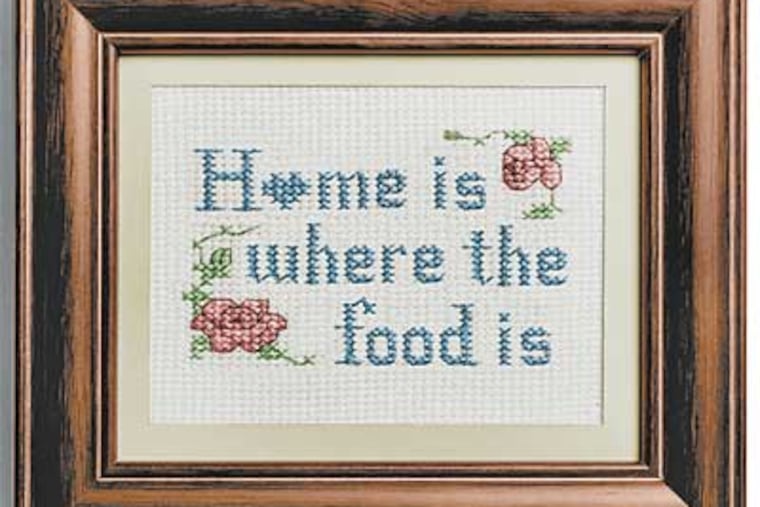
Home is where the food is
Home cooking and potluck are the trends for '09 . Also fewer processed foods, lower carbs, and more veggies. The new ethnic: Peruvian.
The watchword for 2009 is
less
, as in: getting by on less; using less expensive ingredients; eating out less often.
And more home cooking.
The trend will affect families at all points along the culinary spectrum. Bon Appetit magazine, for example, suggests its home cooks substitute truffle oil for more expensive truffles, while Wegmans supermarkets say sales of supplies for home baking and canning are way up.
"Over the last year, we've seen increased sales of baking ingredients such as flour, even over the spring and summer when flour prices were rising dramatically," says Josephine Natale, spokeswoman for the supermarket chain.
She says a recent spike in sales of salty snacks such as pretzels and chips is evidence people are entertaining more at home. And when folks buy more canned soups and frozen pizza, Natale says, it shows they're making more affordable meals at home.
In the prepared-foods section at Wegmans, dishes containing beef and fish are not selling as well as those with pasta. Wegmans' best seller in the prepared-foods category is rotisserie chicken.
But a run on canning jars and lids really shocked Natale.
"Our sales of canning supplies would have been up over 100 percent compared to 2007, if we'd had more to sell," she said. "And apparently this has been the case nationwide."
The surveys and reports that go into making predictions for the year point to continuing consumer interest in eating locally grown food (organic, too, if that doesn't get too pricey). Don't expect us to revert to an all-processed-foods diet.
Instead, we'll be looking for cheaper cuts of meat such as hanger steak, flatiron steak, and short ribs - and doing more braising. Better dust off that slow cooker.
Fish-lovers will seek out less expensive choices, such as branzino and Arctic char, and that's a good thing for people concerned about over-fishing. And the more fish we consume, the more we'll want and need a certification system to ensure safety.
This could be the year we take the advice of health experts and reserve the largest part of our dinner plates for vegetables, reducing our reliance on protein and carbs.
We'll have to think outside the meat compartment for our proteins, too. We'll look for more sophisticated ways to use eggs, cheese, peanut butter, tofu, seitan, sardines, nuts, beans and quinoa.
But don't expect to see a whole lot of people become vegetarians, said Bill LeBlond of Chronicle Books.
"People don't really want to cook with tofu and seitan," LeBlond says. "Vegetarian cooking can be difficult and time-consuming."
Sure, if we lose our jobs, we may have more time to cook. But as long as we're employed, we'll be working harder than ever - doing the jobs of our laid-off colleagues, LeBlond says. So, anything that makes shopping and cooking more convenient will still be needed, LeBlond says.
For home entertaining, we may see an uptick in sales of fridge-to-oven-to-table containers in which to carry our contribution to the neighbors' potluck dinners.
Food also will be called on to serve our gift-giving needs in 2009, whether it's a gift of cookware for someone's birthday or homemade fudge for Valentine's Day.
Chances are, kids won't be the only ones toting lunch boxes in 2009. More adults will carry their lunches to work, for the sake of cost as well as quality. And while their lunches will likely be leftovers, adults will look for carriers that don't scream "I'm so broke, I have to bring lunch from home!"
In 2009, we'll continue to expect our food to do more for us - such as aid in digestion, thwart illness, stave off serious diseases, maybe even make us happier.
Expect increased sales of gluten-free products and foods containing antioxidants, soy, probiotics, ginger and green tea, says registered dietitian Althea Zanecosky, even though the full effects of those compounds are still unknown.
And you can expect to see more drinks made from antioxidant-rich purple fruits. You may want to stock up on stain removers, too.
We'll want more sourcing on our food labels in 2009. Expect to see the country of origin for each ingredient, not just the finished product.
Sales of nonsugar sweeteners from rebiana, contained in the leaves of the South American stevia plant (see it on store shelves as Stevia and Truvia), will likely continue to grow, as more adults and children are diagnosed with prediabetes. Honey is another no-no for diabetics, and a new alternative is glucose-free Yacon syrup.
The market for organic and natural foods may be in limbo. The NPD group predicts a dip, for the first time ever, in sales of organic and natural foods. But Mambo Sprouts Marketing, which is based in Collingswood, reports that only 18 percent of families expect to buy notably fewer organic/natural foods. And 49 percent said they'd try less expensive store-brand organics.
Still, not all is bleak. We'll still eat out from time to time.
The city's steak houses will do well because many of us will likely look for filling, comforting dishes we know we will enjoy. In other restaurants, expect smaller plates of artfully arranged foods, with a lower price tag and a higher cute factor.
And trend-watchers predict more restaurants will be serving Peruvian food and drinks in 2009. Pisco, the Peruvian brandy, is already on the rise, and Epicurious magazine says "Peruvian is the new Thai." We'll see about that when Chifa, the new restaurant from our hometown celebrity chef Jose Garces, opens with his Peruvian-Cantonese menu.
Perhaps the best news (for people like me) is that chocolate will continue to be popular - especially dark chocolate, which is high in flavonols that may lower blood pressure with the same effectiveness as low-dose aspirin.
Sales of dark chocolate jumped 30 percent in both 2006 and 2007, says Jim Corcoran of the National Confectioners Association. But that level of growth probably can't be sustained, so for 2008, he's expecting dark chocolate sales to grow by only 10 percent.
I'll do my best to pick up the slack.
And a vote for two old-timey favorites
Of all the reports and studies used to make predictions about food trends for 2009, two of my pet issues seem to be missing.
First, I'd like to see a return to the use of cloth napkins instead of paper. There's definitely a DIY project in creating individualized napkin rings so family members can keep track of and reuse their napkins. I'm guessing there are twentysomethings out there who didn't know that was the original purpose of the napkin ring.
Second, let's bring back the flask to replace the carry-around water bottle. For me, this is a matter of style and grace, more than refillability. Do we really need to carry 20 ounces of water with us everywhere we go? Flasks are cool.
Mushroom Lasagna
Makes 8 servings
EndTextStartText
5 sheets fresh lasagna noodles or 12 ounces dried lasagna noodles
One 1-pound ball fresh mozzarella cheese, thinly sliced
3/4 cup shredded or grated parmesan cheese
For Mushroom Sauce:
1 ounce dried porcini mushrooms
1/2 cup boiling water
3 tablespoons olive oil
1 medium-small yellow onion, finely chopped
1 carrot, finely chopped
1 rib celery, finely chopped
3 pounds fresh shiitake mushrooms, cleaned and coarsely chopped
One 29-ounce can tomato puree
2 cloves garlic, minced or pressed
1 teaspoon salt
For Italian White Sauce:
5 tablespoons unsalted butter
1/3 cup all-purpose flour
1/4 teaspoon salt
1/8 teaspoon ground nutmeg
1 1/2 cups milk
EndTextStartText
1. To make the mushroom sauce, cover the dried mushrooms with boiling water in a small bowl and let stand for 30 minutes.
2. In a deep, heavy saucepan, heat the oil over medium-high heat. Add the onion, carrot and celery and saute until tender but not browned, 2 to 3 minutes. Add the shiitake mushrooms, tomato puree, garlic and salt and bring to a boil over high heat, stirring constantly.
3. Drain and rinse the porcinis, discarding the liquid, and then add them to the tomato-mushroom sauce. Decrease the heat to low and cook, uncovered, for 45 minutes to an hour, stirring occasionally. Cool to room temperature (or cover and refrigerate up to 1 day).
4. To make the white sauce, melt the butter in a heavy saucepan over medium heat. Stir in the flour, salt and nutmeg and cook until bubbly. With a whisk, gradually stir in the milk. Heat to boiling, stirring constantly, until thickened and smooth. Cool to room temperature (or cover and refrigerate up to 1 day).
5. Spray a large piece of foil with vegetable oil cooking spray. Soak the fresh lasagna noodles in boiling water for 3 minutes to soften (or 10 minutes, if using dried noodles). Drain the noodles and place them in a single layer on the foil to prevent sticking. Cut them, if needed, to fit your baking dish.
6. To assemble the lasagna, heavily butter the bottom of the baking dish. Preheat the oven to 375, if baking immediately. Spread half of the mushroom sauce over the bottom of the dish, then add 1 layer of the pasta, half of the white sauce, another layer of pasta, half of both cheeses, another layer of pasta, then repeat, ending with the cheeses. (If making ahead, the casserole can be covered with foil and refrigerated up to 1 day.)
7. Bake, covered, for 45 minutes, or until hot, bubbly and golden brown.
Per serving:
603 calories, 30 grams protein, 52 grams carbohydrates, 12 grams sugar, 33 grams fat, 76 milligrams cholesterol, 1,249 milligrams sodium, 4 grams dietary fiber.
EndText
Sausage and Quinoa
Makes 2 servings
EndTextStartText
Olive oil spray
3/4 cup quinoa
1 cup chicken or vegetable broth or water
1/2-3/4 pound sausage links
1/2 green bell pepper, cored, seeded and sliced
1/2 yellow bell pepper, cored, seeded and sliced
1/2 red bell pepper, cored, seeded and sliced
Sea salt
4 plum tomatoes, quartered lengthwise
EndTextStartText
1. Preheat oven to 450.
2. Spray the inside and lid of a cast-iron Dutch oven with olive oil. Pour the quinoa into the pot, add the liquid, and stir to coat the grains and make an even layer. Add the sausages to the pot in a single layer, if possible. Scatter the bell peppers on top and lightly season with salt. Top with the tomato wedges.
3. Cover and bake for about 45 minutes, or until 3 minutes after the aroma of a fully cooked meal escapes the oven. Fluff the quinoa with a fork when serving. Serve immediately.
(Broadway Books, 2005)
Per serving:
531 calories, 28 grams protein, 57 grams carbohydrates, 22 grams fat, 40 milligrams cholesterol, 562 milligrams sodium, 7 grams dietary fiber.
EndText
African Peanut Butter Stew
Makes 2 servings
EndTextStartText
Canola oil spray or 2 teaspoons peanut oil
1/2 medium onion, diced
3/4 cup white rice
1/2 cup plus 1 tablespoon chicken or vegetable broth or water
1/2-3/4 pound chicken breasts or thighs
1/2 red bell pepper, cored, seeded and sliced
2/3 cup milk (skim is OK) or water
2-4 garlic cloves, minced or crushed
1/2 teaspoon cayenne pepper
Sea salt
3 tablespoons peanut butter, creamy or chunky
3 or 4 tomatoes, diced, or one 14-ounce can diced, drained
1/2 sweet potato, cut into 3/4-inch cubes
1 handful fresh spinach or about 5 ounces frozen
EndTextStartText
1. Preheat oven to 450.
2. Spray the inside and lid of a cast-iron Dutch oven with canola oil or wipe with peanut oil. Scatter the onion in the pot.
3. Rinse the rice in a strainer under cold water until the water runs clear. Tip the rice into the pot, add the liquid, and stir to make an even layer. Place the chicken on the rice. Add the bell pepper.
4. In a measuring cup, whisk the milk, garlic, cayenne pepper, salt and peanut butter until the peanut butter dissolves. Pour over the chicken.
5. Layer in the tomatoes, sweet potato and spinach.
6. Cover and bake for 45 minutes, or until 3 minutes after the aroma of a fully cooked meal escapes the oven. Serve immediately.
Per serving:
426 calories, 27 grams protein, 33 grams carbohydrates, 15 grams fat, 39 milligrams cholesterol, 626 milligrams sodium, 9 grams dietary fiber.
EndText
» READ MORE: diannamarder
.