FanDuel and DraftKings seek dismissal of lawsuit at the center of Bryce Harper video controversy
The NFL and Genius Sports have also asked a Philly judge to dismiss the case, which centers on two suburban men who allege that they developed addictions to in-game microbets.
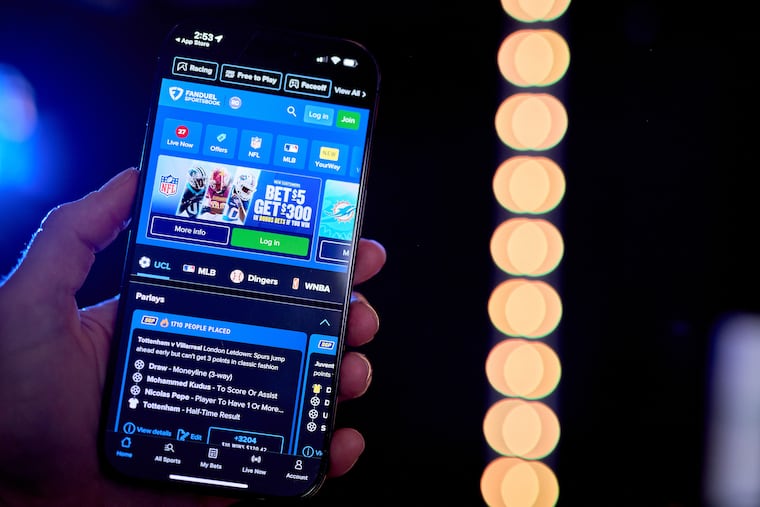
FanDuel and DraftKings have each asked a Philadelphia judge to dismiss a lawsuit that accuses the companies of profiting from practices that two bettors say caused them to develop gambling addictions.
The sportsbook operators, as well as the National Football League and the data company Genius Sports, were sued in March by the nonprofit Public Health Advocacy Institute on behalf of Terry Thompson and Christopher Sage, men from the Philadelphia suburbs who allege that they compulsively placed in-game microbets through FanDuel’s and DraftKings’ apps and were enticed to continue gambling by rewards that VIP managers offered, even after they displayed signs of addiction.
But attorneys for FanDuel and DraftKings argue that the lawsuit — which claims that the companies violated Pennsylvania’s consumer protection law, and were negligent in protecting Thompson and Sage from harm — is inherently flawed, according to preliminary objections that were filed July 15 in Common Pleas Court in Philadelphia.
“Courts around the country, including courts that sit in this Commonwealth, have held that there is no duty of care to protect customers from their own lawful wagering, even where such wagering is alleged to be compulsive,” wrote attorney Erin L. Leffler, who represents FanDuel.
Thompson, of Montgomery County, placed his first bet with FanDuel in 2020 and went on to lose nearly $1.8 million, his lawsuit alleges. He planned to die by suicide earlier this year rather than confess the scope of his losses to his family, the lawsuit says.
Sage, of Delaware County, began wagering with DraftKings in 2019 and eventually lost about $175,000. To fund his gambling, he alleges, he stopped making payments on his mortgage and truck, and borrowed money from loan sharks.
Lawyers for FanDuel and DraftKings wrote that Thompson and Sage knew about their addictions for longer than the state’s two-year statute of limitations for product liability lawsuits.
Yet the sportsbooks contend that they should not even face product liability claims, because they do not sell an actual product but instead offer customers a free online app.
The Public Health Advocacy Institute declined to comment Monday.
The lawsuit attracted national attention following a July 9 Inquirer report that revealed Bryttanni Morgan, a FanDuel VIP manager, had sent a personalized video of Phillies first baseman Bryce Harper to Thompson in November 2024. (Morgan, who is named in the lawsuit, was also a VIP manager for Sage.)
Harper later wrote on Instagram that he had recorded the message through the paid video service Cameo but had not known that FanDuel intended to use it as a reward for a VIP gambler who had an addiction.
The Phillies star is not named in the lawsuit. The Pennsylvania Gaming Control Board — which regulates casinos, online gambling, and sports wagering — has said it is reviewing the Harper video.
FanDuel and DraftKings, in their preliminary objections, suggested that Common Pleas Court Judge Gwendolyn N. Bright could pause the case to allow the gaming control board to evaluate elements of the case that fall under its regulatory purview, like in-game microbets.
The board has not yet reviewed the court records, a spokesperson, Doug Harbach, wrote in an email Monday.
“With that said, the PGCB’s role as the regulator of gaming in the Commonwealth is, first, to make sure that all persons and entities licensed by us to engage in that activity have and maintain suitability through a showing of ongoing good character, honesty and integrity,” he said.
One of the defendants, London-based Genius Sports, licenses official statistics and data from the NFL, the NCAA, and other leagues, and supplies that information to betting markets. The company also earns commissions on gamblers’ microbets, Thompson’s and Sage’s attorneys have alleged, a revenue stream that reached more than $125 million in 2025.
In addition to licensing its data to Genius Sports, the NFL has also owned as much as 8.7% of the publicly traded company’s stock, making it Genius Sports’ largest shareholder.
Genius Sports and the NFL are also seeking to have Thompson’s and Sage’s lawsuit dismissed.
Attorneys for Genius Sports wrote that the company is “merely an upstream data supplier” and has no control over sportsbook apps.
The NFL argued that the court has no jurisdiction over the league, which had no “relevant contact of any kind” with the plaintiffs.
Other possible resolutions
In a separate court filing, FanDuel’s attorneys argued there is a more proper path to resolving the case.
“This dispute belongs in arbitration, not in court,” the lawyers wrote.
After creating accounts with FanDuel, Thompson and Sage each agreed to the company’s terms and conditions, which require customers to resolve complaints through mandatory, multistep arbitration.
“The arbitration agreement was not hidden in the terms,” reads part of the response to the lawsuit. “It was prominently disclosed at the outset.”
FanDuel successfully argued for arbitration earlier this year in the Southern District of New York, where a former Jacksonville Jaguars executive, Amit Patel, sued the sportsbook operator for $250 million, claiming it worsened his gambling addiction, according to a report in Sportico, a sports business web site.
Patel was sentenced in 2024 to more than six years in federal prison for embezzling more than $22 million from the Jaguars. He used some of the money to place online wagers.
FanDuel later agreed to pay $5 million to the NFL, in “the interest of being a good partner with the league,” ESPN reported.
The Inquirer will continue to report on issues related to the growth of gambling addiction — among teens and adults — across Pennsylvania. If you or someone you know would like to speak with a reporter, please contact David Gambacorta or William Bender at dgambacorta@inquirer.com or wbender@inquirer.com

The Inquirer’s journalism is supported, in part, by the Lenfest Institute for Journalism and readers like you. News and editorial content are created independently of The Inquirer’s donors. Gifts to support The Inquirer’s high-impact journalism can be made at inquirer.com/donate. A list of Lenfest Institute donors can be found at lenfestinstitute.org/supporters.
