Philly Haitians and allies march to demand protections as TPS expires
Protections expired for an estimated 350,000 Haitians, putting them at risk of deportation to a shattered homeland.
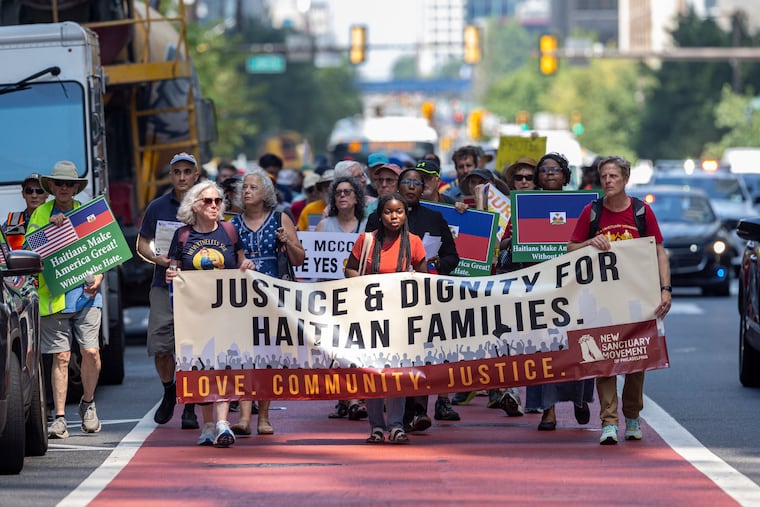
Dozens of Haitians, allies, and supporters rallied in Center City on Thursday, demanding that Pennsylvania’s U.S. senators help restore temporary protected status (TPS) for thousands now in danger of being deported to the shattered Caribbean nation.
They gathered outside the office of Republican U.S. Sen. Dave McCormick near 20th and Market Streets, then marched to the office of U.S. Sen. John Fetterman, a Democrat, near Second and Chestnut Streets.
People held up signs that said, “Our Haitian community is here to stay,” even as protections and work permits have ended for about 350,000 Haitians in the U.S. The Haitian community numbers about 11,000 in Philadelphia, and leaders say it seems everyone knows someone who had TPS or has it themselves.
Speakers said that TPS is more than an immigration status, that it is what allows neighbors, friends, and family members to live here, to work, pay taxes, and help build the country.
They called on the senators to help pass Senate Bill 4814, which would require the secretary of the Department of Homeland Security to designate Haiti for TPS through April 2029.
A spokesperson for McCormick said: “We respect everyone’s right to come together and voice their opinion. We appreciate the input.”
Efforts to reach a spokesperson for Fetterman were not immediately successful.
Pastor Kenel Stevenson said he knows of no local Haitians who have been taken into custody by U.S. Immigration and Customs Enforcement, or fitted with ankle monitors, as the ACLU says is happening elsewhere.
But the mood among his fellow Haitians is grim, he said.
“There is fear, fear of repatriation, of being returned to a place where there is no safety,” Stevenson said.
Nearly 100 people gathered before moving east toward Fetterman’s office shortly before noon, filling the breadth of Chestnut Street as police officers stopped traffic for the group to pass. Oppressive heat and humidity caused some older people to lag.
TPS has expired for an estimated 350,000 Haitians, ending their ability to legally work in this country and putting them at risk of deportation to a homeland riven by natural disaster and violent crime.
The Rev. Frantz Ulysse, pastor of the First Haitian Church of God of Prophecy in Olney, said fear and uncertainty are not things he expected his parishioners to feel on American soil.
He searches himself to offer hope at a moment when people are desperate for some sense of tranquility.
“I had a mother called me the other day and asked if I could take custody of her child if she’s taken away,” Ulysse said.
Community leaders fear mass family separation, as Haitian nationals have married U.S. citizens and are raising American-born children.
“We are not criminals,” he said. “We have engineers, doctors, professors,” people who are eager to help and contribute.
“If people go back to Haiti, they will die, and if they stay as things are, they are in hiding, scared, and can’t leave their house,” he said, joining others outside Fetterman’s office.
Still, he said, he has not given up hope.
“America is a country of immigrants, and I believe they will stand with us,” Ulysse said. “Help us fight until the end!”
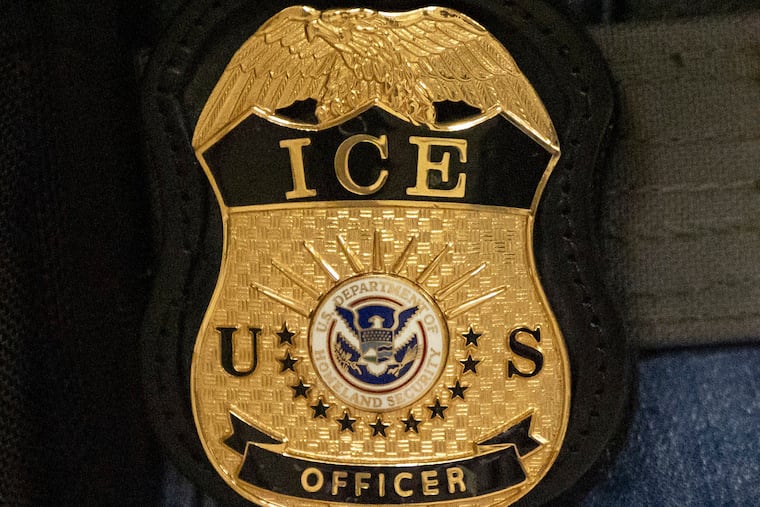
Hundreds of Haitian nationals have been told by immigration officials to appear at ICE offices to be fitted with ankle monitors, according to the ACLU.
Temporary protected status provides permission to live and work in the United States for people whose homelands are riven by war, natural disasters, epidemics, or other extraordinary circumstances.
Haiti suffered a massive earthquake in 2010 that led the Obama administration to announce that undocumented Haitian immigrants in the U.S. would be eligible for TPS. Thousands more would be welcomed over time under humanitarian programs and become eligible as Haiti grew mired in crisis ― a deadly cholera epidemic, hurricanes, the collapse of basic government functions, and the rise of armed gangs.
Haitian American pastor Ketty Pointe-Jour said Thursday that her immigrant parents would not believe what is happening today.
They fled Haiti for their lives, she said, and “the U.S. opened its arms for them. The America they knew in the ’60s and ’80s is completely different from what we are seeing now.”
The Trump administration has sought to end TPS for Haiti and other nations. In June, the Supreme Court ruled that the administration could terminate temporary protected status for countries like Haiti and Syria.
More broadly, the ruling appears to make Department of Homeland Security decisions about TPS unreviewable by lower courts, creating deep uncertainty for the future. The White House has pledged to deport people who lose legal status, including those who had TPS.
Haitians are not the only population affected.
TPS is set to lapse for more than 170,000 people from El Salvador in September, and in October 100,000 from Ukraine face the same termination.
Advocates say the Trump administration’s promise of deportations will hurt families that include spouses and children who are American citizens.
What is more, immigration researchers and organizations say, the country will pay a financial price ― in lost taxes, wages, spending, and services, as large numbers of workers and dollars exit the U.S. economy.
The nation’s 1.3 million TPS holders work at higher proportions than the country as a whole, pay billions of dollars each year in federal and local taxes, and contribute to the solvency of a Social Security system from which they are unlikely to ever draw benefits.
Outside Fetterman’s office, Dottie Baumgarten said she came from her Cheltenham home to support the Haitian community. She hoped the presence of supporters helped immigrants feel less alone.
“The Haitian challenge is not just Haitians,” she said, “it’s immigrants in general, and we have to support them. We are destroying their families.”