The people vs. Elon Musk | Editorial
The midterm elections pit voters’ discontent with Trump and Republicans against unprecedented spending by the superrich.
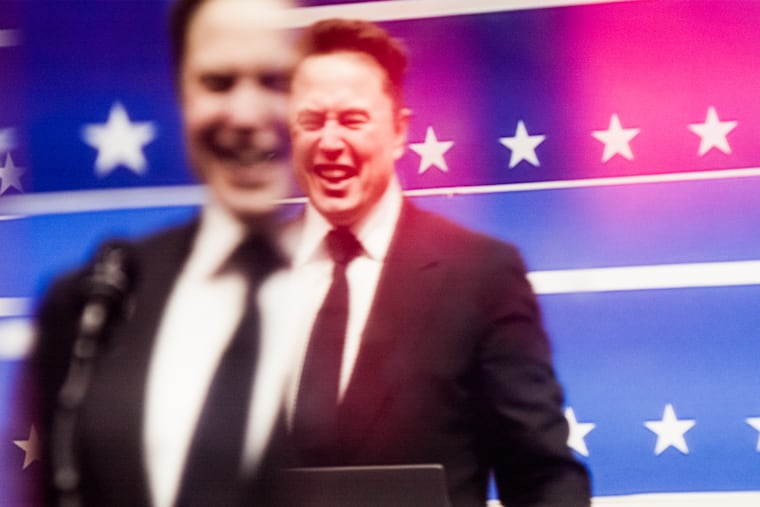

Every available indicator suggests Democrats have the American people on their side in the coming election. As for Republicans, they have Elon Musk.
The world’s richest man has spent at least $445 million for Republicans in the midterms, which is approaching the annual budget of Bucks County. After spending $290 million to return Donald Trump to the presidency, Musk has upped his investment by more than half in an effort to mitigate the president’s political reckoning for high prices, an unpopular war, rampant corruption, and more. These are obscene figures, reaching a clip of more than $3 million a day in recent months. And yet, with a personal wealth thousands of times greater than his peak political generosity — thanks in no small part to government contracts, subsidies, and tax breaks — the Tesla and SpaceX mogul could continue such spending indefinitely.
This is a culmination of the pernicious combination of the country’s increasingly extreme concentration of wealth and a half-century of U.S. Supreme Court rulings unleashing those riches on our politics. These twin troubles perpetuate each other: The superrich spend more and more to elect a government that, in turn, does more and more to make them richer. And the cycle repeats.
» READ MORE: The Inquirer’s 2026 General Election Endorsement Guide | Opinion
Musk has now spent more on American politics than almost anyone, including George Soros, an eternal bogeyman of the right; his fellow billionaires Michael Bloomberg and Tom Steyer squandered more but did so on their own abortive presidential campaigns. That makes Musk single-handedly responsible for the GOP’s entire outside spending advantage in this campaign. And apart from Republicans’ structural upper hand in the Senate and success in gerrymandering House districts, that is the only advantage they have.
So what does Elon want in return? For one thing, more government money and less government regulation. Musk’s companies have enjoyed at least $38 billion in government contracts and other direct public subsidies over the last 20 years, according to a Washington Post analysis. He also stands to reap enormous benefits from the Trump administration’s laissez-faire approach to artificial intelligence despite dire warnings about its dangers.
But Musk has ideological interests of a sort, too, chief among them a virulent bigotry toward racial minorities, immigrants, and trans people. His compulsive posts on his social media platform reveal a preoccupation with white supremacist notions, which he translated into deadly federal policy by eliminating foreign aid during his disastrous stint as Trump’s so-called government efficiency czar. That any man can wield such influence over a major political party is troubling; that this man can is downright frightening.
» READ MORE: President Trump’s desperate campaign to buy off voters | Editorial
The Supreme Court began to ordain this state of affairs with its 1976 ruling in Buckley v. Valeo, which equated individual political spending with constitutionally protected speech. The justices dramatically exacerbated the problem with their 2010 ruling in Citizens United v. FEC, which freed corporate and union spending and led to unlimited contributions through super PACs and more opaque groups. The avenues for wealthy people and interests to influence government have only proliferated under today’s conservative-controlled court, which is more likely than any to strike down every attempt to restrain the flow of money into politics.
Despite this cycle’s resulting avalanche of spending in Republicans’ favor, however, the ruling party’s prospects appear to have continued to deteriorate. It’s not clear that all of Musk’s money has clinched the case for any candidate, but it is a powerful argument for reforming our highest court and restoring a measure of financial and ethical sanity to our politics.
About our editorials
Editorials express an opinion about a matter of policy or public interest that has been researched and written by our Editorial Board, a group of journalists separate from the newsroom. Unlike news stories, which are fact-driven and written by reporters, editorials advocate, champion, argue, critique, and offer solutions. Editorials are not intended to dictate what readers should think, but to cut through the noise of polarized debate and provide a catalyst for elevated discourse.