Top aviation officials were traveling when flights were halted nationwide
The FAA has still not announced the exact cause of the technical disruption, but what was supposed to be a single, routine upgrade somehow stymied the nation’s air traffic control system.
Hundreds of thousands of travelers were hobbled when the Federal Aviation Administration called a halt to flights nationwide on Nov. 13.
Among those caught up in the stoppage — either in the air at the time or having just flown — were top transportation officials and contractors involved in addressing the problem.
The fact that they, too, were in transit highlighted what everyone learned firsthand that Friday: Busy weekend travel days can be a bad time to try to fix aging aviation technology.
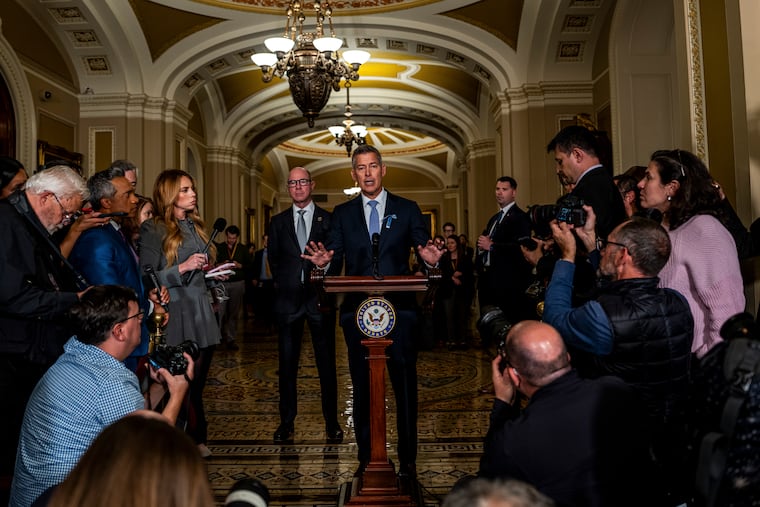
Transportation Secretary Sean Duffy, who oversees the FAA, was himself midflight, en route to Washington after visiting vendor facilities in Texas.
“I was on the airplane, an airplane from Dallas when this happened, hence my attire, and haven’t gone to change, so I apologize for wearing a jacket and jeans with you,” Duffy said during a White House news conference later that day.
Duffy has been pushing through air-traffic control upgrades at a speedy pace to complete them by the end of President Donald Trump’s term. The FAA, under Duffy’s watch, has come under criticism for authorizing the work that led to the stop in the middle of a Friday, a time of week when air travel typically spikes.
Aviation experts previously told the New York Times that such upgrades had historically been performed overnight or during midday periods when fewer planes are flying — and not on Fridays — in case something goes wrong.
And something went seriously wrong on that Friday, Nov. 13.
The FAA has still not announced the exact cause of the technical disruption that led to the longest stop of U.S. air travel since the terrorist attacks of Sept. 11, 2001. But officials have suggested it happened after a technician for L3Harris Technologies, a contractor working on the modernization project, installed a new router at an FAA facility in El Dorado, Ark.
What was supposed to be a single, routine upgrade somehow stymied the nation’s air traffic control system.
The situation, which caused the cancellation of thousands of flights and disruptions that extended throughout the weekend, has prompted finger pointing between transportation officials and the vendor about who was to blame for the initial problem and whether it was remedied quickly enough.
Officials at the FAA have questioned the staffing levels at L3Harris’ Melbourne, Fla., headquarters and requested a list of employees who were physically present at the facility during the incident, according to four people familiar with their correspondence who requested anonymity to discuss internal matters. L3Harris sent them staffing information in response.
In a statement, L3Harris said that it had been fully staffed that day and had responded quickly and appropriately to the FAA to help resolve the issue.
While many important details of the events of that day are still not known, the following is an account of what transpired immediately after the FAA realized it might have an issue on that frantic Friday.
L3Harris, a large defense contractor, is responsible for maintaining the networks that facilitate communications between air traffic controllers and pilots. Many parts of the nation’s air traffic control system are obsolete, and the company is in the midst of upgrading copper wire to high-speed fiber optic cable.
Shortly after completing about five hours of work that day, the L3Harris technician in El Dorado who was installing the router noticed a problem, said two people familiar with the matter.
Because the L3Harris employee had been approved to do the work at the facility and an FAA official on site was not expected to provide detailed supervision of the job, the L3Harris worker called his company’s headquarters in Florida to request assistance, those people added.
Kaitlyn Arena, a spokesperson for L3Harris, said that the FAA had approved the timing of the work at El Dorado after conducting its own operational risk assessment.
As the technician was reaching out to L3Harris’ headquarters around 3 p.m. Eastern time, the FAA’s air traffic command center in Warrenton, Va., detected that its communication system was being overloaded.
The FAA feared the glitch meant that air traffic controllers could not effectively guide pilots while they were flying, though in the end officials never completely lost communication and the systems outages, while widespread, did not engulf the entire system.
Leaders at the command center in Warrenton called an emergency meeting with top officials at the FAA, including Bryan Bedford, its administrator, and Franklin J. McIntosh, who runs the agency’s air traffic control division.
Bedford and McIntosh had just completed their own weekend travel to their respective homes in Indiana and Texas, said three people with knowledge of their movements who requested anonymity because they were not authorized to speak publicly.
The leaders also reached out to Duffy, who was in the air.
From their respective locations, Duffy, Bedford, and McIntosh participated in an initial emergency call at 3:45 p.m. with leaders at the command center, minutes after controllers there noticed the widening problem.
During that virtual meeting, the Warrenton officials explained the situation and their determination that a nationwide flight stoppage had to be issued to protect passengers and crews — an assessment with which Bedford and Duffy agreed, according to two transportation officials.
The nationwide halt was enacted at 3:54 p.m. Planes continued to land but new flights could not take off. Airlines’ call centers were quickly flooded with desperate customers, trying to rebook.
L3Harris was not involved in the decision to halt flights but was quickly brought into discussions to resolve the situation.
Coincidentally, two senior L3Harris executives on the FAA contract were also in the air at that time.
Kathy Crandall, president of the company’s mission networks division, and Chris Collings, vice president and general manager of managed services, were both on long-haul flights back to the United States from a business trip in Australia, said people with knowledge of their movements who requested anonymity to discuss confidential matters.
They joined calls with FAA officials when they landed.
Arena, in the statement, declined to discuss the executives by name, but said that the FAA had reached a L3Harris senior leader with decision-making authority “immediately” by phone and another joined a call with the FAA within a minute of receiving an invite.
Isolating the source of the problem in order to get planes back in the air safely was a prolonged process among government officials and L3Harris employees. Officials from both the FAA and L3Harris say their staffing was sufficient to tackle the problem, even though it took several hours to resolve.
L3Harris officials said that their network operations center — a round-the-clock monitoring facility the company operates in Melbourne — was at full strength.
Senior company executives — including the CEO, Sam Mehta — were at the network operations center in Melbourne “immediately after being notified of the issue,” Arena said.
The company also brought in additional workers to help manage the situation, two people with knowledge of what happened said.
Over the next few hours, officials managed to identify and isolate two facilities in Arkansas and Texas that had been overloading the network and disable the misconfigured routers, allowing them to bring the air traffic network back online, FAA leaders told reporters.
At 8:15 p.m., the ground stop lifted, and flights began to take off again.
This article originally appeared in the New York Times.