Pope Leo leans into statesman role, urging peace in an era of renewed war
Leo is also being seen by some as the pope that many believe the cardinals who elected him had hoped for — a plain-talking, Chicago-born counterweight in an era of unbridled American power.
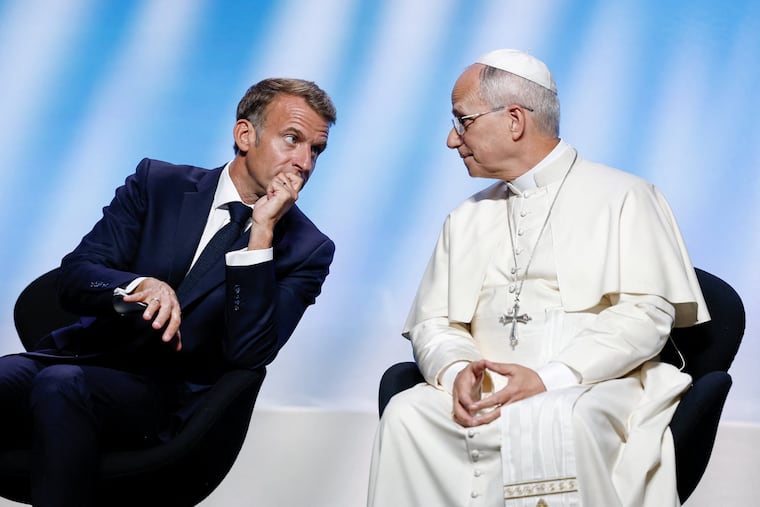
METZ, France — Pope Leo XIV capped a four-day trip to France in the intellectual birthplace of the European Union, heralding its success at “tearing down walls that were dividing it” and leaning into his role not only as spiritual leader of 1.4 billion Catholics but as an increasingly influential statesman.
In back-to-back addresses delivered symbolically in a conference center named after Robert Schuman, the late French foreign minister who was a founding father of the European Union — and now a candidate for Catholic sainthood — Leo struck what has become his trademark: a balanced tone on hot-button issues like migration that seem to leave interpretation to the beholder.
He was less equivocal on religious freedom, the importance of international law and multilateralism, and his deep distaste for invoking God’s name for the purpose of war. Leo spoke in a part of Europe — near the once violently disputed border with Germany — where Schuman championed continental integration as a binder of lasting peace.
At a time when President Donald Trump has pressed NATO allies into ramping up military spending, Leo acknowledged that “the search for peace in Europe, as throughout the world, must not be confused with a naive form of pacifism.” But he also warned against “the illusion that rearmament is the answer.”
During tours of Africa and Spain in April and June, Leo — who initially seemed uneasy with fame — emerged as a confident and emotive spiritual leader capable of moving throngs.
During his trip to secular France, the U.S.-born pope did just that in Paris, Lourdes and Metz, including drawing 800,000 faithful for an outdoor Mass on Saturday, the largest crowd in the capital since France’s World Cup victory in 2018. The night before, Leo, the 71-year old leader of a two-millennia-old faith, managed to easily pack a stadium with 80,000 roaring youth.
Yet more than on some of his other trips, a different pope was also on display in France: Leo as an emerging elder statesmen.
“We’re now dealing with a pope I’d describe more as a diplomat,” said Claude Dargent, a Paris-based expert on religion and politics.
Leo is also being seen by some as the pope that many believe the cardinals who elected him had hoped for — a plain-talking, Chicago-born counterweight in an era of unbridled American power.
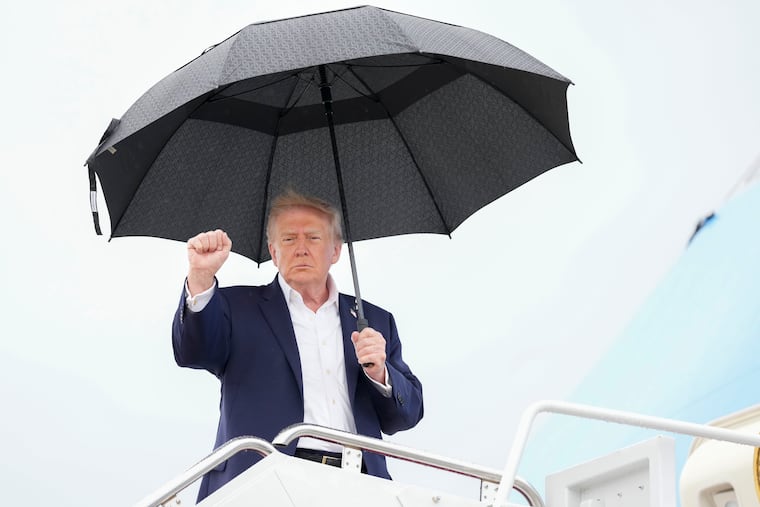
In April, when President Trump openly criticized the pope as “WEAK on Crime, and terrible for Foreign Policy,” Leo appeared unbowed, saying he had “no fear.” But he has since sought to lower the tone and refrained from fanning the flames of a feud with the White House.
Instead, he has taken to challenging the notion of “might-is-right,” and offering an alternative world where kindness, generosity and, above all, human dignity hold sway.
He calls it our “common humanity.”
Days after Trump skewered the United Nations and spoke of victors taking spoils, Leo addressed UNESCO — the UN’s cultural agency in Paris — to rousing applause. He spoke of the horror of war and the glory of peace. He reiterated the risks of artificial intelligence, as he did in his first major Encyclical, raising red flags at a time when Trump has defended its breakneck advancement.
At a time when Venezuela is under the thumb of Washington, and Moscow is waging war in Ukraine, Leo condemned the quest for “domination” and the rise of modern “neocolonies” of powerful nations. In France, where nationalist Marine Le Pen is polling first in next year’s presidential election, Leo warned of creeping authoritarianism in the free world.
“A truly free society does not impose uniformity but protects the diversity of consciences, preventing authoritarian tendencies and promoting an ethical dialogue that enriches the social fabric,” Leo said.
In Metz, he doubled down on a point for which the White House has taken him to task: his claim that “God’s name” can never be used to “justify violence or oppression.” He reiterated his fears over the erosion of international law.
“International law and multilateralism emphasize the genuine equality of States in their relations and constitute the best antidote to the desire for domination, which lies at the root of every conflict,” Leo said. “Today, relations between individuals and States are becoming increasingly uncivilized. The value of keeping one’s word is dismissed; instead, people boast of lies and deceit.”
He spoke of a new European transformation through waves of migration. He reiterated earlier backing for legal pathways, and improving conditions in origin countries to inhibit migration. But he also called for integrating newcomers as if they were “part of one’s own family” and offering them opportunities.
French President Emmanuel Macron, who was at the speech in Metz, had invited leaders from the E.U.’s other 26 member nations, though few appeared to have accepted. The prime minister and grand Duke and Duchess of Luxemburg attended, as did the head of a German state, Anke Rehlinger, minister-president of Saarland, the Élysée Palace said.
The crowds in France, though perhaps slightly more reserved than those in neighboring Spain, were often young. In Paris, a smattering of nonbelievers joined the faithful in cheering the pope. At a university event in central Paris on Saturday, three young men — none Catholic or even religious — whooped for Leo, fanboying over a pope that one of them described as the American the world “needs.”
“For us in France, it is important that we have an American saying these things, you know, an American with a wonderful message of peace who speaks so many languages, and who, you know, is speaking this truth when we have the insanity of Trump,” said Robin Pitrat-Demurger, 21, a Paris political science major.
“I am here because I want to hear him and see him,” Pitrat-Demurger continued. “But also because I am happy to hear an American say these things, and to know that other Americans might listen to him because he is one of them.”
As is customary in papal trips, there was pageantry, especially when Leo became the first pope to view the restored Notre Dame Cathedral following its devastating 2019 fire. He joined a high procession dressed in gleaming white and gold. As incense swirled and thunderous organ music played, he venerated a relic said to be the crown of thorns at the crucifixion of Jesus.
In Lourdes, he comforted the sick and elderly who seek miraculous cures in a city where a 19th century miller’s daughter is said to have witnessed apparitions of the Virgin Mary. He said Mass for 150,000 pilgrims, and later met individually and collectively with seven carefully selected victims of abuse by clergy. Several of the victims praised Leo after the exchange.
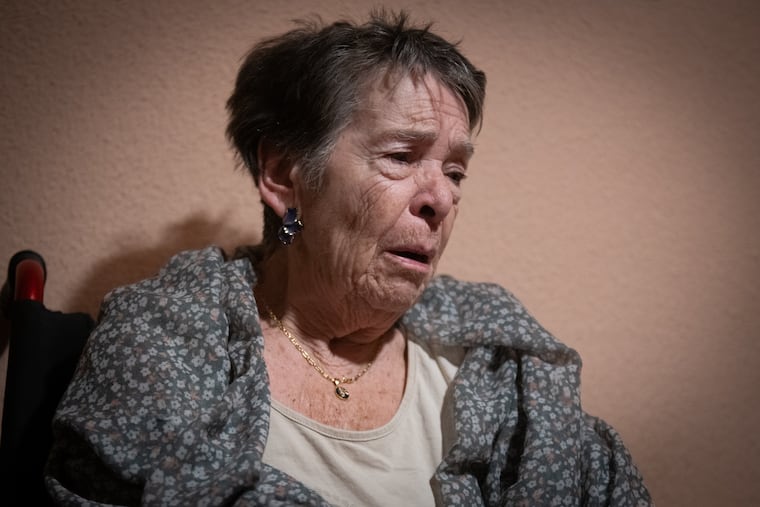
At an event at a hospital, rows of disabled people in rickshaw-like wheelchairs hung hopefully on the pope’s words, some of them in tears.
MAGA influencers have dubbed Leo the “woke pope,” but in France, if anything, he was seen as the opposite, at least on social issues.
In Paris, he spoke up for conservative Catholic principles not always popular in secular France, taking aim at surrogacy and the country’s recently passed euthanasia law — calling it an industry built around “arranging one’s own death.”
He did so in a manner that was described by some in the French press as astutely aware of French identity and self-perception. Perhaps it was genetic. Leo spoke fondly of his familial roots in Normandy and Béarn.
“He said some things that he doesn’t like in France and I feel like it’s important, because a pope can’t always have a speech everyone agrees with, but he does it in a gentle way,” Zoe le Barzic, a history major at the Catholic University of Paris who came to hear Leo. “There is so much division right now. I don’t think he wants to add to it. He is being very diplomatic.”
Yet Leo has not shied away from all comments on American politics, albeit treading lightly and seemingly going there only when pressed by the media.
Asked on the papal flight to Paris about Trump’s decision to ban CNN and other news outlets from the White House, Leo told reporters: “I’m very happy that here, you are all welcome. And good coverage. I think it’s very important that we have it all the way around for everyone.”