ICE arrest of a Princeton scholar mobilizes academics, sparks fear of the U.S.’s ability to attract top talent
The arrest has triggered a broader conversation about the negative impact that many say President Donald Trump’s mass deportation plans have on drawing international talent at universities.
“Please help.”
That was the message Eva Yi Xie sent her colleagues at the Brody Lab at Princeton, when U.S. Immigration and Customs Enforcement agents arrested her at Ronald Reagan Washington National Airport Thursday.
Xie had been in Washington, D.C. to present her work at an annual meeting hosted by the Society for Neuroscience. Her arrest caught her colleagues by surprise.
Even so, her plea was quickly answered.
The Princeton community sprang to action even before the specifics of Xie’s case were known — her visa expired, but she has a pending asylum application that her attorneys contend allows her to be in the United States legally.
The university arranged legal counsel for Xie, who’d been taken to a short-term processing center in Chantilly, Virginia. Meanwhile, academics like Carlos Brody, leader of the Brody Lab and professor at the Princeton Neuroscience Institute, took to social media and spoke to reporters to draw attention to Xie’s detention.
“She came to us from [the Massachusetts Institute of Technology] and she arrived here and immediately started publishing papers and accomplishing things at tremendous pace,” he said on a call. “She is also an extremely warm-hearted person and is someone that will clearly contribute to the U.S. so much.”
Xie’s arrest has triggered a broader conversation in academic circles about the impact many say President Donald Trump’s mass deportation plans have on drawing international talent to U.S. universities.
By late Friday, a federal judge had blocked any potential plans to transfer Xie out of the district — rapid moves across judicial districts can create gaps in communication between attorneys and clients.
Xie’s attorneys challenged the legality of the arrest in a habeas petition. Senior U.S. District Judge Anthony J. Trenga ordered the government to respond by 5 p.m. Wednesday.
Kerry Doyle, one of the attorneys representing Xie, said the neuroscientist first came to the United States from China in 2016 and overstayed her visa. But Xie’s asylum application has a hearing date set for 2028 — a typical wait due to backlogs in the court system.
In the past, a pending asylum application generally protected someone from arrest unless there was a final order of removal. But immigration attorneys like Doyle note ICE has increasingly targeted people with pending petitions for relief under the Trump administration.
“They’re just flagging people for this and it’s illegal and improper for them to be arresting people randomly because they’re visa overstays who’ve had pending applications, who followed all the rules, who don’t have any criminal issues,” said Doyle.
A U.S. Department of Homeland Security spokesperson disagreed, writing Xie was supposed to be in the country on a temporary basis and was required to leave September 2016, six months after her initial arrival.
“Xie has NEVER held valid authorization to study in the United States,” said the spokesperson. “To be clear, a pending application does not confer legal status in the United States.”
Increased ICE arrests at airports
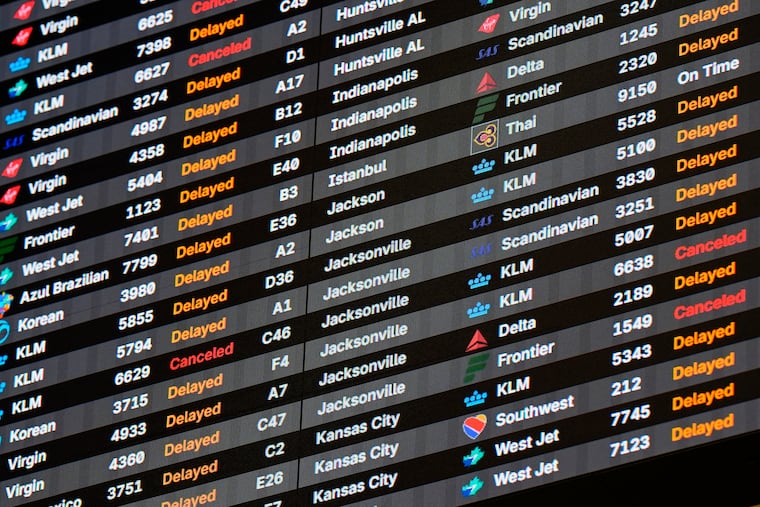
ICE began arresting people with expired visas in at least 15 airports over the summer, using information provided by the Transportation Security Administration. These arrests have become the subject of protests in places like Philadelphia International Airport where at least 50 people have been detained since July, according to activists.
The airport arrests have also been a cause of frustration in places like Nevada, where Democratic U.S. Sen. Jacky Rosen says ICE activity has disrupted tourism. This week, Rosen and U.S. Sen. Alex Padilla (D-Calif.) introduced a bill that aims to curb ICE activity at and around airports without a judicial warrant related to a felony criminal conviction. It would also limit information sharing between ICE and TSA unless there’s a specific warrant.
A spokesperson only reiterated DHS’ plans to continue airport operations in a statement.
“DHS reversed the horrendous Biden-era policy that allowed aliens in our country illegally to jet around our country,” said the spokesperson. “Under President Trump, DHS will no longer tolerate this.”
The administration’s doubling down on its mass deportation plans comes at a time when universities say they’re seeing increasingly stringent immigration policies discourage international student enrollment.
The Institute of International Education released a survey this week of more than 800 universities that found a 9% enrollment drop compared to this time last year with 88% of participants blaming the visa application process.
“Incidents like these send a clear signal to talented scientists around the world: do not come to America, or you will risk the threat of being thrown indiscriminately behind bars,” said New Jersey Sen. Andrew Zwicker, a Democrat representing Princeton, in a statement.
Brody agrees, likening attracting academic talent to building a winning sports team.
“If you’re in Philadelphia and you’re trying to build a world-class team, you don’t recruit only from Philadelphia, you recruit whoever the best people are,” said Brody. “In American science, that’s what we’re trying to do. We’re trying to do the best science in the world.”