Navy weighs major warship redesign to match Trump’s preferences
With midships towers and steam-powered catapults, the warships the president envisions would resemble those used during World War II and cost billions.
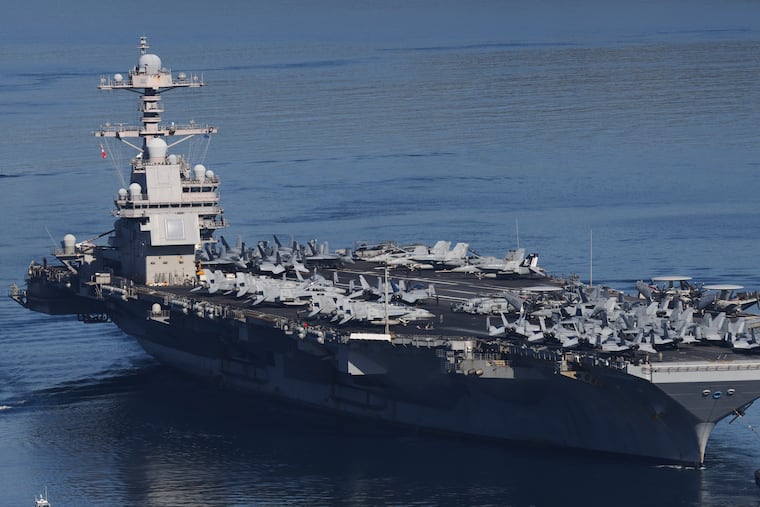
The U.S. Navy is considering a major redesign of its new aircraft carriers to better match President Donald Trump’s preferred aesthetic for the warships, according to seven current and former U.S. officials familiar with the matter.
The service is evaluating the feasibility of moving the multistory tower that acts as the carrier’s command center farther forward, toward the middle of the ship, to resemble older vessels, the officials said. The review, which has not been previously reported, is in response to Trump’s concerns about the “look” of the new Ford-class ships, where the tower is near the rear, these people said.
The timing and extent of the Navy’s evaluation is unclear, with current and former officials cautioning that the service was concerned that such a change would require significant time and money. Like others, they spoke on the condition of anonymity to discuss a sensitive situation.
Moving that command center, known as the “island,” would be the second major design change prompted by the president, who on Thursday issued a national security memorandum directing the Navy to develop a plan to revert to older steam-powered catapults on future carriers. The systems help launch jets off the ships’ flight decks.
Trump’s preference, current and former officials said, is for the new aircraft carriers to look more like those that were in service during World War II.
The Navy also examined the issue during his first term as president, said a former senior U.S. official. A study found that moving the island could cost billions of dollars in redesign costs and significantly delay the program, this person said.
“It came back that the cost and time to do so would just be extraordinary,” the former official said.
There are three Ford-class carriers in various stages of development. The USS John F. Kennedy is undergoing sea trials and getting closer to joining the fleet while the USS Enterprise and USS Doris Miller are under construction. The first carrier in the class, USS Gerald R. Ford, is already in service and recently finished a lengthy combat tour in the Middle East.
Plans call for building up to 10 Ford-class carriers over the next four decades, at a projected future cost of $22 billion each, according to the nonpartisan Congressional Budget Office and the Navy’s most recent shipbuilding plan.
Relocating the island would be “a major redesign,” said Bryan Clark, a former Navy officer who studies the service at the Hudson Institute, a right-leaning think tank in Washington. Such an alteration to the carrier’s layout, he said, would affect the ship’s buoyancy and weight and come at a significant cost.
“You could change it,” he added, “but it’s very disruptive.”
The Pentagon and the Navy referred requests for comment to the White House, which pointed to the new national security memorandum when asked about Trump’s desire to relocate the island on future Ford-class aircraft carriers. The memorandum does not address the issue.
Another U.S. official familiar with both the potential changes to the catapult and the island said that the Navy is taking both matters seriously because of the delays and severe cost overruns they could create.
Trump’s interest in the redesign modification marks the White House’s growing influence over the complex mechanics of naval shipbuilding.
Since returning to office, Trump has promised to “resurrect” the lagging industry, and he has already issued multiple executive orders addressing the matter.
Thursday’s national security memorandum would, among other changes, revert the Ford class’ advanced electromagnetic catapult system to steam power. The document emphasizes the administration’s preference for “proven, reliable,, and affordable technologies and ship designs.”
Such a change, multiple officials said, also could run into the billions of dollars and exacerbate chronic delays in the U.S. shipbuilding industry.
The lead Ford-class carrier, the USS Gerald R. Ford, required 17 years to construct. Its design incorporated new technology that led to delays — including the electromagnetic catapult, a feature the Navy has since credited as being highly effective.
The Ford class of carriers will phase out its predecessor, the Nimitz class, which dates back to the late 1960s.
Relocating the island to the back of the newer vessels was done for efficiency and safety, three U.S. current and former officials familiar with the program told the Post. It not only creates more parking space for aircraft close to the carriers’ catapults, allowing crews to reduce the amount of time it takes to launch jets, it also improves landing safety by reducing the chance for turbulence when planes come back to land, the officials said.
The Navy’s surface fleet has been plagued by years of delayed maintenance and low readiness rates, in part because of how often past U.S. administrations have deployed carriers to confront global crises.
Amid the ongoing Iran war, the Pentagon under Trump has further stretched the readiness of its carrier fleet while surging naval assets to the Middle East to conduct strikes and enforce a blockade of Iranian ports.
The USS Ford itself faced an extended deployment that ended earlier this year after a fire rendered many crew members’ sleeping quarters uninhabitable. Officials also acknowledged that the Navy’s newest carrier experienced problems with the “vacuum collection, holding, and transfer” system that supports hundreds of toilets on board.
Democratic lawmakers this week called on Defense Secretary Pete Hegseth to investigate new reports of rapidly worsening conditions aboard the USS Abraham Lincoln, which has been deployed to the Middle East since November. Families of sailors aboard the Lincoln have been outspoken about the situation, and the Navy is investigating a man-overboard incident it says may be connected to mental health issues.
While speaking to reporters on a trip to Panama on Thursday, Hegseth called the reports “completely misrepresented.”
On Friday, as questions continued to swirl around conditions on the ship and its lengthy deployment, Trump told reporters at Joint Base Andrews that the Lincoln’s time at sea had been “not nearly long enough.”
The Lincoln is on an extended combat deployment that has seen its sailors at sea for 200 days without a port call to provide the crew some rest. It is scheduled to be relieved by the USS George Washington in the coming weeks.
Trump has repeatedly shown interest in the design of Navy warships. Last year he unveiled plans for a new class of battleships to lead his vision for a Golden Fleet, prompting criticism from many naval analysts and lawmakers who argued the ships would waste scarce American shipbuilding power on a design the service does not need.
The Congressional Budget Office has since estimated that the Trump Class battleships would cost about $275 billion over 30 years, coming at a cost of $18 billion per ship after finishing the first one.