Trump officials strip military language criticizing Confederate memorial
The administration has plans to restore a statue removed from Arlington National Cemetery that one retired general called "the most egregious example of racism that they had seen on any public land."
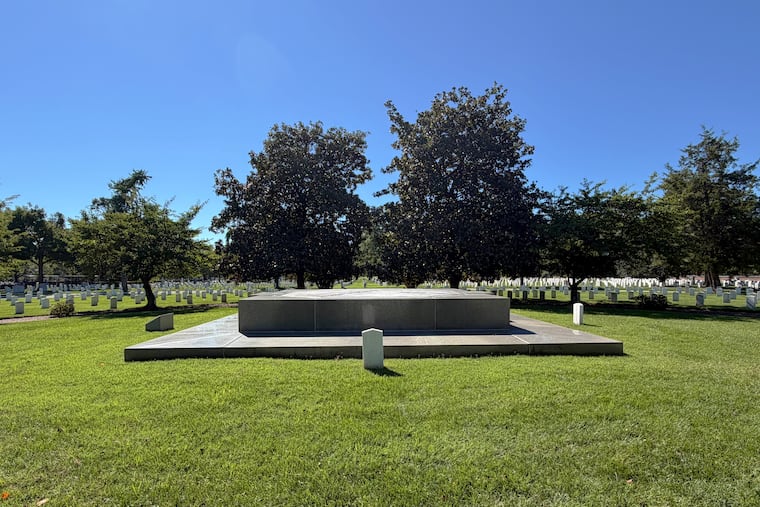
The Trump administration has removed language criticizing a memorial to the Confederacy formerly located in Arlington National Cemetery, part of its ongoing effort to reshape portrayals of the Civil War.
The Confederate Memorial, a 32-foot bronze statue commissioned by the United Daughters of the Confederacy and unveiled in 1914, was removed from the military cemetery in 2023. Its removal followed a congressional mandate to rid U.S. military property of names and symbols honoring the Confederacy and its leaders.
The decision by the bipartisan Naming Commission to remove the statue was based on criticism and backlash over the memorial’s depictions, which included an enslaved woman carrying an infant child of a white officer and an enslaved man following his owner to war.
A Defense Department website and a marker at the memorial’s former site included contextual language describing the sculpture as portraying a “nostalgic, mythologized vision of the Confederacy, including highly sanitized depictions of slavery.” The website also described the two Black figures as enslaved people, including an enslaved woman depicted as a “Mammy,” and it remarked on how the portrayal of the “faithful slave” helped to shape American pop culture.
Now, that language has been removed from the website, and the marker in the cemetery has been replaced by a new sign that omits wording critical of slavery and the Confederacy.
The website also formerly featured additional context about the sculpture’s symbolism, including a Latin phrase inscribed on it.
“An inscription … construes the South’s secession as a noble ‘Lost Cause,’” the website previously read. “This narrative of the Lost Cause, which romanticized the pre-Civil War South and denied the horrors of slavery, fueled white backlash against Reconstruction and the rights that the 13th, 14th and 15th Amendments (1865-1870) had granted to African Americans.”
That language and other text was removed in recent weeks, according to photographs of the sign and archived versions of the webpage.
Asked about the changes to the sign and the website, the Defense Department referred questions to Arlington National Cemetery, which did not respond Monday.
The statue was relocated to the Virginia Military Institute in 2023 amid some congressional GOP opposition. Defense Secretary Pete Hegseth said last year that the statue would be reinstalled at Arlington National Cemetery. Last year, then-Virginia Gov. Glenn Youngkin (R) had said that the statue would return next year.
“The Army expects to display the sculpture at this site in 2027 after it has undergone comprehensive conservation and refurbishment,” according to a new marker in Arlington National Cemetery at the statue’s former site.
Stephen West, a Catholic University historian, said he first noticed that the sign had been changed when he visited Arlington National Cemetery on Sunday.
“The language that used to be on the sign and website described the Memorial correctly. Ezekiel’s sculpture did sanitize slavery, and it did mythologize the Confederacy,” West wrote in a text message to the Washington Post. “And so as a historian, I’m deeply disturbed by the removal of that language and by plans to restore the statue — especially because they’re of a piece with the censoring and slanting of history at other federal sites.”
Trump has previously said he supports efforts to recognize the Confederacy and sees it as a freedom of speech issue.
“When people proudly have their Confederate flags, they’re not talking about racism,” Trump said in a 2020 interview with Fox News. “They love their flag, it represents the South; they like the South.”
The president has decried efforts to remove Confederate statues and worked to reinstall them in his second term.
A statue of Confederate Gen. Albert Pike that was torn down and torched by protesters in 2020 was restored to its original location in downtown Washington in October. And last year the Pentagon ordered that a portrait of Gen. Robert E. Lee in his Confederate uniform be restored to the West Point library. The painting, which had been ordered removed by the Naming Commission, featured an enslaved man in the background tending to Lee’s horse.
Ty Seidule, a retired U.S. Army brigadier general who served as vice chair on the commission, said he was particularly disturbed by the Confederate Memorial’s pending return.
The Confederate Memorial “is the cruelest monument that I have ever seen,” Seidule said in an interview Monday. He said that he and a number of his colleagues called the statue “the most egregious example of racism that they had seen on any public land in America. It is a pro-slavery, anti-United States monument.”
Seidule said the rewording of the marker and the website is the first step the administration is taking before bringing the memorial back to the cemetery. Restoring the monument, he said, would be “against the will of the American people through their elected representatives in the law that they created.”