Who is the federal judge overseeing the case roiling Philly DA Larry Krasner’s office? And what will he do next?
U.S. District Judge Paul S. Diamond has a reputation as a stern, no-nonsense jurist. He is weighing what to do in a controversial post-conviction case marked by accusations of lawyer misconduct.
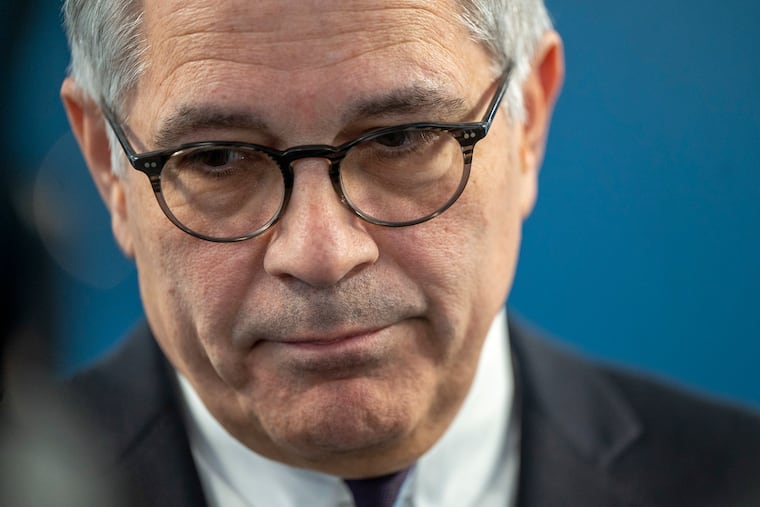
Nearly a decade ago, when U.S. District Judge Paul S. Diamond was asked to determine the fate of a prosecutor who admitted breaking the law, he did not hold back.
Just moments after then-Philadelphia District Attorney Seth Williams pleaded guilty in a public corruption case, Diamond had Williams handcuffed and hauled off to jail to await sentencing.
Then, a few months later, Diamond imposed the maximum prison term allowed by law — five years. And he upbraided Williams as a “criminal” who surrounded himself with “parasites” and “fed his face at the trough” of public money.
Now, Diamond is overseeing a new case with a new set of accusations against a different district attorney.
The allegations against top prosecutor Larry Krasner have come as part of a dispute with staffers over how to handle a case, and Diamond has already made clear that he views the assertions as serious — suggesting in a hearing last month that he believed some could amount to federal crimes.
“If what they say is true, potential wrongdoing abounds,” Diamond said, listing off offenses including perjury, conspiracy, and obstruction of justice.
To some area legal observers, the pointed remarks were reflective of Diamond’s reputation as a stern, no-nonsense jurist — particularly when it comes to assessing the conduct of fellow lawyers.
In the last year, Diamond had a hand in federally disbarring one of Krasner’s staffers and suspending another for three years.
In 2017, while the case against Williams was still pending, he ordered it to proceed to trial just months after the indictment was unsealed — a highly unusual timetable for a federal case, but one the judge said was necessary because of its “obvious and possibly calamitous effect on the city’s criminal justice system as well as the city itself.”
And even in a comparably trivial legal dispute in 2014, Diamond was unabashedly critical of a lawyer who sued over the rights to a song by the R&B artist Usher, writing: “It is difficult to convey the poisonous atmosphere created by [the lawyer’s] continual belligerence.” The lawyer was ultimately suspended from practicing in the region’s federal courts for three months.
Samuel Stretton, a veteran defense lawyer who often handles legal ethics cases, said Diamond “has high standards. And if someone violates, in his mind, those high standards, he takes a very tough position on them and voices that opinion quickly.”
Still, Stretton said he thinks Diamond’s principled views are sometimes expressed in overly harsh ways.
“He has a strong belief in ethics, and lawyers having those especially, and he feels he must enforce them,” Stretton said. “But sometimes his manner of enforcing them is overstated, and he’s abrupt and a little bit of a bully.”
The question now facing Krasner is what actions Diamond might take in the post-conviction case pending in his courtroom — and whether any could lead to consequences for the city’s DA.
Who is Paul Diamond?
Diamond, 73, was appointed to the region’s federal bench in 2004 by then-President George W. Bush. He was unanimously confirmed by the U.S. Senate.
Before his judicial nomination, he spent nearly two decades in private practice. He began his career as an assistant district attorney in Philadelphia in the late 1970s, and graduated from the University of Pennsylvania law school and Columbia University.
While he worked in private practice, Diamond focused on civil litigation, white-collar criminal cases, and disciplinary matters, according to an online biography. And his clients were sometimes unique.
In 1994, he represented a South Philadelphia candy making company that pleaded guilty to safety violations after an unguarded taffy-pulling machine killed one of its workers.
A few years later, he represented Lower Merion Township when the Barnes Foundation sued and accused township officials of using racism and discrimination to try to hurt the foundation. The suit was dismissed, and a defiant Diamond was later quoted in The Inquirer saying he planned to bill the Barnes around $1 million to cover the township’s legal fees.
“This is a claim that should never have been filed; it’s outrageous that it was ever filed, and now the Barnes is going to see the mother of all fee petitions,’’ he said.
A consistently exacting judge
Like all federal court judges, Diamond oversees a mix of criminal and civil cases. And even though not all receive significant public scrutiny, Diamond is viewed by some as a consistently exacting judge.
In 2012, for example, he ordered a 60-year-old grandmother jailed for using her dead mother’s Social Security checks to support her grandchildren.
“Did it ever occur to you to go out and get a job?” Diamond asked the woman. “Did it ever occur to you that the way to help your grandchildren is not to commit a series of endless federal frauds?”
Last year, he was subtly critical of the Trump administration in court documents, writing that it was using competing interpretations of the law to try to justify its policy to detain nearly all undocumented immigrants.
It is “difficult to credit the Government’s squarely contradictory position here,” Diamond wrote.
The Krasner matter that ended up in his courtroom arrived as a routine post-conviction case: Dennis Johnson, who was found guilty of second-degree murder in state court in 2009, filed a petition in federal court seeking to have his conviction overturned.
The petition was filed more than 10 years ago, but it wasn’t until 2022 that the origins of the current controversy would begin to take shape.
A frenzy within the DA’s office
That year, after the district attorney’s office had spent years opposing Johnson’s bid for relief, prosecutors changed course.
Then-Assistant District Attorney Jaclyn Mason filed a brief agreeing with Johnson’s lawyers that his trial counsel had been ineffective. And she said her office had discovered problems or inconsistencies with testimony from key witnesses, leading her to recommend that the conviction be overturned.
The case was first sent to a federal magistrate to review, and Judge Lynne A. Sitarski — relying on Mason’s brief — agreed with her position.
But Sitarski’s recommendation was not binding — the final call would fall to Diamond. And this spring, Diamond signaled he was not inclined to accept the assertions in Mason’s brief. He scheduled an evidentiary hearing to hear testimony that could corroborate — or undercut — the office’s conclusion.
That triggered a frenzied sequence of events inside the DA’s office, prosecutors have since testified.
To prepare for the hearing, Mason’s supervisors in the law division reviewed her brief and found a series of what they called “material misstatements.” They decided they needed to try to withdraw Mason’s filing and apologize to Diamond for the mistakes. And they asked that Mason sign on to the new filing with them.
But Mason declined and resigned. She’s since said she only filed her brief at the urging of her then-boss, Matthew Stiegler, who she said had done nothing to review the case himself but instead was “colluding” with Johnson’s defense attorneys to secure his release from prison.
Mason said she didn’t want to become a scapegoat for Stiegler or the office. And she accused her colleagues of attempting to force her to lie to protect the institution.
Her former supervisors have denied that, saying that once they noticed the errors in her brief, they were ethically obligated to correct the record in front of Diamond.
But as they strategized their approach, they said, they encountered consistent resistance from an unusual source: Krasner.
In their telling, Krasner was ardently opposed to asking the state attorney general’s office to take over the case — something the supervisors generally agreed was appropriate because of the drama surrounding the matter within their office.
And according to the supervisors — Katherine Ernst, Steven Wildberger, David Napiorski, and Peter Andrews — Krasner made a series of notable statements during their discussions, including that he wanted to handle the case in a way that would “protect the office,” that those who didn’t follow his orders would face “consequences,” and that he wanted to keep the matter from the attorney general’s office because he viewed its staffers as “Nazis.”
Several potential paths forward
All of those assertions were aired in Diamond’s courtroom in recent weeks, after the judge decided the evidentiary hearing in Johnson’s case would, for now, focus on the conduct of the prosecutors involved, rather than the merits of his petition. The judge said he’ll evaluate that aspect of the case later.
The attorney conduct portion of the hearing concluded last month, leaving Diamond with several choices about what to do with their startling testimony, legal observers said.
The most immediate issue is whether he’ll allow the DA’s office to continue handling Johnson’s case. Given the dysfunction prosecutors testified to, he could ask the attorney general’s office to take over instead.
But Krasner — who was not called to testify and who has said he can’t comment on the case while it’s pending — will likely have the opportunity to propose his own solution in court documents. In earlier filings, he said he engaged an outside lawyer to handle the matter on the office’s behalf — which, in his view, would insulate the case from the issues roiling his office, and preclude the need to involve state prosecutors.
Beyond that question, however, the testimony about conduct by the DA’s office could, in theory, lead to other consequences.
Stretton, the defense lawyer and ethics expert, said Diamond could refer the matter to the federal court’s disciplinary committee. There, a panel of judges could seek to determine if any of the prosecutors involved — including Krasner — behaved in a way that might warrant disciplinary action, such as a suspension or disbarment from practicing in federal court.
That process, which is largely confidential, would also likely be lengthy: In an earlier federal case that led to sanctions for two supervisors in Krasner’s office, a federal judge said he was seeking to initiate the disciplinary process in 2022, and punishments were not decided for another three years.
After that, Stretton said, if discipline is imposed in federal court, the matter would likely be forwarded to the state’s disciplinary board, which would make its own determination of possible penalties. That could also be an extended process.
And in what would likely be the most serious scenario, Stretton said, Diamond could refer the matter to federal or state prosecutors — or prosecutors could decide to pursue it themselves — to determine if crimes were committed. That, too, would almost certainly not be resolved quickly.
Stretton said any of those processes — and any potential outcomes — could also be further delayed or complicated because of inevitable disputes or competing interpretations over what lawyers did. In his view, for example, ethical rules generally allow a supervisor such as Krasner to pursue a legal strategy opposed by his subordinates as long as he had a “reasonable” argument for doing so.
And the testimony that unfolded before Diamond has already demonstrated that different lawyers had different recollections of what occurred: Mason accused her bosses of encouraging her to participate in a cover-up, but the supervisors said that wasn’t true.
The supervisors, meanwhile, accused Krasner of trying to get them to violate their ethical obligations, a contention he has similarly denied.
For now, the case remains on hold as Diamond weighs how to move forward. He has asked lawyers in the case to file additional briefings by Tuesday about how they believe the case should proceed.
Beyond that, Diamond has not indicated how quickly he might rule on the matter.