Korean culture’s global rise takes center stage at Chuseok festival in Blue Bell
"When someone loves what you love," Pastor Daniel Cho said. "It's exciting."
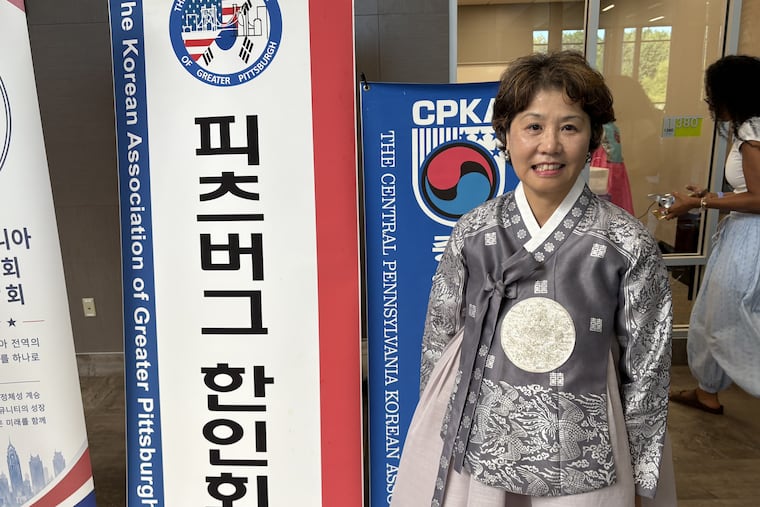
Ask Pastor Daniel Cho why Korean culture has become so popular in the United States, and he just smiles, shaking his head in wonderment.
“I’m not sure, but we’re pleasantly shocked,” said Cho, 59, a Montgomery County Presbyterian minister, who is leaving soon for missionary work in Vietnam. “Turn on the TV and see Korean dramas, K-pop music, and Korean food being everywhere.
“It’s wonderful how we’ve gotten to share our culture. When someone loves what you love, it’s exciting.”
That excitement was palpable Saturday at Montgomery County Community College in Blue Bell, where about 1,500 people gathered for “Happy Chuseok Fest 2026,” a Korean Thanksgiving celebration.
Part of a 2,000-year-old tradition, Chuseok is the time Koreans pause to reflect on family, gratitude, ancestors, harvest, and respect for nature.
“I love it because I get to spend time with my family,” said Kelsey Chung, 14, a ninth grader from Newtown Square. “It’s important to remember the traditions.”
Sponsored by the Korean Culture Community Foundation and Montgomery County, the Chuseok festival is highly significant for the roughly 30,000 to 40,000 Korean Americans living in Pennsylvania, said Sharon Hartz, president of the foundation.
“We know Christian and Jewish holidays,” she said. “But Koreans didn’t really have a holiday that was theirs. Chuseok is becoming more widely known.”
At the festival, vendors were selling kimchi (fermented cabbage), kimbap (rice, vegetables, and meat in seaweed), bulgogi (marinated beef), and, of course, fried chicken, the most popular Korean food abroad, according to the Korea Herald.
Beyond chicken, Korea is widely known for a “deep-rooted culture that people around the world have grabbed onto,” said sociologist Sam Richards of Pennsylvania State University, a Korean scholar who spoke at Saturday’s event.
“South Korea was poor 60 years ago, but it’s an economic superpower now,” said Richards, described by the Korea Times as a “megastar” whose YouTube videos are popular in Korea because of his love for and understanding of the culture.
“The Korean government rebuilt the country by putting money into exporting culture — music, television, movies.”
Americans, he said, are quite familiar with the K-pop superstars BTS, the most popular band in the world. Then, among other works, there is Squid Game, the dystopian thriller TV series, as well as the black-comedy film Parasite, Richards said.
“The government succeeded, as people were attracted to what South Korea has exported.”
A key to the appeal of Korean entertainment is that humility, a national trait, stands out among actors and musical artists, Richards said. Also, he noted, “you won’t see Korean artists putting themselves forward.”
“Pop stars say ‘we,’ not ‘I,’” Richards said.
Korea’s new role in the American zeitgeist is remarkable, said Nani Shin, executive director of the Philadelphia Asian American Film Foundation, whose organization was tabling at the Chuseok event.
“No one in the 1970s knew where Korea was,” Shin, who was born in South Korea, said. “Now, the culture isn’t only known, but celebrated. It’s wild.”
It is important to remember, however, that Koreans look to keep their traditions alive for themselves and their children.
“That’s why I’m here,” said Will Press, 43, who stood outside the event Saturday. He married a Korean woman, he said, which means “she, and I, want our children to know that Korea is part of their heritage.”