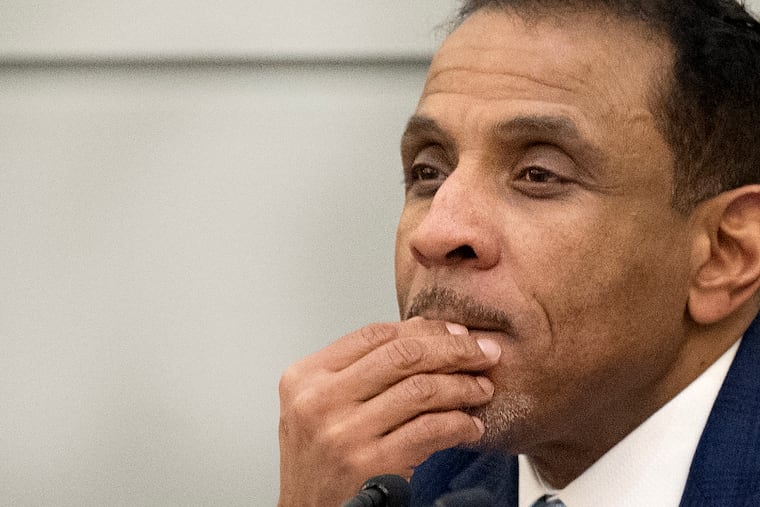
President Donald Trump denied Johnny Doc’s request to be let out of prison early
John Dougherty was one of about 5,600 people whose commutation applications were denied earlier this month, the Justice Department said.
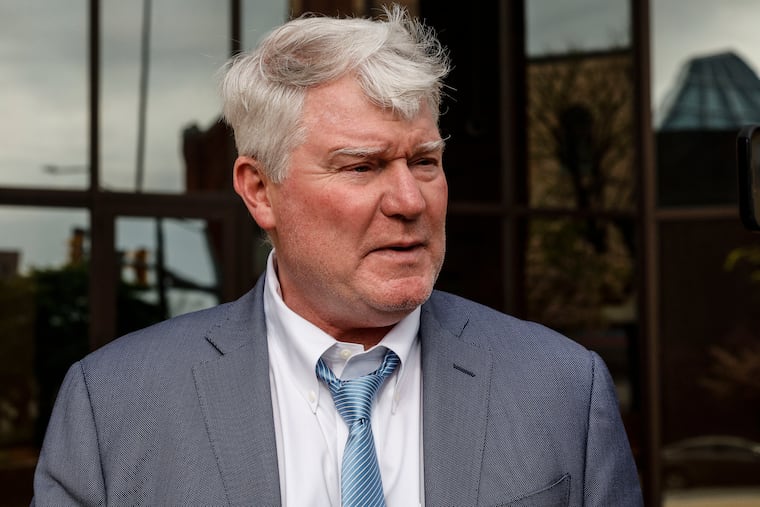
Convicted former Philadelphia labor leader John J. Dougherty has taken a variety of steps to try to cut his six-year prison term short, including by taking the witness stand this spring to tell a federal judge about the unique health challenges faced by his wife.
But one other avenue he pursued last year — an appeal to the White House for mercy — apparently hit a dead end.
President Donald Trump earlier this month denied Dougherty’s request for a commutation, according to the Office of the Pardon Attorney’s website, meaning Trump — at least for now — will not use his broad powers of clemency to clear the way for Dougherty’s early release.
Dougherty — who, nicknamed Johnny Doc, was once a singular power broker in the city’s Democratic Party — was one of about 5,600 people whose commutation applications were denied on July 10, according to the pardon attorney’s site. A commutation keeps a defendant’s conviction intact but ends or reduces their sentence.
Trump, a Republican, also denied about 300 applications for a pardon, a broader form of relief that is added to the record of the case and reverses any restrictions stemming from a conviction, such as limitations on voting or seeking public office. The New York Times first reported on the wave of denials this week.
Presidents have broad authority to issue pardons and commutations in federal cases, and Trump has shown a willingness to grant them to political allies during his second term in office.
One of his first actions after being sworn in again last year was to issue pardons to nearly every person charged with participating in the riot at the U.S. Capitol on Jan. 6, 2021. Trump has also bestowed clemency on political figures convicted of corruption and those he maintains were “persecuted” by the Justice Department under former President Joe Biden.
Biden also used his clemency powers in unique ways, granting nearly 1,500 commutations during his final weeks in office, commuting dozens of death sentences, and, controversially, granting a wave of preemptive pardons to family members and allies.
Dougherty’s attorney, George Bochetto, said Tuesday that he was not involved in the effort to petition for a commutation and did not know about it. It was not immediately clear if Dougherty submitted an application himself or if he had another associate help with its preparation.
The pardon attorney’s website made basic information about Dougherty’s application available through its case search system, showing Dougherty’s name and his Bureau of Prisons register number and saying his application was filed last year.
Bochetto has been overseeing a different relief effort: Dougherty’s attempt to have a judge grant him compassionate release.
In court documents and in testimony before U.S. District Judge Jeffrey L. Schmehl, Dougherty has been saying for months that his wife, Cecilia — who has long suffered from a debilitating brain injury — has seen her condition worsen while he has been imprisoned. Dougherty has asked to serve the rest of his sentence on house arrest in order to oversee her care, saying if he is not allowed to do so, his wife will likely die.
Schmehl denied that request earlier this year, but has been reconsidering after Bochetto appealed.
Dougherty, 66, was sentenced in 2024 to six years in prison after being convicted in separate trials — the first after a jury found that he had spent years bribing former Philadelphia City Councilmember Bobby Henon, the second over nearly $600,000 he and others embezzled from his union, Local 98 of the International Brotherhood of Electrical Workers.