Philly workers celebrate ‘beauty of union solidarity,’ bemoan rising costs at Labor Day parade
Local labor leaders noted some recent contract wins by area unions during the annual celebration.
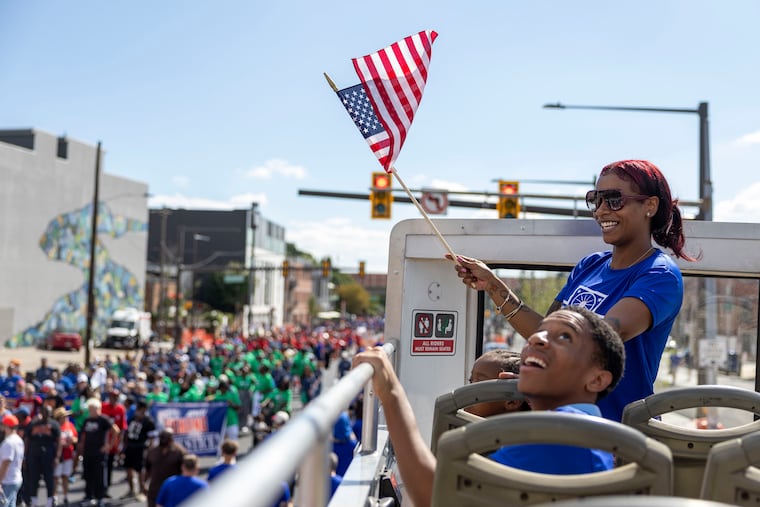
For more than an hour, waves of union members and their families marched and chanted along a half-mile stretch of Washington Avenue late Monday morning, their steps amplified by the percussive thunder of drum line groups.
Some could have easily opted to spend their Labor Day — balmy as it was, with blue skies and occasional tufts of cotton candy clouds — on a beach or at a barbecue, mused Wendell Young IV, president of United Food and Commercial Workers Local 1776, as he trekked past houses and storefronts in a blue T-shirt that bore the words “Solidarity is a vibe.”
But Young said he thought anger over some of President Donald Trump’s policies — such as a controversial attempt to end collective bargaining rights for more than a million federal workers — had compelled many union members to instead take to the streets for the 39th Annual Tri-State Labor Day Parade.
“He’s more interested in putting his name on buildings and arcs,” Young said, “than protecting the rights of workers.”
Economic anxiety was a recurring theme throughout the parade, as it is across much of the U.S. Federal Reserve data in January showed that wealth inequality in the country had reached its highest level since 1989.
“Workers in general are very concerned about cost increases across the board,” said Danny Bauder, president of the Philadelphia Council AFL-CIO. “Inflation keeps increasing [prices], and the job market is tight.”
Nina Coffey, secretary and treasurer for SEIU Local 668, which represents 20,000 social service union employees in Pennsylvania, said members most often express concern about the “rising costs of healthcare, being able to put food on the table, as well as unregulated artificial intelligence that we’re facing.”
Yet uncertainty did not overshadow what was an otherwise joyous day.
Behind Coffey, on Washington Avenue near Fifth Street, SEIU members on a purple and gold float tossed candy to giddy children on a sidewalk, where handfuls of smiling onlookers waved and recorded with their phones.
Bauder praised what he called “the beauty of union solidarity” — the communal lift that members experience when another union achieves a victory. He cited, as an example, the 1,500 unionized Peco workers who won raises and full retirement medical coverage after briefly going on strike in July, and hotel union workers who also secured wage increases after going on strike in June.
» READ MORE: Peco’s new contract gives all workers pensions — but not the kind you might think
During a rally before the parade, outside the Sheet Metal Workers’ Local 19 Training Center on Columbus Boulevard, city and state officials preached from a platform about organized labor’s enduring presence.
“Philadelphia is a union town forever,” said city managing director Carlton Williams, who added that union workers have cleaned more than 150,000 city blocks under Mayor Cherelle L. Parker’s administration.
Parker appeared briefly during the pre-parade gathering, then left abruptly.
“The mayor was here and wasn’t feeling well. She will be fine,” Parker’s spokesperson, Joe Grace, wrote in a text message. “She is sorry to miss an important event for organized labor that she never, ever misses.”
Parker later returned, and then attended two additional Labor Day events.
Pennsylvania Lt. Gov. Austin Davis, who also addressed the assembled union members, noted that his father is a union bus driver in Pittsburgh.
“I know what a good union job can do for a family. I’ve seen it,” Davis said. “And I think we’re going to continue to fight to protect that way of life here in Pennsylvania.”
A recent Gallup poll found that unions have a 71% approval rating, a figure that was surpassed only in the 1950s and in 1936.
The same poll showed that 47% of Americans want unions to have more influence than they currently do.
But only 10% of U.S. workers are union members, according to the most recent data from the U.S. Bureau of Labor Statistics. That percentage is slightly higher in Pennsylvania, at 10.9%, and New Jersey, at 14.7%.
Perception of unions improved during the COVID-19 pandemic — when nurses, bus drivers, and grocery workers were deemed essential — and has remained high ever since, Paul Clark, a professor of labor and employment relations at Pennsylvania State University, wrote in an email.
As many Americans’ standard of living has fallen, and income inequality has grown more extreme, labor unions have appeared to many as the “only institution that could help working people win a bigger share of the wealth they were creating and that they deserved,” Clark said.