The number of kids in Philly has dropped nearly 10% in 15 years
Philadelphia has lost 9% of its under-18 population in the past 15 years and the suburbs are following suit. Experts and residents without kids cite expenses and other life priorities as some reasons.
Philadelphians can expect to see fewer children darting through water geysers in front of City Hall and paddling around the pond at Sister Cities Park in the coming decades.
The city and suburbs are losing their populations of kids, and fast.
Between 2010 and 2025, Philadelphia’s number of residents under 18 dropped by 31,038, to 312,490 children in 2025 — a decline of about 9%, according to an Inquirer analysis of Census Bureau data. That trend is even more dramatic for children under 5, whose population fell 12%. Those are notable shifts when compared with the city’s overall population loss of about 3%.
This is not unique to Philly. In the last 15 years, nearly every major U.S. city has lost residents under 18, said Katie Martin, who directs research on Philadelphia trends and public opinion for Pew Charitable Trusts. And elsewhere in the Philadelphia region, every suburban county has seen its number of children decline during that span. The trend has the potential to become a big workforce and financial problem if it does not turn around.
Demography experts say survey respondents often cite the climbing cost of living and political concerns as reasons for not having kids. Beyond logistics, people in the Philadelphian area say, the decision to not have children is driven by a desire for freedom and flexibility.
“I feel like I wouldn’t have been able to do and experiment as much … if I had been responsible for other human lives,” said Maureen Ferguson, 44, of Souderton, Montgomery County, who has never looked back on her choice to not have kids, filling her life with artistic endeavors like music, theater, illustration, and stand-up comedy.
The population and societal trends driving Philly’s drop in kids
A confluence of changes in population trends is helping demographers piece together what is driving the drop in kids.
For one, a reduction in teen pregnancies and births is changing the landscape. Teen births in Philadelphia fell from 3,072 in 2010 to 809 in 2025, according to data Martin and Pew sourced from the state.
“That has been a huge change,” Martin said. “Not just in Philadelphia, but something you’re seeing nationwide.”
It is a component of a larger trend of having children later in life, she said, which usually leads to each family having fewer children overall.
The pandemic may have contributed as well, as the data show a particularly sharp decline in the number of children in the city between 2020 and 2023.
The counties around Philly have likewise seen notable drops in their populations of children. Between 2010 and 2025, declines in the number of children ranged from 3% in Montgomery County to 12.7% in Bucks County.
Finances have been a recurring theme, Martin said. In a survey Pew conducted last year in Philly, both women and families rated their financial situation as worse than during the pandemic.
Rising housing and childcare costs are likely contributing to the trend in Philly and beyond, said Genevieve Diebold, a senior planning data specialist with the Delaware Valley Regional Planning Commission. She added that fertility rates started decreasing meaningfully following the Great Recession of 2007-09.
Costs are certainly one thing that have deterred Avery Walker, 32, who lives in Point Breeze.
“I know how expensive children are,” she said. “They are a drain on all of your resources — mentally, emotionally, physically, financially — and I would have to give up a lot.”
Prioritizing freedom and flexibility
For Walker and others The Inquirer interviewed who do not have kids and do not plan to, the reasoning runs deeper than cost. It comes from a desire to live spontaneously and prioritize hobbies, health, and relationships with partners and friends.
Walker, who works in supply chain, likes living on her own schedule, sleeping in, traveling, trying new restaurants, and attending concerts and does not want to give up or modify how she does those things in the ways she likely would need to if she had kids, she said.
Jennifer Gamba, a 48-year-old paralegal in Fairmount, has been married to her husband for about 14 years. They never had strong feelings one way or another about having kids, Gamba said. Over time, the biological door began to close, and that was OK with them.
“It just wasn’t really something we prioritized,” she said.
Maintaining a good relationship with her husband, managing her rheumatoid arthritis, running marathons, and exploring national parks took precedence over kids.
“I think you have to be all in, and I don’t know that I am all in,” Gamba said. “I think I could do it, but it might not have been the best version of me.”
For Kelley Galloway, a 38-year-old real estate agent in Fishtown, finances and politics are factors. The idea of raising children, especially girls, in this political and economic climate is scary, she said. But those issues just reaffirmed the decision she had made long ago.
Throughout her adulthood, Galloway has focused her energy on buying a home, creating a dinner club for women in Philly, advancing in her career, and traveling.
“I went to three concerts this week, and none of them were planned,” Galloway said. “That’s something I could never do if I had children, and that’s why I moved to the city. I wanted to be able to enjoy my life and experience things.”
Jessica Hawk, 57, always knew she didn’t want kids. She never liked playing with dolls as a child, preferring instead to play manager or teacher.
“Whatever that maternal thing is that drives you to have a child, that is missing in me,” Hawk said.
The retired English teacher in Glassboro, Gloucester County, has one million TikTok followers for her videos about education, but she started receiving attention from a different faction about six years ago when she began posting about being happily child-free. Her videos were seen around the world and resulted in her doing interviews for Russian and German media, she said.
“I had so many women in my DMs saying to me, ‘I wish I could forgo having children but, in my culture or in my family or in my religion, I don’t have a choice,’” Hawk said.
She spoke out, she said, to help women who don’t want kids understand just how many like-minded others are out there.
What does this trend mean for the region’s future?
This population shift could become even more stark, and eventually spell major issues for the city and the suburbs.
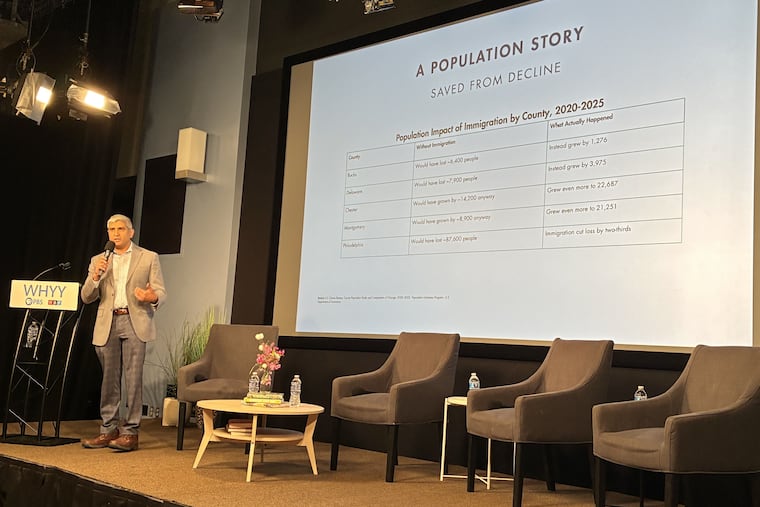
Foreign-born residents have been driving the region’s population growth in recent years. Since those residents tend to have more children than people born in the United States, the immigrant population may be mitigating the drop in young residents and masking what would be an even more dramatic decline, said Letícia J. Marteleto, a sociology professor at the University of Pennsylvania.
But that balance may be short-lived as President Donald Trump’s administration continues its dramatic efforts to curb immigration.
An uneven distribution of younger and older residents could compromise bedrock systems designed to keep people financially secure and physically healthy into old age.
Social Security and Medicare rely on contributions from those in the workforce. If there are fewer young people paying into the system and more older people extracting from it, it is increasingly difficult to cover each older resident.
“The whole thing becomes very expensive,” Marteleto said.
The healthcare system, she said, would become similarly imbalanced, an especially acute problem in a place that dubs itself a city of “eds and meds.”
Those dire consequences are a long ways away, she said, but, at this point, it is hard to imagine the population trends turning around without significant government intervention like affordable childcare, housing, and healthcare.
“If we don’t do the necessary things to provide women with the right circumstances for wanting to have more children,” Marteleto said, “we are going to keep getting what we are getting.”