This drug can save the life of a mother after birth. The Pa. House wants to make it unlawful for midwives to carry it.
The women this impacts aren't choosing between a midwife and a hospital. In 23 counties there is no hospital. They are choosing between an attendant who carries a life-saving drug and one who doesn't.
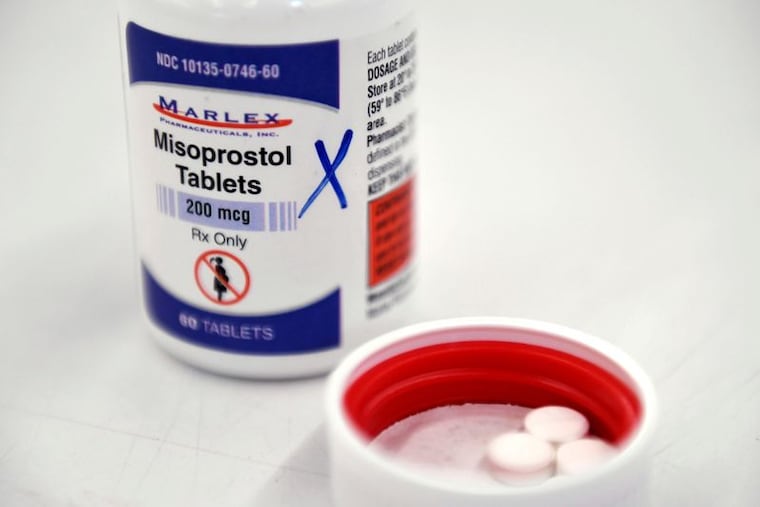
A woman in Pennsylvania can see a telehealth prescriber, never leave her house, and have misoprostol arrive in her mailbox to end a pregnancy.
House Bill 2520 would make it unlawful for the trained woman kneeling beside her bed to carry that same drug to stop her bleeding to death after she gives birth.
Same molecule. Same state. Same woman. Which path is lawful depends on which outcome she is having.
I am not writing about abortion. I am writing about incoherence, and about what it is going to cost women in the counties where our hospitals have closed.
Here is why that drug matters enough to write about.
Outside of pregnancy, about 15 milliliters of blood reach a woman’s uterus every minute. At the end of pregnancy, it is 500 to 600. A tenth of everything her heart pumps goes to one organ. After the baby is born, one thing closes those vessels: the uterus clamping down on itself. When it does not, and in most hemorrhages it does not, nothing is holding them shut.
Obstetricians put the threshold for postpartum hemorrhage at 1,000 milliliters. At the rate blood moves through a uterus at term, a woman reaches that level in under two minutes.
Hold that against the next number. In 23 of Pennsylvania’s 67 counties there is no hospital where a baby can be born. Fifty-six of our hospitals stopped delivering babies between 2005 and 2026, taking us from 121 birthing hospitals to 79.
For a growing number of Pennsylvania women, the nearest labor and delivery unit is 40 minutes away.
Two minutes against 40. No transfer, however well organized, is fast enough. Whatever is going to save her has to already be in the room.
We have decided this six times already
Pennsylvania does not usually insist that only a licensed clinician may act while someone is dying.
Any bystander may do chest compressions. Any bystander may take a defibrillator off a wall in a shopping center and use it on a stranger. Any bystander may perform abdominal thrusts on a choking person. Public buildings hang bleeding-control kits beside the defibrillators, and we teach ordinary people to pack a wound and apply a tourniquet. Trained school staff carry epinephrine.
And in 2014, this commonwealth decided that any member of the public should be able to reverse an opioid overdose with naloxone. Not a nurse. Anyone.
We were right to do it.
Every one of those laws has the same shape. Name the emergency. Name the drug or the device. Require training, not a license. Grant immunity. They rest on one judgment: In the minutes before professional help arrives, a trained ordinary person acting beats nobody acting.
There is no such law for a woman bleeding after childbirth. She can hemorrhage to death in a building with a defibrillator in the lobby and naloxone behind the front desk.
The drug is not exotic
The medicine that stops most of these hemorrhages is not a controlled substance. Misoprostol sits on the World Health Organization’s Essential Medicines List for exactly this purpose. It is stable at room temperature, swallowed or placed under the tongue, and needs no refrigeration, no needle, and no operating room.
The better drug, oxytocin, has to be kept refrigerated between 2 and 8 degrees Celsius (35.6 and 46.4 degrees Fahrenheit). That is precisely why the WHO recommends misoprostol for births far from hospitals — which is most births in the world, and a growing share of births in rural Pennsylvania.
So this bill would remove the one uterotonic that survives the setting in which it is most needed.
Which brings me back to where I started. That same molecule is, in practice, one of the more obtainable prescription drugs in America. It moves through telehealth services and mail networks, and much of the public conversation of recent years has been about how much easier that access has become.
I have no quarrel with a woman reaching a doctor via telehealth instead of driving for two hours. That is the same problem I am describing, solved.
My quarrel is that Pennsylvania is preparing to solve it in one direction and criminalize it in the other.
What the bill does
HB 2520 creates a category called “lay midwife” and makes four things unlawful for anyone in it. Three concern disclosure and recordkeeping, and there are reasonable arguments for them.
The fourth is that she may not administer a prescription medication in the practice of midwifery. The bill then requires her to hand the mother a signed form saying so, in advance, in her own name.
I understand the impulse. Someone looked at unlicensed practice and reached for the tool that says stop.
This bill would remove the one uterotonic that survives the setting in which it is most needed.
But the women this impacts are not choosing between a midwife and a hospital. In 23 counties, there is no hospital to choose. They are choosing between an attendant who carries a life-saving drug and an attendant who does not.
The answer to a maternity desert is not fewer drugs in the bag.
We have known the other answer for a decade, and we wrote it down six times. Name the emergency. Name the drug. Require the training. Grant the immunity.
We did it for a stranger on a shopping center floor. We have not done it for a mother.
Naomi Whittaker is a board-certified obstetrician-gynecologist in Lewisberry, Pa.