Krasner’s controversial shortcut in one exoneration case? He’s used it dozens of times.
The Philadelphia district attorney conceded a 2009 murder conviction without reinterviewing witnesses or reviewing trial records — and it’s not an isolated case.
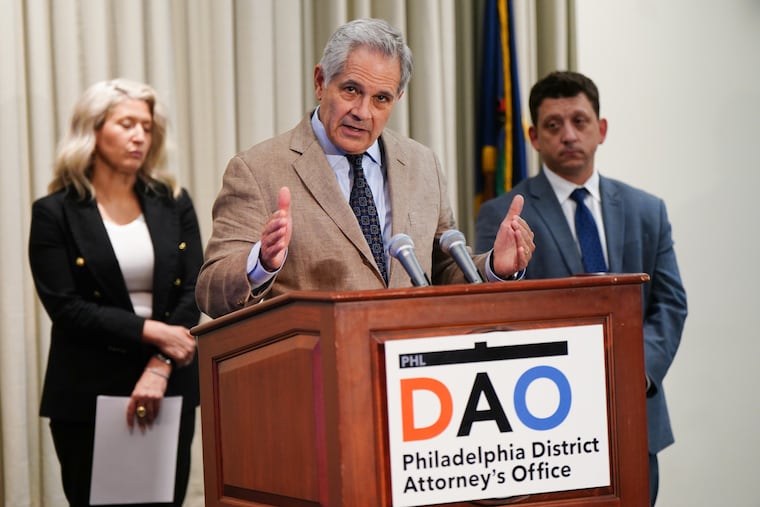
District Attorney Larry Krasner’s recent legal trouble stems from the mishandling of a single post-conviction appeal involving a man imprisoned for murder.
But a review of legal filings, judicial rulings, and court transcripts shows that many of the same shortcuts that came to light during an evidentiary hearing into the district attorney’s decision to concede the 2009 second-degree murder conviction of Dennis Johnson have been used in scores of other murder cases.
In Johnson’s case, it was revealed that the district attorney’s office moved to concede the conviction despite not doing any independent investigation. Prosecutors in Krasner’s office did not review the investigative file or read through the original trial transcript. They did not reinterview witnesses, speak with the police who investigated the murder, or meet with the former prosecutor who tried the case.
Instead, Matthew Stiegler, who until recently was the head of the district attorney’s office’s Conviction Integrity Unit, had many meetings with Johnson’s lawyers from the Defender Association and the Pennsylvania Innocence Project. At the suggestion of Johnson’s lawyers, Stiegler “decided” to concede the case, U.S. District Judge Paul S. Diamond, who presided over the evidentiary hearing, found.
Jaclyn Mason, an assistant district attorney who resigned in June, testified that by the time she was assigned to write the concession brief, “[Stiegler] already made … the decision here that this is going to be a case that should be conceded.”
Mason said Stiegler told her, “If it’s good enough for the Innocence Project, it’s good enough for me.”
Stiegler told Diamond the DA’s office rarely conducted any investigations and had no investigators or investigation resources. If a witness recanted, Stiegler said he did not interview the witness. Instead, Stiegler testified he would determine “what was right” based on the defendant’s allegations.
» READ MORE: The day Larry Krasner’s office was put on trial — by his own prosecutors | Paul Davies
Overall, the district attorney’s office told Diamond it had conceded “about” 60 cases in this manner since 2018.
Diamond found the district attorney’s office’s handling of Johnson’s appeal “troubling” and “disturbing.”
Other details emerged during the hearing regarding Krasner’s and Stiegler’s efforts to cover up how Krasner’s office handled the appeal that prompted Diamond to refer the matter to federal prosecutors to investigate Krasner for potential crimes, including conspiracy or obstruction of justice. Diamond also found that Stiegler may have committed perjury. After Diamond’s ruling, Stiegler stepped down from his supervisor role, but he remains at the district attorney’s office.
For his part, Krasner on Wednesday filed court papers demanding Diamond be removed from the case, arguing that the judge’s criminal referral was “baseless.”
“When it comes to all of these nominally-serious-but-actually-wafty accusations of criminal conduct, tempered by ‘coulds’ and ‘mights’ and ‘may haves,’ [Diamond’s] analysis rests on nothing of substance,” Krasner wrote.
But independent of Diamond’s findings, Johnson’s case exposed the shoddy way Krasner’s office has handled concession cases — which the DA has held up as a signature accomplishment of his tenure.
Indeed, similar problems emerged in a separate case that ended up before the state Supreme Court.
That case involved Lavar Brown, who was convicted of second-degree murder in the robbery and shooting death of a Rite Aid worker in North Philadelphia in 2003. He was convicted of killing a second man two years later and sentenced to death, in part because of the first conviction.
In 2021, Krasner’s office said Brown’s case was “infected by serious misconduct” by past prosecutors, and he deserved a new trial, which a Common Pleas Court judge granted.
The families of the two murder victims asked the state Supreme Court to intervene, arguing that Krasner had a conflict of interest because two of his former law partners had previously been involved in Brown’s case.
A federal judge called the district attorney’s office’s handling of one appeal “troubling” and “disturbing.”
Once the high court dug into the case, it found multiple problems surrounding the district attorney’s office’s concession claim. The justices found prosecutors from Krasner’s office did not interview a single witness, police officer, or former prosecutor involved in the case, and ignored incriminating evidence in its own files.
The “investigation did not go beyond a cold review of the inconclusive paperwork in its own records,” Justice Kevin M. Dougherty wrote in a scathing 109-page opinion.
The court also found Krasner’s office withheld a key memorandum in which a witness identified Brown as being involved in the murder and submitted a joint court filing with Brown’s attorneys that “was false in multiple respects.”
The court found the district attorney’s office “violated its duty of candor” to the court, and that Brown’s conviction should not be overturned.
The court pointed to other cases that indicated the Brown case, like the Johnson case, was not a one-off failure.
“There have been numerous instances of untrustworthy concessions, lack of candor, misrepresentations of fact, lack of adequate investigation, and avoidance of hearings,” Dougherty wrote.
Dougherty found that under Krasner, the district attorney’s office conceded relief in roughly 115 cases — far more than the figure given to Diamond.
The high court said Krasner’s Conviction Integrity Unit was poised to review more than 1,000 cases. Given the district attorney’s office’s “checkered concession program,” the court ruled the state attorney general should be allowed to review future concessions.
Krasner did not respond to a request for comment. But in its filings to the state Supreme Court, the district attorney’s office said the 115 concessions represented less than 2% of the roughly 7,600 cases for which the Law Division prepared legal filings as part of its post-conviction review program since 2018.
But the district attorney’s office failed to mention that nearly all its concessions involved murder cases, including a disproportionate number on death row.
As such, the dozens of people convicted of the most heinous offense were either set free or had their sentences reduced. But in none of the cases has another suspect been charged, meaning the true killers have either been released on technical grounds or never found.
More troubling is how Krasner’s office apparently engaged in questionable conduct in other concession cases. Consider:
In 2024, a federal appeals court found Krasner’s office “slant[ed] the facts” and misled the court in its effort to overturn a death sentence issued to Robert Wharton, who was convicted in 1985 of killing a couple in their home. The appeals court ordered Krasner to write a letter of apology to the family of the victims.
Krasner’s office moved to concede Kevin Johnson’s 1986 first-degree murder conviction, claiming the testimony from three eyewitnesses was not credible. But the state attorney general’s office supplied the court with information that showed the eyewitnesses were acquainted with Johnson before the murder. The U.S. Court of Appeals for the Third Circuit rejected the DA’s effort after finding Krasner’s office “sought to evade judicial review” through a settlement agreement that mirrored a “striking pattern” of other murder convictions that have been overturned.
In 2019, Krasner’s office filed a letter with the Post-Conviction Relief Act court, advising that “after thoroughly reviewing the DNA testing results and the trial notes,” it agreed to accept Derek Murchison’s offer to plead to third-degree murder and a reduced sentence. Murchison was convicted of first-degree murder and sentenced to life imprisonment for the 2001 strangulation of Linda Willis. Evidence introduced at trial included his confession to the mother of his two children and testimony that put him near the house at the time of the murder. Murchison appealed, claiming DNA evidence found at the crime scene did not match his. But the Post-Conviction Relief Act court found Krasner’s office did not consult with any DNA experts, seek any additional forensic testing, or interview any of the multiple witnesses presented at trial. The court found the DNA claim would not have changed the outcome of the trial and dismissed the petition, which was affirmed by the Superior Court.
This list goes on.
» READ MORE: Krasner hasn’t said a word about a growing exoneration controversy — but his own court filing does | Paul Davies
The district attorney’s office supported a petition for release from Javier Artache, who claimed ineffective defense counsel after he was convicted of first-degree murder for shooting a man in the head. But the Third Circuit rejected the office’s relief argument because it was “unsupported by the record.”
In some instances, the district attorney’s office simultaneously shops a concession in state and federal court. In 2019, Antonio Martinez appealed his 1985 double murder conviction in state court. While that appeal was going on, he filed a separate appeal in federal court, claiming evidence was withheld at trial.
The district attorney’s office asserted that Martinez’s federal petition needed immediate attention, as the state courts were largely closed because of the pandemic. During an evidentiary hearing in federal court, it was revealed that no one had interviewed the trial prosecutors or the detectives about the claim of withheld evidence.
U.S. District Judge Mitchell S. Goldberg scheduled another evidentiary hearing so the trial prosecutor could testify. But two weeks before the hearing, the district attorney’s office was back before the state Post-Conviction Relief Act court, which granted Martinez’s petition, and his sentence was vacated.
The district attorney’s office dismissed the charges, and Martinez was released from prison in 2021. The same day, Krasner’s office dropped Martinez’s claim in federal court.
Goldberg, who left the bench and returned to private practice in January, said the failure to inform the court about the state proceedings violated the district attorney’s office’s duty of “candor to the court.”
Krasner issued a statement at the time that said, “It is no surprise that when you do the work of undoing institutional wrongs, there is resistance from people who want to make excuses for those wrongs.”
But even as more dubious concessions have come to light, Krasner has yet to offer an accounting for whether his office’s actions constitute its own failures.