Bryce Harper had his best month as a Phillie, and even he is not quite sure how he’s done it
Harper’s surge — which has coincided with his move back to right field — has showcased what the star does when he’s at his best. And that means focusing on hitting better pitches.
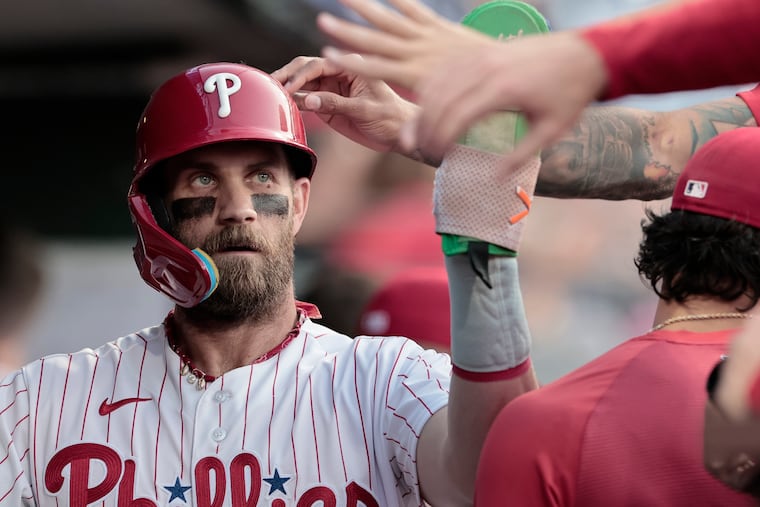
Bryce Harper banged an opposite-field two-run homer in the first inning Wednesday and doubled off a tough lefty reliever in the fifth.
Yet he fixated on what happened in between.
In his second at-bat of a 6-0 Phillies victory in Seattle, Harper lined out to left field on a full-count sinker below the strike zone from hard-throwing Mariners righty Bryan Woo.
“He was really upset that he swung at it,” hitting coach Kevin Long said later. “That’s something he would do last year, the last year and a half, two years, where it really wouldn’t be that big of a deal. But now he’s back to where he’s making a conscious effort to make sure he’s taking what the pitcher gives him.
“And it’s showing.”
» READ MORE: ‘The game is where it needs to be’: Bryce Harper wants compromise (and no salary cap) to keep sport thriving
Is it ever.
Objectively, without a trace of recency bias, Harper is having his best month in seven years with the Phillies. Entering play Friday, with four games left in August, he has gotten on base in 55 of 108 plate appearances, a mind-bending .509 clip, and reached in 29 consecutive games, the longest streak of his career.
Some context: Guardians outfielder Steven Kwan has the second-highest on-base percentage among qualified hitters in August … at .463. Harper, fifth among active players with a .387 career mark, has only once carried a .500 OBP through a full calendar month — and not since April 2017 with the Nationals (.509).
Harper has drawn 28 walks this month for a majors-leading 25.9% walk rate. But it’s not like he’s being overly passive at the plate. He’s batting .338 (27-for-80) and slugging .600 with six doubles, five homers, and an 1.109 OPS.
Even Long, who has worked with Harper since 2018 in Washington, recently asked him how he’s doing it.
“And I couldn’t really give him an answer,” Harper said before a game this week in Seattle. “He was just like, ‘Why are you doing what you’re doing right now?’ I just haven’t really thought about it. Obviously the walks have come in bunches the last three weeks. It’s a lot of walks. I’m not trying to walk. I’m not trying to do those things. I’m just trying to play the game, and if I’m walking, I’m walking.”
Harper chuckled.
“K-Long’s kind of stopped asking me about it,” he said, “because I haven’t really given him a great answer.”
Long has some explanations, and we’ll explore those shortly. But Harper’s surge — he’s fifth in the majors with a .971 OPS since the All-Star break — coincided with his move back to right field, which enabled the Phillies to pull off a deadline trade for contact-hitting second baseman Luis Arraez. Harper has also started every game despite a sore left knee.
And so, although the Cubs’ Pete Crow-Armstrong has emerged as the favorite in the National League MVP race over even Shohei Ohtani, it’s appropriate to wonder if Harper should be entered into the conversation given his value to the Phillies.
OK, so maybe that’s a September question.
But with a few days left in August, no less than a former MVP and .307 career hitter who was known as “The Hitman” is marveling at Harper’s combination of patience and aggressiveness this month.
“I don’t think I’ve ever seen a guy that does what he does,” Phillies interim manager Don Mattingly said. “The base on balls, the attack with the swing, and being able to control the zone is something that’s rare.”
Walk this way
Harper’s dad always tells him he’s at his best when he accepts his walks. The logic: Teams don’t want him to beat them, so they walk him or try to get him to swing at non-strikes.
It’s been that way since he was a kid.
“I was 10-11 years old, and a coach would try to play mind games of like, ‘Hey, we’re not going to pitch to you today,’” Harper said. “Whack, they’d throw a pitch right down the middle and freeze me a little bit. I never want that feeling. I always want to be prepared to hit.”
And because he never knows when that strike will come, Harper tends to guard against being overly passive by chasing more pitches that he should lay off. It’s a delicate dance.
» READ MORE: From May: Bryce Harper is off to a strong start. And ‘protecting himself’ has played a key role.
Last season, Harper saw a lower rate of strikes (43%) than any hitter in the majors, though it was consistent with his previous six seasons with the Phillies (42.6%). But his out-of-zone swing rate climbed to 35.6% last season from 31% from 2019-24, while his walk rate dipped to 12.1% last season from a six-year mark of 14.4%.
So, Harper went to spring training with a renewed aim to improve his plate discipline and only “hit that ball in that box.” He even set a goal to “walk 140 to 150 times.” It was ambitious. In the last 10 years, only Juan Soto walked that often in a season (145 times in 2021).
But Harper’s intentions were clear.
“I just need to make sure I walk and not just want to get hits all the time,” he said in March. “I want to hit. I want to be a hitter, obviously. I want to hit homers and hit doubles and all those things. But sometimes it’s better for me if I walk. I can do that a little bit more this year.”
Through the end of July, not much had changed from 2025. Harper was still seeing a low rate of strikes (42.2%) and swinging a high rate of non-strikes (34.6%), according to Statcast, and walking at only a slightly higher rate (13.4%).
But this month, at last, Harper is doing exactly what he intended to. He has swung at only 23.3% of pitches out of the zone and walked at a 25.9% clip.
It’s hitting nirvana.
“He’s doing it exactly how you should,” Long said. “It’s not taking away his aggressiveness. He’s still being ultra aggressive, especially in the zone. But the ones out of the zone, it’s almost like he’s not auto-swinging. He’s really making a conscious effort to make sure that the pitch is where he wants it.”
» READ MORE: What makes Bryce Harper and Kyle Schwarber such unique stars? We asked each about the other.
It’s not like Harper hasn’t hit like this before. In 2021, when he won his second NL MVP award, he controlled the strike zone with a 24.9% out-of-the-zone swing rate and a 16.7% walk rate.
To Harper, the road back to achieving those marks was adjusting his mindset.
“[It’s] me just giving a crap about it, right?” he said in spring training. “Just making sure I do it. That’s a big thing for me. … It’s just buying in.”
Said Long: “I’ve seen him take several borderline pitches where he goes, ‘Man, I just didn’t think that was a strike.’ Well, that’s what good hitters do, and that’s what he’s doing.”
There’s another explanation, too, and it can be found in the on-deck circle when Harper bats.
The Arraez effect
Even though Harper feels most comfortable in the No. 3 spot in the order, the Phillies didn’t add a cleanup hitter in the offseason.
And Harper came to camp with lineup protection on his mind.
“Whoever’s in that four spot,” he said in February, “is going to have a big job to do.”
But after all these years, Harper uniquely understands that he’s the guy opponents will always pitch around, no matter the situation. Unless the Phillies summon the ghosts of peak Mike Schmidt and Ryan Howard to hit behind Harper, he’ll never get pitched differently.
» READ MORE: Batting practice … in a hotel room? It’s part of the ‘routine’ for Luis Arraez, baseball’s most unique hitter
So, no, Harper isn’t suddenly seeing more strikes since the Phillies traded for Arraez on Aug. 3 and put him in the cleanup spot. Never mind that Arraez’s ability to put the ball in play is unrivaled in the sport. The rate of in-zone pitches to Harper with Arraez behind him (40%) is actually lower than the overall season rate (41.8%).
“I think teams are going to pitch me the way they want to pitch me,” Harper said, “no matter who’s behind me.”
Probably. But just because teams approach Harper with similar caution doesn’t mean that Harper’s mindset isn’t wildly different.
To wit: In spring training, Harper noted that the Phillies’ “numbers in the four spot weren’t very good last year.” On some level, then, the implication was that he felt a burden to drive in runs ahead of Alec Bohm, J.T. Realmuto, Nick Castellanos, and others.
Now, here’s how he talks about Arraez, who has struck out only three times in 89 plate appearances for the Phillies:
“Having a guy like that behind me is definitely a different aspect just because I can kind of put all the faith in him to get the job done,” Harper said. “He’s going to put the ball in play; he’s going to have great at-bats; he’s going to see pitches.
“It’s just a different type of baseball that he plays comparatively to a lot of the game nowadays. He’s an asset to our team completely just because of those reasons.”
Surely, then, it’s easier for Harper to holster his bat and accept a walk rather than chasing after pitches off the plate and getting himself out.
» READ MORE: Trea Turner isn’t moving off shortstop (yet). The Phillies’ goal for now: Help him get better.
It isn’t perfect. Harper concedes he must be more productive against lefties (.207 average, .657 OPS). And Long said Harper “was concerned for a minute” over an 11-game stretch with only one extra-base hit. He has three doubles and two homers in his last five games.
“I’m like, ‘This is really what you want. You’re getting on base every single day, two or three times, you’re making really good decisions,’” Long said. “I told him, ‘I’ve got to believe that the extra-base hits will come with all this — and they have. But it’s really about just making a conscious effort to hit better pitches.”
For more than a month, Harper has done that as well as ever, maybe even at an MVP level.

The Phillies haven't won a playoff series since 2023, and their postseasons keep getting shorter and shorter. How can they fix it? Radio play-by-play announcer Scott Franzke joins Phillies Extra, The Inquirer's baseball podcast, to discuss Trea Turner's future, the managerial uncertainty, whether the Phillies can get "creative" to change the mix of the roster, and more. Watch here.
You can also subscribe to the podcast version of Phillies Extra on Spotify or Apple Podcasts.
Previous episodes: Larry Andersen | Matt Klentak | Jeff Francoeur | Luke Murton | Mike Hazen | Tony Gwynn Jr. | Kevin Stocker | Bobby Dickerson | Jim Bowden | John Middleton