Mayor Parker renews call to expand involuntary commitment law following fatal Philly police officer shooting
The change in law has been a long-held goal for Parker as her administration attempts to drive a turnaround in Kensington.
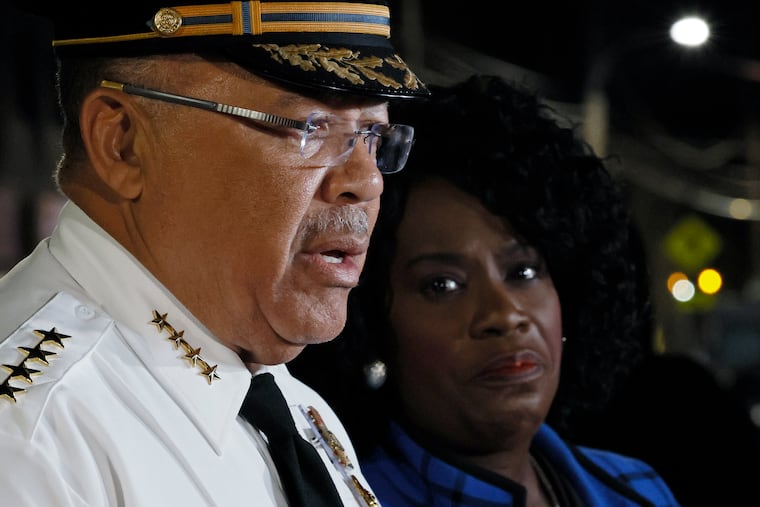
Hours after a Philadelphia police officer was fatally shot and another was wounded by a man who ambushed them with a shotgun in West Philly, Mayor Cherelle L. Parker stood in front of the hospital and called for a specific policy change.
During a news conference outside Penn Presbyterian Medical Center, the mayor asked Gov. Josh Shapiro and the state legislature to change Pennsylvania’s laws on involuntary commitment, which do not currently allow the city to hold people who use drugs in a hospital without their consent.
The change in law has been a long-held goal for Parker as her administration attempts to drive a turnaround in Kensington, the neighborhood located across the city from the site of Saturday’s shooting, and where open drug use and sales have proliferated for decades.
State law says that in order for the city to involuntarily commit a patient, the person must be a danger to themselves or others as a result of severe mental illness, not primarily drug or alcohol use.
“We are coming to the Commonwealth of Pennsylvania [to] seek legislation that will expand involuntary commitment laws to cover not only severe mental illness, but substance use disorder,” Parker said Saturday, “and any kind of mental and/or behavioral challenge that could interfere with Philadelphia’s ability to keep itself safe.”
Within hours, Shapiro’s office said in a statement that he’d already discussed the matter with Parker and committed to reviewing the law.
Days after the West Philadelphia shooting, it remains unclear whether such a change in state law would have applied for Eric Lewis, the city water department employee charged with murder and related counts for shooting the officers.
» READ MORE: How a brief conversation on a West Philadelphia porch left one officer dead, and another seriously wounded
Court records show that a judge previously ordered Lewis to undergo substance abuse treatment after he was charged in 2012 with theft and receiving stolen property.
And in 2015, a judge ordered Lewis to receive a drug and alcohol assessment as part of his probation sentence after he was convicted of carrying firearms in public and simple assault.
But police officials have not indicated that Lewis still has substance use-related health problems or that drugs played a role in the shooting in West Philadelphia that killed Officer Shane Seiber and wounded another. District Attorney Larry Krasner said on Saturday that it was “premature” to say.
The mayor’s office has declined to comment aside from Parker’s public statements Saturday, and a spokesperson deferred questions to the police department.
» READ MORE: What we know about the shooting in West Philadelphia that killed a police officer
Parker, a centrist Democrat who has made Kensington a primary focus of her first term, spoke about the involuntary commitment law in December 2023, shortly after she won election and before she was sworn in as mayor.
She said during a news conference at the time that she had met with behavioral health providers who outlined potential roadblocks to addressing the sprawling addiction and homelessness in Kensington.
“When you talk to the providers, they’ll tell you... What are you going to do about this issue called involuntary commitment?” Parker said then.
She said the administration needs support from the state General Assembly in order to help people “get access to the treatment that they need when they are not in a position or place and space to determine that it is what they need.”
Two years later, Parker had a bipartisan group of lawmakers on board.
In May 2025, State Sen. Daniel Laughlin, an Erie County Republican who leads the state Senate’s Law and Justice Committee, introduced legislation to amend Pennsylvania’s Mental Health Procedures Act to explicitly classify substance use disorder and alcohol dependence as mental illnesses.
Laughlin was joined in his effort by State Sen. Anthony Williams, a West Philadelphia Democrat. The two said in a memo issued along with the legislation that it would “enable individuals with severe SUD or alcohol dependence to receive emergency evaluation and treatment before reaching crisis levels while providing pathways for loved ones to seek help for those who cannot advocate for themselves.”
Williams said Monday that Parker had asked him to sponsor the legislation, but it has since stalled in the Senate. The bill hasn’t received a committee hearing. Williams chalked that up to the “politics of the Senate,” which is controlled by the GOP.
The legislative session ends in November, meaning that if the bill is not passed by then, it would need to be reintroduced at the start of the next legislative session in January. Democrats are vying to flip the state Senate in the November election, which could lead to a different legislative makeup by next session.
Williams said he wants to reintroduce it.
“Circumstances that led to introducing the bill, unfortunately, haven’t changed,” he said. “We see circumstances where, because of the construct of the law and the limitations, we can’t prevent some tragedies from occurring.”
The existing law allows for healthcare professionals, police, or others who are responsible for a patient who witness behavior they consider dangerous to initiate what’s known informally as a 302 petition, referring to Section 302 of Pennsylvania’s Mental Health Procedures Act. The city’s Department of Behavioral Health and Intellectual Disability Services can then authorize the evaluation, even without the patient’s consent.
Under the law, a patient can then be admitted to an inpatient facility, such as a hospital, for up to five days. To extend involuntary treatment after that, the hospital or facility must file additional paperwork in court outlining the patient’s illness.
As of 2024, 34 states allowed for the involuntary commitment of patients whose primary diagnosis is substance use disorder, according to the American Society of Addiction Medicine.
However, some advocates who want the city to further embrace a harm-reduction approach oppose Parker’s effort to expand state law. They say that forcing people into treatment before they are ready doesn’t work and can be harmful to patients.
Carla Sofronski, executive director of the substance use policy group Pennsylvania Harm Reduction Network, said that the state’s healthcare system is not prepared to adequately treat an influx of patients who could be in withdrawal from the city’s toxic drug supply.
“People have the right to choose what to do with their bodies,” she said. “What would you say to a cancer patient that decides that they no longer want to continue with their treatment? People should have autonomy over what to do.”
Staff writers Ellie Rushing and Gillian McGoldrick contributed to this article.