‘Shoeless’ Joe Jackson is known for ‘Field of Dreams’ and the Black Sox. But his career started in Philly.
The classic 1989 film grew the legend of Shoeless Joe, whose iconic career started with 10 games in North Philly that have long been forgotten. And he had no interest in playing for the A's.
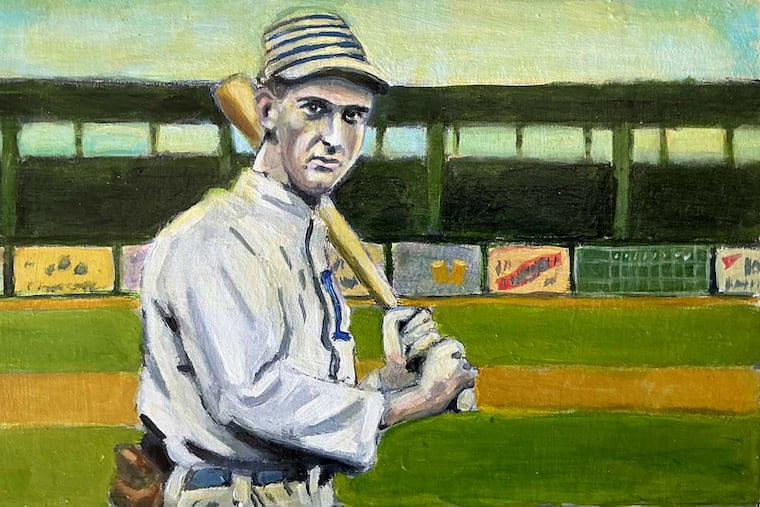
It was just the previous season that Joe Jackson played a game without cleats, so he had only been “Shoeless Joe” for a few months. Yet it was already obvious that Shoeless Joe was destined to be a star. That’s why Jackson was on a sleeper train bound for Philadelphia in August of 1908.
Philadelphia Athletics manager Connie Mack had dispatched three scouts — including his top lieutenant — earlier that summer to get eyes on Jackson in Greenville, S.C., before signing him for $900.
But Jackson didn’t want to leave his tiny South Carolina hometown. He had just turned 21 years old and was married weeks earlier. A son of a sharecropper, Jackson never went to school and was thrilled to be earning $75 a week for the Greenville Spinners.
» READ MORE: Mickey Harrington was the Phillies’ Moonlight Graham. He never got his Field of Dreams.
Jackson, leery of life up North in the big city, delayed his trip while another teammate whom Mack signed left for Philly.
Shoeless Joe finally relented and boarded the train with his minor-league manager Tom Stauch, who was instructed to deliver Mack the player an A’s scout described as “the sweetest hitter I’ve ever seen.”
Stauch woke up when the train pulled into Philadelphia. Jackson wasn’t there. He hopped off overnight during a stop in North Carolina while everyone was sleeping. Jackson sent Mack a telegram, claiming that his mother was ill and he had to take care of her. Shoeless Joe would one day become baseball royalty before being blackballed in one of sports’ greatest scandals. But he had no interest in playing for the A’s.
“Connie Mack understood,” said Dan Wallach, the former executive director of the Shoeless Joe Jackson Museum in Greenville, S.C.
Field of Dreams
Shoeless Joe will be remembered Thursday night when the Phillies play the Twins in an Iowa cornfield where the 1989 film Field of Dreams was shot. The portrayal of Jackson — “Is this heaven?” his character, played by Ray Liotta, famously asked after emerging from the stalks — is an iconic piece of Hollywood lore.
His baseball career was made for movies, so much that films — the other being 1988’s Eight Men Out — were released in consecutive years about Jackson. He was a baseball superstar who became tied up in a gambling scandal that nearly took down the sport after Jackson and seven Chicago White Sox teammates were banned for life amid accusations of throwing the 1919 World Series.
Jackson denied until his death at age 64 in 1951 that he lost on purpose and a legion of supporters have since worked to clear his name.
» READ MORE: Phillies to wear 1939 throwbacks for Field of Dreams Game against Twins
Major League Baseball clarified in 2025 that Jackson — along with Pete Rose — was no longer banned as lifetime penalties expire once someone died. So Jackson’s Hall of Fame case will be voted on in December 2027 by a panel assembled by the museum.
“I have never advocated for him to be inducted into the Hall of Fame because I think he’s more famous outside the Hall than in it,” said Wallach, who now hosts a baseball podcast called My Baseball History. “Obviously, I think his play and his career warrants that he be honored the way his contemporaries are. But the entire thing that makes his story unique and gives people a reason to fight for him is that he belongs in the Hall of Fame and he’s not in it. So the day he gets in it, there’s no story anymore. I have mixed emotions about him getting in.”
Jackson, like he is portrayed in Field of Dreams, is best remembered for his time with the White Sox. He won the World Series in 1917 and then hit .375 in the 1919 Series against Cincinnati that the “Black Sox” were accused of throwing. He’ll always be known for the years in Chicago. But his big-league career started in Philadelphia.
“He didn’t spend a ton of time in Philadelphia,” Wallach said. “But it was an interesting footnote to his career.”
It started in Philly
Mack sent Socks Seybold, a player who scouted Jackson earlier that summer, back to South Carolina in hopes of persuading Jackson to give Philly a chance. Seybold found Jackson working at a cotton mill. Shoeless Joe said he would come to Philadelphia but he had to bring his wife, Katie. The A’s agreed.
Mack usually required his players to be high school educated and preferred that they went to college. But Jackson didn’t even know how to read or write. He never signed autographs and carried a copy of his signature signed by his wife in his wallet that he would trace if he had to complete a legal document.
“He knew the lines he was making on the paper spelled ‘Joe Jackson,’ but I don’t think he knew he was writing a ‘J’ and writing an ‘O’ and writing an ‘E,’” Wallach said. “I don’t think he knew exactly what he was doing, but he could mimic the paper.”

The Phillies will play in the cornfield on Thursday (7:30 p.m., Netflix) against the Twins in Dyersville, Iowa.
- Phillies to wear 1939 throwbacks for Field of Dreams Game against Twins
- Rains threaten the Phillies ‘Field of Dreams’ game Thursday night
- ‘Shoeless’ Joe Jackson is known for ‘Field of Dreams’ and the Black Sox. But his career started in Philly.
- Iowa native Derek Hill says Phillies’ Field of Dreams game will be a ‘full circle’ experience
- Mickey Harrington was the Phillies’ Moonlight Graham. He never got his Field of Dreams.
- Bryson Stott’s ‘Field of Dreams’ cleats were born in Downingtown
- Phillies jump to Iowa and Netflix for ‘Field of Dreams’ game. Scott Franzke just hopes there’s a booth.
That’s how much Mack thought of Jackson’s ability that the owner overlooked his education. Mack offered to get Shoeless Joe a tutor and tried to find ways for him to get comfortable in Philadelphia. But there was little Mack could do.
The A’s players teased Jackson when they went out to dinner and he held his menu upside down.
“If the waitress came to him first, he would say, ‘Give me a second and let everyone else order,’” Wallach said. “He would listen to his teammates’ orders and whatever he thought sounded the best, that’s what he would order when it came back to him. His teammates weren’t stupid. Most of them were college educated. They saw exactly what was going on. He just didn’t feel comfortable being there.”
Jackson played five games for the A’s in 1908 at Columbia Park in Brewerytown before playing the next season in Savannah, Ga., where he led the South Atlantic League with a .358 batting average. Mack called Jackson back to Philadelphia for the final month of the 1909 season and he again played five games at the newly opened Shibe Park at 21st and Lehigh.
“Connie Mack did what he could to make Joe’s time in Philadelphia positive,” Wallach said. “But it just wasn’t going to work. It became clear pretty quickly that Joe was talented and was going to be a star but that wasn’t going to happen with the Athletics.”
Mack traded Jackson before the 1910 season to Cleveland, knowing the player he lured to Philadelphia would be better suited elsewhere.
» READ MORE: Chase Utley’s path to the Phillies Wall of Fame was forged with hours in the video room
Jackson’s career is now cleared to reach Cooperstown, N.Y., via the Classic Baseball Era Committee. It might not happen in December 2027, but he will eventually be enshrined. The numbers — his career .356 average is fifth best all-time — are too strong to deny.
His plaque will likely detail the betting scandal, his trusty bat Black Betsy, and his time in Chicago and Cleveland, where his career blossomed after Mack sent him there.
But the first line under Jackson’s nickname will say “PHILADELPHIA” as Shoeless Joe’s iconic career started with 10 games in North Philly that have long been forgotten.
“Connie Mack said he regretted selling Jackson to Cleveland,” Wallach said. “They really had a mutual respect for each other. Connie Mack wanted Joe to work out in Philadelphia. He knew he was going to be a star. He knew he had this ability. He won batting titles in every league before Philadelphia. He was great.
“But it was like he traded him to Cleveland out of mercy because he wanted him to have success. It was clear to him that that wasn’t going to happen in Philadelphia.”
Let's talk about the Phillies' bullpen. Larry Andersen happens to be an expert on the subject. The popular Phillies radio analyst had a 17-year major-league career in which he appeared in 699 games – all but one in relief. He joins Phillies Extra to break down the biggest question standing between the Phillies and a long run through October: How will they bridge the gap to closer Jhoan Duran? Watch here.
You can also subscribe to the podcast version of Phillies Extra on Spotify or Apple Podcasts.
Previous episodes: Matt Klentak | Jeff Francoeur | Luke Murton | Mike Hazen | Tony Gwynn Jr. | Kevin Stocker | Bobby Dickerson | Jim Bowden | John Middleton | Ryan Howard