He was the first Phillies pitcher to return from Tommy John surgery. He still wonders what might have been.
Steve Ontiveros was off to a great start for the Phils in 1989. Then he felt the telltale pain in his arm.
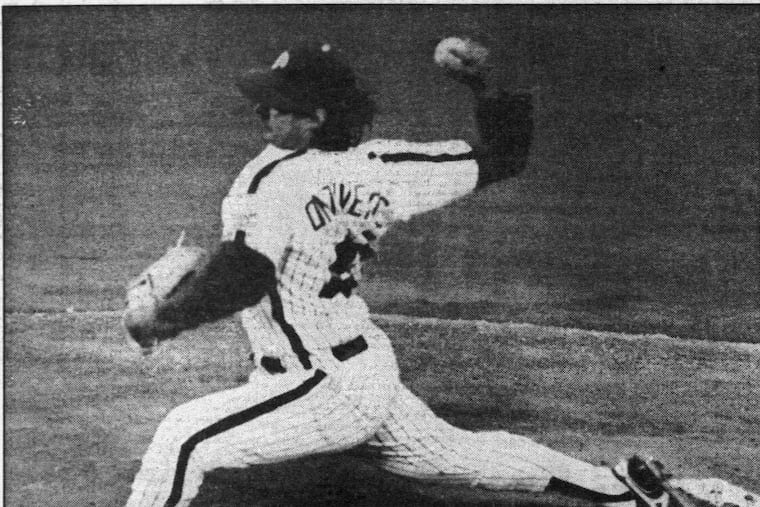
Steve Ontiveros was for once healthy, and had not yet joined the Phillies, when he and Tommy John became teammates, pitchers on the Oakland Athletics in 1985. Ontiveros was 24 years old, a right-hander having a terrific rookie season: a 1.93 earned run average, eight saves. John was already 42, still the same soft-throwing lefty he’d always been, more than a decade removed from undergoing the revolutionary surgical procedure that still bears his name. They did not know then the physiological connection they would come to share.
Over the 11 games that he pitched for the Phillies in 1989 and 1990, in an era full of forgettable baseball here, Ontiveros managed to complete a remarkable story — and to introduce Philadelphia to the future of sports medicine. He was the first Phillies pitcher to have Tommy John surgery and return to pitch for the team.
After starting 2-0 and allowing just two earned runs in his first 20 innings in ‘89, after offering a glimpse of greatness to an awful Phillies team, Ontiveros needed some magical science and the steady hands of surgeon Frank Jobe just to take the mound in the majors again. When he caught the news reports that John had died at 83 late last Saturday night, Ontiveros couldn’t help but recall John’s daring and desperate decision back in 1974 — his willingness to have Jobe try replacing a torn ligament in John’s left elbow with a fresh tendon from somewhere on John’s body.
» READ MORE: Don Mattingly remembers former Yankees teammate Tommy John as ‘a really great person’
The procedure saved John’s career. It has saved hundreds of pitchers’ careers since. Steve Ontiveros’ star-crossed stretch in Major League Baseball was one of them.
“He was fantastic,” Ontiveros, 65, said by speakerphone as he and his wife, Cindy, drove near their Scottsdale, Ariz., home Tuesday morning. “Think about it: No one in the history of the game had had that done. It was so off the wall, out of outer space, to even think about that type of surgery. But when that’s your livelihood, you’ll do anything. You’ll take any chance because you want to play. You want to compete.”
He and John — who appeared in 760 games, won 288, threw 46 shutouts, and should have been inducted into the National Baseball Hall of Fame long ago — were different people, different pitchers, and at different stages of their lives when they met. The A’s picked Ontiveros in the second round of the 1982 draft. A standout at the University of Michigan, a fierce black goatee rimming his mouth, he had five pitches, each of which he could throw with exquisite control. “When I was healthy,” he said, “I got people out.”

Mike Sielski alerts
John, with his granddad-bod physique and his slow-slower-slowest stuff, seemed a being from another time, another world. Ontiveros, for instance, would be baffled watching him slide himself into a scalding hot whirlpool before every start. The Centers for Disease Control recommends keeping the water in a Jacuzzi under 104 degrees Fahrenheit, but John would crank the temperature to 115 and spend 10 minutes practically poaching himself. When Ontiveros asked him about the strange ritual, John explained that the soak had been part of his pre-start preparation for years. It saps my energy, he told Ontiveros. When I come in, if I’m throwing 85, I get killed. But if I’m throwing 82, they can’t touch me.
John was in the midst of his 25th and next-to-last season in the majors, winning nine games and pitching 176⅔ innings for the Yankees in 1988, when Ontiveros first experienced the arm trouble that would dog him thereafter. The prospective third starter on an Oakland team that starred Jose Canseco, Mark McGwire, Dennis Eckersley, and Dave “Smoke” Stewart and would win the American League pennant, Ontiveros had pain flare up in his elbow during spring training. The A’s pushed him back in the rotation, to the No. 5 spot, to give him more rest, but it didn’t help.
Before Ontiveros’s June 6 start in Kansas City against the Royals, the A’s training staff tried to stabilize his elbow by wrapping it in tape as if it were an injured knee. Twenty pitches into his warmups, the tape fell off, and though Ontiveros allowed just one earned run in seven innings that night, he knew something was wrong.
“I’m in the seventh inning, and I throw a pitch, get the ball from the catcher, and I’d have to walk around the mound until the pain went away,” he said. “When I’d climb back on the mound, I’d make another pitch. I did that through the entire inning. I said, ‘I can’t do this anymore.’”
He didn’t appear in another game for the A’s that season after early August, and in the offseason he underwent elbow surgery that wasn’t as radical as John’s but was close. A ligament in Ontiveros’ elbow had stretched so far that, he said, “it wasn’t performing as a ligament anymore.” So orthopedist Lewis Yocum shortened it, folding it over onto itself and suturing it.
The A’s released Ontiveros in December ‘88, and the Phillies signed him as a free agent in February ‘89. Pitchers like him were the Phillies’ currency back then: injured or aging long shots who had once been promising prospects or accomplished big-leaguers. Danny Cox, Dave LaPoint, David Palmer, later Fernando Valenzuela and Sid Fernandez: Each of them tried to complete a semi-miraculous comeback.
Despite being a nonroster invitee to spring training, Ontiveros cracked the rotation, then dominated the Cubs — eight innings, one earned run — on April 6 before throwing seven shutout innings to beat the Montreal Expos at Veterans Stadium five days later. The Phillies were 5-2 and in first place in the National League East. “This qualifies as a pleasant surprise in my book,” manager Nick Leyva said after the game.
» READ MORE: Hayes: Alec Bohm, Philly’s latest scapegoat, nears the end of his run as a Phillie. Appreciate him.
But after his brilliant start against the Expos, Ontiveros felt the same twinge of pain that he had the season before. He lasted five innings, giving up just one run, in a loss to the New York Mets on April 19 before the Phillies put him on the injured list, with a “strained ligament,” for nearly two months. “I went down, and we lost two other pitchers,” he said. “We instantly sucked after that.” He returned in June and was hammered: three starts, 10⅔ innings, 19 hits, 11 earned runs.
“I wasn’t able to separate the pain from the pitch,” Ontiveros said. “It starts accumulating in your head, the pain that’s going to be coming. It takes away your focus from getting a hitter out. You focus on, ‘What am I feeling right now? Is my arm going to fall off on the next pitch?’ I could not overcome that amount of pain mentally. There may be some people who could. I was not one of them. I was so distracted by the amount of pain I was feeling and the amount of pain that was to come if I kept throwing.”
There was no avoiding the knife now, but the Phillies had little experience with Tommy John surgery. Larry Christenson was their first pitcher to have it, in 1983, in a last-ditch effort to end his lengthy succession of elbow injuries. He never pitched for them or anyone else again. The good news for Ontiveros and the Phillies was that Jobe himself would handle the operation. The bad news was that, even 15 years after John’s pioneering procedure, only so many advancements and improvements to it and a pitcher’s rehabilitation process had been made.
Before Jobe and his team performed the surgery, on July 20, 1989, they asked Ontiveros if he wanted them to take the healthy ligament from his right arm or his left. The left, of course, Ontiveros told them. Why weaken and damage his right arm further? Except the doctors screwed up, instead removing a six-inch tendon from Ontiveros’s right wrist and grafting it onto his elbow.
The mistake prolonged Ontiveros’ rehab, which was hardly the kind of comprehensive, reliable course of action that would reassure an elite athlete whose livelihood was hanging in the balance. Working with the Phillies’ medical and training staff and with Steve Kush, a trainer based in Arizona, Ontiveros tried to improve his right arm’s range of motion before strengthening the muscles around his elbow joint. But no one was completely certain what exercises he ought to be doing or how often he ought to be doing them. When he visited Jobe for a postsurgery consultation, Ontiveros asked the doctor for some direction.
“He literally handed me a copy of what they did with Tommy John,” Ontiveros said. “It was 10 pages of nothing. There was no structure to any of it. I gave it to Steve, and we just kind of winged it.”
Having read that another pitcher, John Tudor, had recovered from Tommy John surgery in just eight months, Ontiveros pushed himself to match that ambitious timeline. “I went out in the offseason, and I threw outside,” he said, “and it was cold, and I felt a little tug. I went, ‘Uh, oh.’ I pushed it too fast, and it set me back months.” Still, the makeshift rehab went well enough that in August 1990, he made a start for the Phillies’ single-A affiliate in Clearwater. He lasted one inning. His arm, he said afterward, felt like he had stuck his finger into an electrical socket, and he was certain his career was finished. It did not have to be. There was some inflammation in his elbow, but rest would heal it. He talked with Cindy. They decided he would not give up.
When he pitched again in the majors, for the Phillies, at Wrigley Field against the Cubs on Sept. 13, 1990, throwing two shutout innings in relief, his senses seemed sharper: the smell of the grass on the infield and the ivy on the outfield walls, the tingle of Lake Michigan’s breeze.
» READ MORE: Murphy: The Phillies’ playoff chances are complicated by one of MLB’s toughest remaining schedules
“I went through so much [stuff] with the Phillies, and I loved playing for them,” said Ontiveros, who after retiring ran a baseball academy for 20 years that produced 13 major-league players. “I absolutely loved the fan base. Yeah, they’re brutal, but they’re also amazing. You do well, and they’ll let you know about it. Just being able to know a fan base has passion — I played four years in Oakland before that, and you’d see them come in by the third inning and leave by the seventh inning, and these were World Series-caliber players on a World Series-caliber team. You went to Philly, and it was intense, and I loved that.”
Through a second Tommy John surgery, he somehow kept pitching, returning to the A’s, going 6-4 and leading the American League in ERA (2.65) in 1994, earning a spot on the AL All-Star Team in 1995, appearing in three games for the Boston Red Sox in 2000 when he was 39. When he was as close as he would get to being Tommy John himself, to having something else in common with the man whose name now lives forever.
“It gave me longevity,” he said. “That was good. That wouldn’t have happened otherwise. I’d have been done. It gave me an opportunity to continue my career. It’s just unfortunate that there weren’t that many people ahead of me.”
True, but there have been so many after him who could keep pitching, who could keep playing the game they loved. That legacy is Steve Ontiveros’, too, and as they continued on their morning drive, perhaps because she could hear the wistfulness and what-might-have-been in his voice, Cindy Ontiveros asked her husband a question.
“How many people have come back from two?”
“Not many,” one of them said.

Let's talk about the Phillies' bullpen. Larry Andersen happens to be an expert on the subject. The popular Phillies radio analyst had a 17-year major-league career in which he appeared in 699 games – all but one in relief. He joins Phillies Extra to break down the biggest question standing between the Phillies and a long run through October: How will they bridge the gap to closer Jhoan Duran? Watch here.
You can also subscribe to the podcast version of Phillies Extra on Spotify or Apple Podcasts.
Previous episodes: Matt Klentak | Jeff Francoeur | Luke Murton | Mike Hazen | Tony Gwynn Jr. | Kevin Stocker | Bobby Dickerson | Jim Bowden | John Middleton | Ryan Howard