PhillyDeals: Commercial property sales plummet
Business-property sales in Philadelphia and its suburbs have collapsed in the last year. As real estate values drop and borrowers slow payments, banks and investors who financed deals at inflated mid-2000s prices face losses, which makes it tougher for them to finance new projects that could help the weak economy.
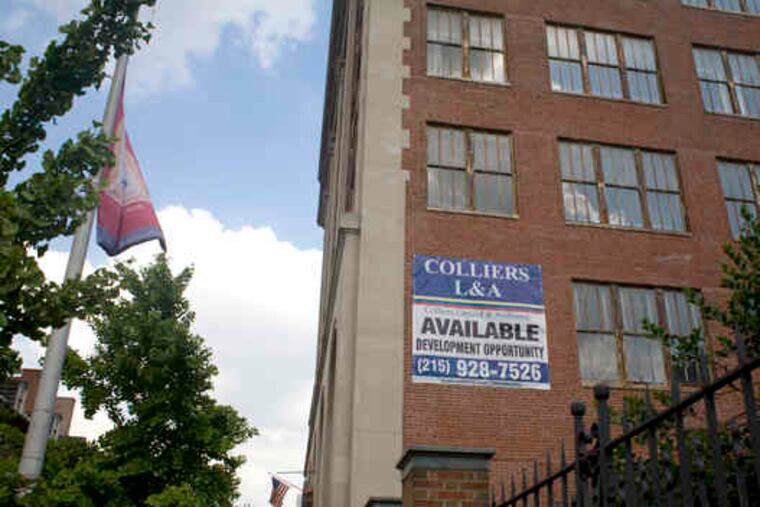
Business-property sales in Philadelphia and its suburbs have collapsed in the last year.
As real estate values drop and borrowers slow payments, banks and investors who financed deals at inflated mid-2000s prices face losses, which makes it tougher for them to finance new projects that could help the weak economy.
Commercial-property sales in Philadelphia and its Pennsylvania suburbs fell 71 percent, to $850 million, for the year ended June 30, LoopNet Inc. of San Francisco said in a report last week.
The most recent data, for the spring quarter, look worse. Office-building sales in the five counties fell to $5 million for April, May, and June compared with $180 million, $250 million, and more than $900 million, respectively, in the previous three spring quarters.
Mall, store, apartment building, industrial, and warehouse sales also were way down.
LoopNet shows similar declines around the nation.
This may be the bottom, because it cannot get much lower. How's the walk back look?
Drip, drop
"The real estate industry is going to go through drip torture over the next three to five years," warns
Matthew McManus
, chairman of
NAI Bluestone Real Estate Capital L.P.
, a Philadelphia commercial real estate investment adviser.
This isn't like the last real estate crash in the early 1990s, when the federal Resolution Trust Corp. took over thousands of buildings from the deadbeat clients of busted banks and resold them in bulk to investors at bargain prices.
This time, the government is trying to keep a lot of banks on life support, rather than killing them and cleaning up after them. "There's not going to be one big tsunami," McManus said. "I think every single transaction is going to be worked out on a one-by-one basis over the next three to five years."
It takes buyers as well as sellers to deal, and opportunistic investors such as Lubert-Adler Partners L.L.C., of Philadelphia, and Hayden Real Estate Investors L.L.C., of Conshohocken, are waiting like vultures to make offers on troubled properties, as loans expire unpaid and banks move in.
Until then, no deals mean no commissions for Philadelphians whose jobs depend on commercial real estate.
"Being in a transactional business, I wish it was more like RTC days," McManus said. "But being a capitalist, I'm not in favor of injecting more capital into banks via taxpayers. It should be survival of the fittest."
Doubling up
Apartment buildings are still changing hands, thanks to federal financing programs, though some landlords complain the business is weaker than expected, as people worried about their jobs are crowding and sharing what used to be one- or two-person apartments.
Earlier this year, NAI Bluestone raised $30 million from Freddie Mac and an additional $6.5 million from Bancorp Bank of Philadelphia and other local lenders to help an affiliate of Jim and Barbara Kravitz's Andorra Group refinance the 202-unit Glen at Shawmont Station apartments in Roxborough and pay off the original lender, Germany's troubled Deutsche Bank AG.
The banks charged 6.2 percent (for 10 years, amortized over 30). Without Freddie Mac, banks would have charged a lot more, McManus said. Government-backed apartment loans "are the only game in town."
Out of town
Just beyond the Philadelphia area, Conshohocken real estate developer
Ironwood Property Group L.P.
is building two large retail developments in Berks County, where big-box retailers and discount chains are belatedly penetrating the home turf of locally based retailer
Boscov's Department Store L.L.C.
Work started last month on $75 million Tilden Ridge, which includes a Wal-Mart Supercenter (due in 2011), a Lowe's Home Improvement Store (to open next year), and 60,000 square feet of restaurants, banks, and other stores, across the road from the largest outlet in the Cabela's Inc.'s shooting-and-outdoor-sports chain.
Tilden is designed to draw the crowds that pack Cabela's, a state and local tax-subsidized complex in whitetail-deer country north of Reading. Cabela's outranks the Liberty Bell as a Pennsylvania tourist destination.
And Ironwood is finishing work on $105 million Exeter Commons, a half-million-square-foot mall for Target, Lowe's, and Giant, south of Reading and across the street from Boscov's owner Albert Boscov's office.
Boscov, who has been refinancing the financially troubled family chain with help from government loan guarantees, gave his personal blessing for Exeter Commons, enabling Ironwood to gain local political support for needed roadwork and permits, Ironwood president Jeremy Fogel told me. "He was very generous. He could have kept us out of Berks County."
Bank of America Corp. financed Exeter in a deal early last year, with backing from Wilmington Trust Corp., Firstrust Bank and Sovereign Bancorp Inc.
But the Tilden Ridge project is being financed by Ironwood equity and the mall's tenants, without bank backing, so far: "The terms we had on that [Exeter] loan are certainly not available today," Fogel told me.