A rosy budget for Philadelphia schools
The Philadelphia School District yesterday found itself in a novel spot - looking at a budget that for the first time in three years does not include a deficit and, thanks to federal stimulus money, gives it the green light to invest in new programs.
The Philadelphia School District yesterday found itself in a novel spot - looking at a budget that for the first time in three years does not include a deficit and, thanks to federal stimulus money, gives it the green light to invest in new programs.
Despite a brutal economy and a drop in local revenue, the district will - for the first time in its history - have $3.1 billion to spend next school year, its chief business officer said yesterday.
A $244 million infusion from the federal stimulus package helps the picture considerably. So does a boost in aid from Harrisburg, which will send the district $1.49 billion this year if the legislature approves.
The district will have $2.37 billion in operating revenue and a $5.3 million surplus carried over from this year, chief business officer Michael Masch said.
No details are available on how the district will spend its money; the School Reform Commission approved only a lump-sum budget, its statement of how much cash it expects to take in and spend next year. A preliminary operating budget is to be approved next month, with final approval scheduled for May.
The commission must consider that $137 million of the federal stimulus money is a one-shot deal. An additional $107 million will be available for a second year.
The relatively rosy picture is a sea change from years past. A surprise $180 million deficit in 2006 during the Paul Vallas administration was eliminated this school year through district cuts and additional city and state aid.
A year ago, the district faced a $38.9 million deficit.
But Masch said he was under strict orders from Superintendent Arlene Ackerman to make sure the district did not spend more money than it took in. He has also been directed to look for additional efficiencies and justify every dollar that does not go directly into student instruction.
"Nothing is sacred," Masch said. "We're doing a forced march through the entire organization."
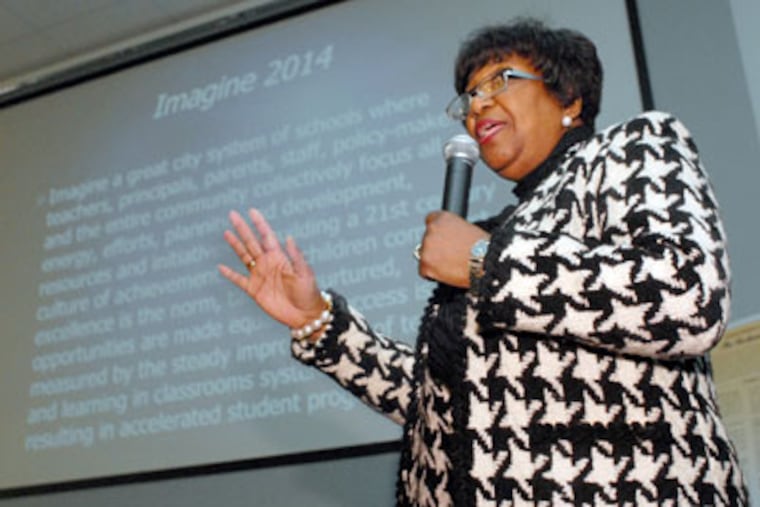
One big question mark for next year's budget is how much the district will need to spend on "Imagine 2014," Ackerman's strategic plan, estimated to cost $50 million over the next five years.
Among other things, the blueprint calls for smaller classes, more guidance counselors and early-childhood programs, and the replacement of failing schools with charter schools or schools run by outside managers.
Masch and his staff are calculating the tab for the first year of the plan, he said.
The budget also does not take into account raises. The district's five unions all signed one-year pacts with modest contract increases last year, and they are at the negotiating table again.
Ackerman said she was pleased with the budget picture for the coming year.
The district receives most of its funding from the state but also relies on local tax revenue.
Because of the tough economy and less tax collection, the city's share is expected to drop 1 percent. Masch estimated that had city revenue grown at the same rate it had in the previous seven years, the district would have had $116 million more to spend in 2009 and 2010.
State dollars did increase, however. Some of the jump is due to money the federal government provided to states in the stimulus package to ensure no cuts to education were made.
The $244 million from the federal government must be used to raise academic levels, promote educational equity, and avoid cuts in public school programs due to lower revenue collections.
That description fits the goals of the strategic plan perfectly, Masch said.
About $81 million of the stimulus money is strictly devoted to Title I funding, money that must be spent on instruction in high-poverty schools. Most district schools fall under this umbrella. An additional $21 million must be spent on special education, and $5 million must go for technology.
Also yesterday, the commission approved the hiring of Thomas Darden as Ackerman's chief of staff effective March 31.
Darden, a former venture capitalist with degrees in engineering and business administration, is a fellow of the Broad Superintendents' Academy, a nonprofit group to which Ackerman has ties.
He will be paid $180,000 and replaces Shawn Crowder, who was paid $154,500 annually as chief of staff. Crowder will head the Office of Strategic Partnerships to help the district raise money from outside sources.