Keeping freshmen from an about-face
The months between high school and college can be daunting, particularly for low-income students. Some never show up in the fall.
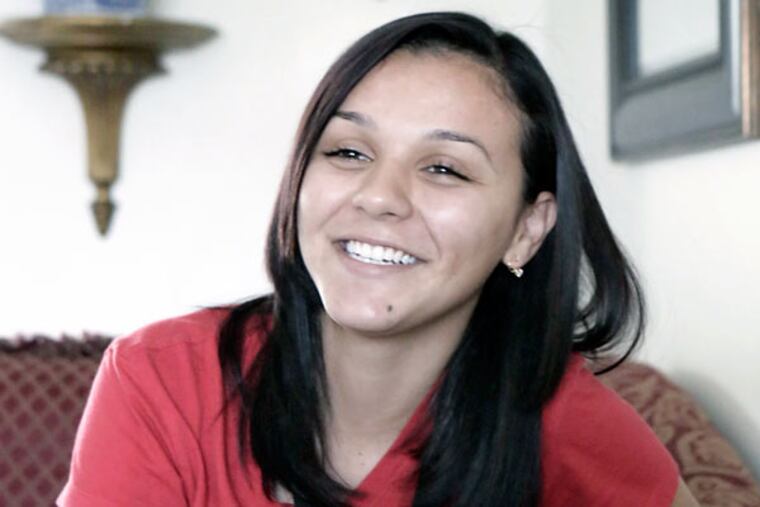
Alesha Figueroa-Falcon was headed to college last fall - until, all of a sudden, she wasn't.
"I chickened out last-minute. It was too far for me," she said. "I felt like I was going to be uncomfortable."
That came as a shock to those who knew her, because she had managed to do everything right, spending her senior year applying to colleges, celebrating the acceptances, and choosing a school.
But the months after graduation can be daunting. For low-income and first-generation students such as Figueroa-Falcon, those months can lead to a phenomenon known as "summer melt" - large numbers of students, as high as 20 percent to 30 percent in urban school districts, never showing for college in the fall.
Figueroa-Falcon was from East Camden, had a run-in with the law when she was 15, grew up without her parents. She would be the first from her family to graduate from high school.
Still, she seemed unstoppable.
After being arrested, Figueroa-Falcon got her grades on track, making the honor roll the next semester at Woodrow Wilson High School.
"Everybody in high school, they were so proud of me," she said. "So I was like, 'I'm not going to let them down.' I know they think I'm four-year-college material, so I'm going to do it."
She applied to more than a dozen colleges and was accepted to most.
Figueroa-Falcon decided to go to Stockton University, known then as the Richard Stockton College of New Jersey.
But as her fall 2014 start date crept closer, anxiety built up, letting itself out in tears every other day. The girl who had worked so hard to get into college was looking for an excuse not to show up.
Then her car broke down.
"When the time came and my car wasn't ready to drive over there, that was my big opportunity to use that excuse for me not to go," said Figueroa-Falcon, now 19.
For students who "melt," worries about money, academics, and social life are exacerbated by information coming in over the summer, including complicated documents.
"In affluent, college-educated families, the 18-year-olds aren't dealing with these forms; it's their parents," said Ben Castleman, a University of Virginia professor of education and public policy who studies summer melt.
"The summer months, it's this unique two- to three-month window where they're not part of the high school anymore . . . but the students have yet to engage with supports at the college."
If no one takes responsibility for checking in, the students can simply fall through the cracks.
For Figueroa-Falcon, news of her decision to not attend Stockton traveled quickly last summer, and teachers and counselors from school started checking in, as did her classmates.
With everyone pushing her, she applied to Rutgers-Camden.
"I just kept trying to make excuses not to go, and then it was just like everything kept happening right for me," Figueroa-Falcon said.
"Rutgers accepted me last-minute, everything was covered, they didn't charge me an admission fee, they didn't charge me a dorm fee. It was just like everything was happening for me to go, and I just took that as a sign."
She will return this fall for her second year.
Research on summer melt shows that intervention can be cheap and effective, Castleman said.
One study he conducted found that students who were offered help by their high school counselors over the summer were 14 percentage points more likely to immediately enroll in college. The average cost: less than $200 per student.
That counseling does not have to be particularly time-intensive, adding up to a few hours of help per student, Castleman said, but it can help ensure students who get into college actually make it there.
One study he conducted, published in the July issue of Journal of Economic Behavior and Organization, found that personalized text-message campaigns - costing just $7 per student - substantially increased enrollment.
Those messages served as reminders and encouragement, with information about forthcoming deadlines, links, and the offer of help just a text message away.
Programs to address summer melt are not yet implemented widely, but many school districts are considering them.
In Camden, there is no system in place to specifically address melt, a spokesman said, pointing instead to programs that work to prepare students generally for college during the K-12 years.
Colleges with underserved populations have begun stepping into the gap months.
At Rutgers-Camden, where just 40 percent of students have parents with bachelor's degrees or higher, incoming freshmen receive four or five phone calls over the summer from other students, checking in and making sure everything is OK.
Orientation is done early in the summer - the first takes place this week - and that helps make attending college seem more real to students, said Mary Beth Daisey, Rutgers-Camden's associate chancellor for student affairs.
Rutgers-Camden also developed a parent orientation program and moved it to the start of the summer.
And administrators this year designed a new calendar for parents. Academic, financial, and support information is listed with phone numbers for various offices, while the calendar highlights important dates: to register for courses, drop courses without penalty, submit financial-aid information.
In Philadelphia, Temple University also enrolls a large number of first-generation and low-income students; there, a student-staffed call center and increased focus on social media have kept melt to between 8 percent and 9 percent of incoming freshmen in recent years, said Karin Mormando, Temple's director of undergraduate admissions.
"We're constantly pushing information out, trying to keep them engaged, and that has worked very well for us," she said.
Current students will call incoming freshmen to answer questions about college life and academic majors, Mormando said. Students also will hear from the academic programs they are entering.
"For us, we're looking to always expand that opportunity to make sure that students feel close and connected, and feel as students before they even reach the campus," she said.
Castleman said he was optimistic about future summer-melt interventions.
"We've got rigorous evidence that a variety of pretty low-cost strategies can generate meaningful improvements," he said.
"We certainly have a long road to walk, but I think that's probably true of just about any policy area we can look at, and I think the good news is we're making steady progress."
One text message at a time.