The Souderton school district has settled with the ACLU after banning residents from meetings
As part of the settlement with residents, the Montgomery County district will have to create an area for demonstrators outside school board meetings.
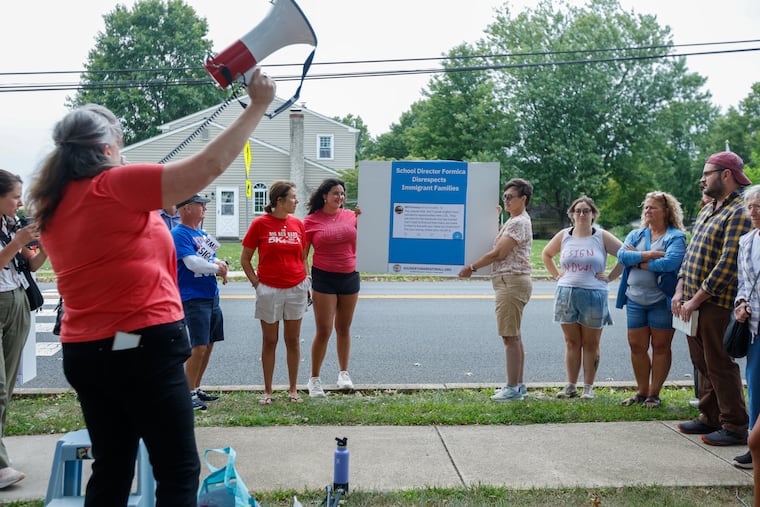
The Souderton Area School District must create an area for demonstrators and livestream school board meetings under a settlement reached in a lawsuit brought two years ago by residents who accused the district of illegally banning them, the American Civil Liberties Union of Pennsylvania said Thursday.
The lawsuit, filed by the ACLU and Ramsingh Legal, PLLC, stems from an incident in 2024, when the Montgomery County district banned three residents who were involved in protesting school board member Bill Formica and his social media posts.
“Members of the public have a First Amendment right to attend and participate in school board meetings,” Sara Rose, the ACLU of Pennsylvania’s deputy legal director, said in a statement. “School boards should take a lesson from this case: you can’t silence critics by banning them from meetings.”
Souderton’s superintendent, Christopher Hey, did not respond to requests for comment.
The residents, who were protesting lewd social media posts by Formica about then-vice president Kamala Harris, were accused by the district of threatening another school board member and her teenage daughter in a parking lot after a September 2024 board meeting.
District officials said the residents had mistakenly believed the girl was Formica’s daughter. The district’s solicitor, Jeffrey Sultanik, wrote in an Oct. 10 2024 letter to Kitt, “You screamed ‘Tell your father he’s an {expletive} ,’ and ‘Tell her dad he’s a fascist and needs to resign.’”
The ACLU said the district had falsely accused the residents — Patrick Kitt and Christopher Spigel, along with Spigel’s teenage daughter — of yelling at the school board member, Kim Wheeler, and blocking her from leaving the lot.
The district lifted the ban on the residents in March 2025.
As part of a tentative settlement agreement in early 2025, the residents agreed to provide a “confidential apology” to Wheeler’s daughter, according to the ACLU, “if the district agreed to livestream and archive its school board meetings, create an area for individuals to demonstrate outside school board meetings, pay plaintiffs’ attorneys’ fees, and issue a joint press release about the settlement.”
But that April, the school board refused to approve the joint press release “and instead asked the plaintiffs to agree not to discuss the settlement publicly” — a demand they rejected, the ACLU said.
It said the district’s lawyer then asked the court to bar the residents from discussing the case and demanded that the residents agree to not bring criminal complaints against any board member based on the 2024 incident.
The residents then withdrew their offer to apologize. Kitt, in a statement, said he “lost all trust that the school board was operating in good faith.”
“When the district tried to silence us — again — I lost all trust that the school board was operating in good faith,” Kitt said. “It became clear that the board wanted the apology to weaponize it against us, and it had nothing to do with Wheeler’s daughter.”
The district then asked the court to force the residents to abide by the settlement agreement, according to the ACLU. While the court found the district had failed to prove the settlement was binding, because it hadn’t been approved by the school board, it still ordered the parties to follow it, the ACLU said.
The residents, however, asked the court to reconsider the portion of the agreement involving an apology to Wheeler’s daughter.
In a Sept. 28 decision, Judge Mia Roberts Perez said that “it is not controversial to acknowledge that the ethical thing to do when an adult harms a child is to apologize to that child, even if the harm was inadvertent.”
“The First Amendment, however, limits the Court’s ability to compel an apology,” Perez said. She struck the portion of the settlement agreement that required the apology.
The district had 30 days to appeal Perez’s order, but did not, Rose said.
The settlement requires the district to livestream and archive recordings of its school board meetings — something the district wasn’t doing while residents were protesting Formica, Rose said. She said it began streaming meetings in early 2025.
It also requires the district to create a “designated outdoor gathering/demonstration area adjacent to (or in the immediate vicinity of) the district’s administrative offices building.”
The district also has to pay $63,000 in attorney’s fees for the residents, under the settlement.