'Lost' Ansel Adams negatives?
Hubbub over authenticity resulted from owner's consulting little-known, paid experts.
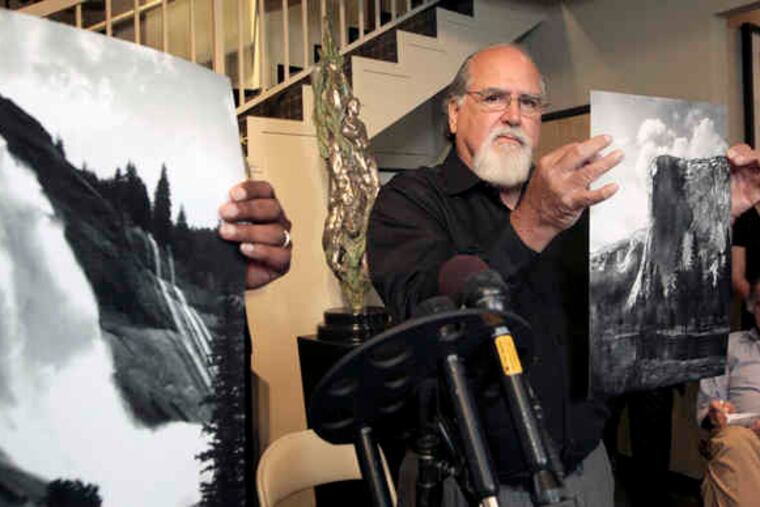
LOS ANGELES - The case of the "lost" Ansel Adams negatives that purportedly are worth $200 million has turned into a public argument between Rick Norsigian, who found them at a garage sale 10 years ago, and the photographer's family and former associates and leading art-photography dealers, who deny that Adams took them.
The brouhaha might have been avoided had Norsigian, a painter for the Fresno school district, taken the advice of Adams biographer Jonathan Spaulding. Spaulding, now executive director of the Museum of the American West at L.A.'s Autry National Center, recalled how Norsigian had visited him about seven years ago. Spaulding says he told Norsigian that although the pictures could have been taken by Adams, the best thing would be to get them to curators, who would know how to do tests.
Instead, Norsigian went on trying to authenticate the pictures on his own. Eventually, he assembled a team of paid experts - virtual unknowns in the photography world. The report and appraisal Norsigian issued last month made headlines because it concluded not only that the 65 glass-plate negatives had been taken by Adams in the 1920s and early 1930s, but also that they were worth at least $200 million.
Norsigian's top authenticators, art consultant Robert C. Moeller III and photographer Patrick Alt, respectively described that sum last week as "puzzling" and a "bunch of crap."
The photos "looked like rather cliched views of Yosemite, technically skillful, but really not outstanding," recalled Spaulding. "But that wasn't totally inconsistent. Ansel was in his 20s then, and it wasn't inconceivable that he was doing work of that sort. But it felt to me like it could have been any number of commercial photographers working at that time."
Norsigian failed to enlist people like Spaulding, whose Ansel Adams and the American Landscape was published in 1995, or Mary Street Alinder, Adams' chief assistant from 1979 until his death in 1984. Instead, Norsigian ended up with Alt and Moeller.
"I don't recognize the names. It seems very questionable to me," said Deborah Klochko, executive director of San Diego's Museum of Photographic Arts.
"To think you can authenticate these to make a lot of money; that's a problem right there," she added. She said she hoped Norsigian would donate his find.
Alinder said she looked at the pictures with an open mind when Norsigian approached her in 2002, thinking "it would be wonderful" if he, indeed, had unearthed unknown Ansel Adams pictures. But "I thought almost all of them did not measure up," she said, although the handwriting on the sleeves containing the negatives did look to her like that of Virginia Adams, the photographer's wife. She said she continued to help Norsigian with contacts to pursue his quest, then stopped in 2004 after he offered her 25 percent of any earnings from future sales of the negatives in return for helping him prove their authenticity.
"I don't think Mr. Norsigian is a bad person, but he wants so hard to believe this," she said, "that he doesn't see all the corners he's bent."
Norsigian responded through his attorney, Arnold Peter, whose firm is helping him market prints and posters. Norsigian offered Alinder a percentage of earnings to serve as a consultant, Peter said, but she would not have been required to vouch for their authenticity.
"He had basically hit a wall," Peter said. "People would tell him these were Ansel Adams works, but wouldn't go on record, and she could help by opening doors, making introductions."
As for Norsigian's reluctance to donate his find for study, Peter said, "We live in a capitalist system, and there's nothing wrong with Mr. Norsigian profiting from the time and resources he's put into this project."
Norsigian's claim rests for now on opinions of two handwriting experts who say it's Virginia Adams' writing on the manila sleeves, and on opinions by Alt and Moeller. Alt is a Culver City, Calif., photographer who has a bachelor's degree from California Institute of the Arts and a master's in painting and photography from UC Irvine; he says he has studied Adams' methods intensely and applies them to his own work.
"I don't have an academic credential for this, but I feel as if my knowledge is as in-depth or more so" than many museum-based scholars, Alt said. "The problem I have with so many curators is they've never looked through a camera."
In the report, he speculated from scorch marks on some negatives that they had survived a 1937 fire at Adams' studio and that Virginia Adams was hurriedly enlisted to catalog them. Alt theorizes Adams showed them to his students at what's now Art Center College of Design in Pasadena "to regale them with what was surely a great story."
It was important for Norsigian to trace a path for the negatives to L.A., where Art Center was then based, because the man he bought them from in Fresno in 2000 had said he acquired them in the 1940s at a warehouse salvage sale in Los Angeles.
Adams' associates say the photographer, known for safeguarding his work, would not have let 65 pictures vanish.
Alt stands by his theory, although he would not be upset if the negatives prove to have been taken by a previously unknown photographer, Earl Brooks, whose niece in Oakland came forward with prints that two former Adams assistants say are matches for three pictures in Norsigian's trove.
Moeller, a Jackson Hole, Wyo., adviser to art collectors, said he had no particular expertise in Adams' work or in photography, but "applied myself in exactly the way I have done over the years" when evaluating and authenticating paintings for his clients. The Norsigian team's 20-page authentication report identifies him as a Harvard-trained former director of the Duke University Art Museum and curator of the Museum of Fine Arts, Boston. Moeller led the Duke museum in 1968-69, when it was in its infancy; from 1970 to 1980, he was a curator of European decorative art and sculpture at the Boston museum.
Moeller said he was surprised when appraiser and gallery owner David W. Streets set the negatives' value at $200 million: "I find it rather puzzling." Alt puts it bluntly: "It's the biggest bunch of crap I've heard in my life."
Spaulding, the Adams biographer, considers the figure "wildly inflated." He said that when he examined the negatives, he told Norsigian that "the real value of a photographic fine art work is in the print" and that even if they were Adams' negatives, prints that somebody else made from them would not be very valuable.
Streets said he stood by his estimate and was "disappointed" Moeller and Alt didn't agree, noting that their expertise was in art aesthetics, not art as commerce. He emphasized that the $200 million is based on a "multi-generational" projection of earnings over decades.
Streets said he factored in a discount because the Norsigian prints would be unsigned and not printed by the photographer himself, but assumed high demand because of global fascination with Adams and his landscapes. The authentication controversy only helps to heat the market for all of Adams' oeuvre, he said.
Streets said that he was not paid for his appraisal, but that he expected to start earning a dealer's commission starting in late September, when plans call for the first 17 Norsigian prints to go on sale at his gallery.