The country’s first film screening took place in 156 years ago
Inventor Henry Heyl showed the first motion picture to 1500 people at the Academy of Music. He also invented the stapler and the paper cup.
Chemist and mechanical engineer Henry R. Heyl moved to Philadelphia from Columbus, OH. in 1863. Shortly after setting up shop near the Curtis Building at 6th and Market Streets, he developed a knack for inventing things.
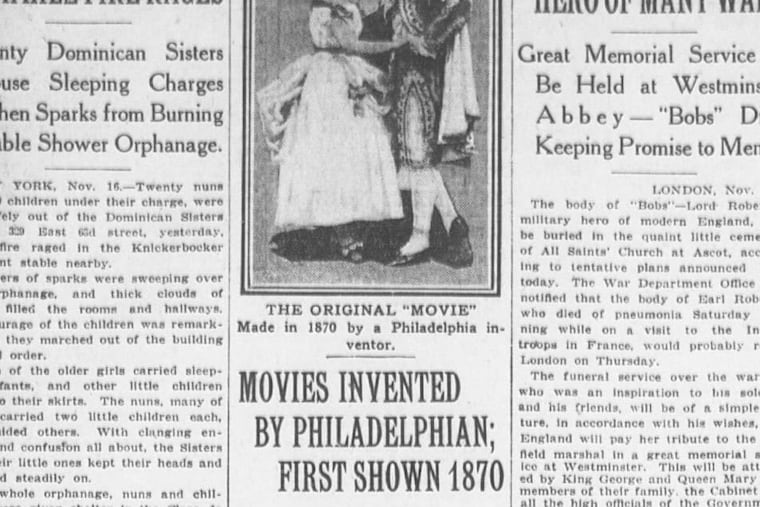
Among Heyl’s first inventions was a gadget that set photographs in motion, which he named the phasmatrope.
Heyl printed 16 photos — each slightly different from the ones before and after it — onto glass. Using a bright lamp, he projected the images through a shutter and onto a blank wall. A handheld crank controlled the device and synced the images with live sound. The result was the first moving image.
On the evening of Feb. 5, 1870, Heyl took his phasmatrope, or magic lantern projector, and demonstrated it to an audience of 1,500 people at the Academy of Music.
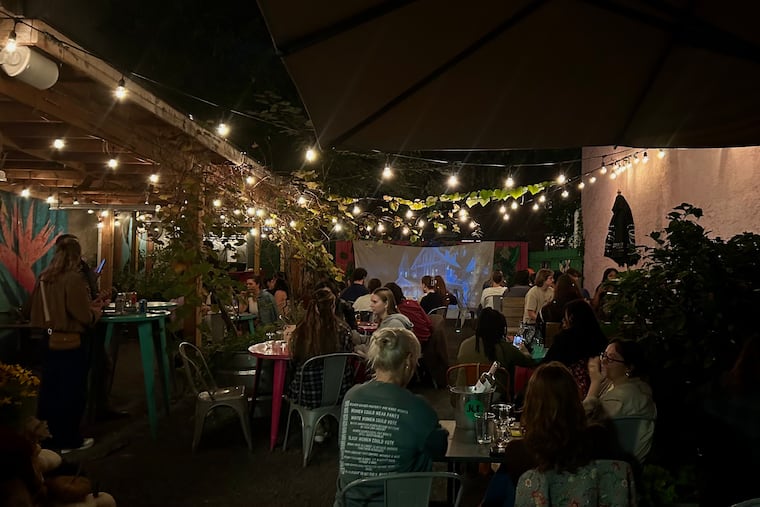
That presentation is considered America’s first motion picture screening and it will be celebrated Saturday at the Philadelphia Film Society Center from 11 a.m. to 1 p.m.
The day party, or firstival, is part of the Philadelphia Historic District’s yearlong celebration of America’s 250th birthday honoring events and happenings with Philly roots.
Heyl showed three films on that evening in 1870, each one a few seconds in length, said J. Andrew Greenblatt, CEO and executive director of the Philadelphia Film Society.
Allright, was a compilation of moves of the Japanese acrobat Little Allright. Brother Johnathan, debuted a character Heyl created and voiced behind the screen. The most famous film in the group is referred to as A Waltzing Couple and it featured Heyl dancing with a cousin. The 40-piece Philadelphia Orchestra provided the accompanying live music and Heyl’s performance effectively made him the first American actor in a motion picture, too.
According to a 1914 story in the Evening Public Ledger, Heyl demonstrated the phasmatrope at the Franklin Institute on March 16, 1870.
But that was its final public showing.
“He put it away and literally never demonstrated the phasmatrope again,” Greenblatt said. “He solved what he wanted to solve and went on to invent other things.”
And invent other things, Heyl did.
In late 1870, he invented the indoor croquet table as part of an ongoing effort to find ways to play outdoor games inside.
In 1877, Heyl filed for a patent for a machine that inserted and clinched staples in one step, or the modern day stapler.
He created the foldable box, the precursor to the takeout container most popular in Chinese restaurants. In 1911, at age 69, Heyl invented the paper drinking cup.
In 1885, Heyl became a director at the Franklin Institute and remained a member of its board of managers for close to 30 years.
In 1919, when he was 77 years old, Heyl fainted and fell from a street car at the intersection of Broad and Walnut Streets, according to a report in the Evening Ledger. He was taken to Jefferson Hospital where he died.
He never filed a patent for his phasmatrope, yet the public showing of his motion picture helped establish the motion picture industry, fueling it with possibility, Greenblatt said. Heyl’s phasmatrope joined and other inventions like the zoetrope, the phenakistoscope, and the zoopraxiscope, laying the film industry’s early foundations.
In the late 1880s, Thomas Edison introduced the kinetograph, what cinema historians refer to as the first movie camera. And in 1895, the Lumière brothers debuted the cinematograph, a 3-in-1 camera, printer, and projector that revolutionized the film making process. Later that year on Christmas Day, the Keith Bijou Theater at 8th and Race Streets showed the first motion pictures in Philadelphia movie theater history.
French magician George Méliès’ silent science fiction film A Trip to the Moon was released in 1902 and is hailed as not just the first science fiction film, but the first to tell a cohesive story — with sound effects.
“Méliès A Trip to the Moon was a stunning 14-minute short in cinema history that everyone remembers,” Greenblatt said. “And when most people talk about the American film industry they just assume it started with Thomas Edison. But that germ was planted right here in Philadelphia.”
This week’s Firstival is Saturday, Oct. 24, from 11 a.m.-1 p.m., at the Philadelphia Film Society Center, 1412 Chestnut Street.
Each week, The Inquirer is highlighting a “first” from the Philadelphia Historic District’s 52 Weeks of Firsts. A “52 Weeks of Firsts” podcast, produced by All That’s Good Productions, drops every Tuesday.