Philly artist Nazeer Sabree hears his paintings before he sees them: ‘I’m making an album’
From his studio in the Bok building, the 28-year old is making waves in the art world.
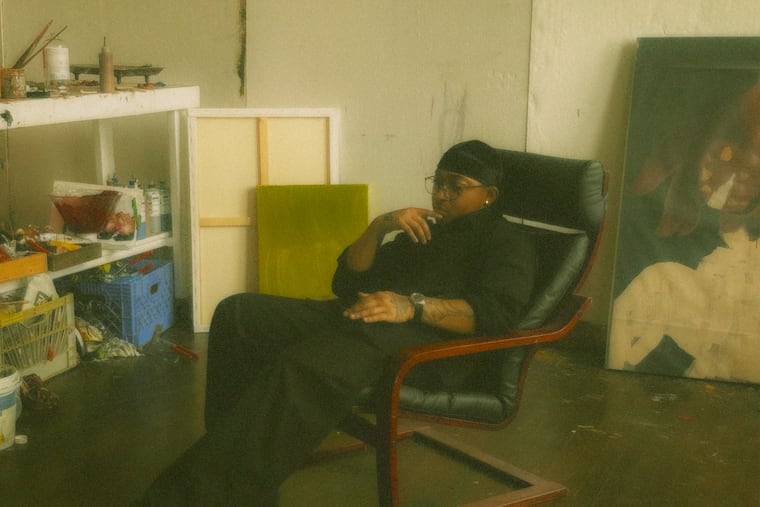
Before Philly artist Nazeer Sabree made a name for himself in the art world by crafting rich oil paintings and archival prints, music was his guiding light.
His memories — of dancing to James Brown’s “I Got The Feelin’” with his grandparents, his ears glued to speakers playing Marvin Gaye’s “What’s Going On,” and dissecting the lyrics from Erykah Badu’s “Green Eyes” and “Soldier” with his mom — shaped his childhood and early artistic interests.
“The music came before I was able to articulate my love for visual arts,” Sabree said, sitting in his Bok Building arts studio. “Often, when I talk about the work, I hear it before anything. And I hear it once it’s done.”
Today, his work is among the permanent collection in institutions like the Philadelphia Museum of Art. He has held residencies at Monument Lab and Fitler Club, and collaborated with Mural Arts and rap star Tierra Whack.
But Sabree, 28, started off by painting custom designs on students’ Timberland boots and screen-printing T-shirts at Charter High School for Architecture + Design (CHAD).
“I was hustling through the art. But before that it was music,” he said.
The melding of visual and musical art for him, he said, is heightened by his synesthesia, a neurological condition that allows him to experience sound both audibly and in color. It’s evident in much of Sabree’s work.
In the making of the 2025 painting Wings of a Crow, the sound of orchestral strings and jazz horns guided his hands over the cotton canvas as he painted with acrylic paint and oil pastels.
In Untitled, Sabree said the echoes of piano keys and drum kicks brought a visual rhythm to the collage.
“It’s a marriage between the two loves of mine and my practice,” Sabree said. “I don’t think I’m painting in a traditional sense. I’m making an album.”
As we chat, Erykah Badu, Mick Jenkins, and Kendrick Lamar play in the background.
Sabree’s broader catalog consists of archival prints and color-soaked silhouettes of Black figures, whose faces are covered in collages filled with news clippings, intimate photos, and American flags. His portraits and collage-lined frames aim to capture the kaleidoscope of human emotion, Sabree said. And like the timeless songs he listened to as a child, he wants viewers to unlock the same sense of liberation from his art, as he discovered from music in his most formative years.
The artist grew up in Cobbs Creek and Francisville, facing challenges that Sabree said kept him frozen in a perpetual state of “hypervigilance.”
“My mind was stressed because I was watching kids get drunk, people get shot, and watching my peers laugh at very jovial kid stuff while carrying guns,” he said. “And I knew what jail looked like because all my uncles were locked up. I was like, ‘Damn, I don’t want to go through that.’”
Sabree credits his mother’s decision to move him from Dobbins Technical High School to CHAD for widening his perspective and expanding his creativity. He no longer had to pass through metal detectors to reach his classes, and instead traveled to Center City, Old City, and Washington Square — sites previously unfamiliar to the aspiring artist. Sabree said the days he ventured beyond the school’s walls gave him a glimpse into the broader world he was determined to explore. “That gave me the flexibility to see different participants of the story that I’m now narrating,” he said.
His curiosity and early flashes of artistic brilliance led to a scholarship to the California College of the Arts (CCA). He moved to the Bay Area in 2016.
“If I don’t go to California, I don’t become Nazeer Sabree,” he said. “I don’t become the person that people see or feel through the work. I don’t become someone who can articulate their experience.”
There, he not only became a more technically sound artist, but he also mastered his “emotional language.” Through yoga, therapy, and literature, Sabree learned to wrestle with anxiety, depression, and the whirlwind of emotions caused by the deaths of loved ones, including his uncle Woody McKenzie, who died in 2018.
The encouragement he received from his mentors, paired with the emotional freedom he felt being 3,000 miles from his hometown, helped him better translate his emotions and past experiences into his visual works. “They were able to pour into me at a level that this city wasn’t able to, and it started that healing process for me,” Sabree said.
After two years in California, he came back to Philly with a renewed sense of self. He was also a more capable artist with a firmer command on his creative mission.
“It gave me a quiet authority,” Sabree said.
While his work is often drawn from his own experiences, Sabree said he isn’t making “trauma porn” and has no interest in “Black escapism.” He wants his viewers to explore the complexity of their emotions and recognize the impact of their own thoughts and actions. He also wants to free people from emotional bondage and encourage self-expression.
“Everything is not black and white. You have a gamut of complex emotions, but that’s what makes you human,” Sabree said. “That’s what being a man is. Having these emotions and learning how to manage them … Allowing yourself the space to get your thoughts out will liberate you.”
In June, Sabree received an Instagram message from artist Tierra Whack, who requested to meet with him for a day of painting in promotion of her June mixtape, Whack’s Museum. Sabree said he’s “grateful” to attract opportunities like these, and he credits his growing success to a higher power.
“I think it’s way bigger than myself,” he said. “A lot of what’s happening is by the grace of God. He gave me something. This isn’t mine. This isn’t my thing. It’s being channeled through me.”