From Curtis Opera, a happy 'Elixir of Love'
Any university-level opera operates by particular rules, with casting dictated by who's available rather than what's possible, and by where student singers are in their vocal metamorphosis rather than what wows audiences.
Any university-level opera operates by particular rules, with casting dictated by who's available rather than what's possible, and by where student singers are in their vocal metamorphosis rather than what wows audiences.
In Curtis Opera Theatre's The Elixir of Love, however, all priorities fused - singers, production, repertoire - with the kind purpose that leaves everybody happy, at least at Thursday's opening at the Prince Music Theater.
Those who wonder why such a silly opera is performed at all (the Donizetti score is enjoyable but rarely great music) might change their minds. Jordan Fein's stage direction and Vinay Parameswaran's conducting showed that the opera is about serious human concerns, while still delivering belly laughs.
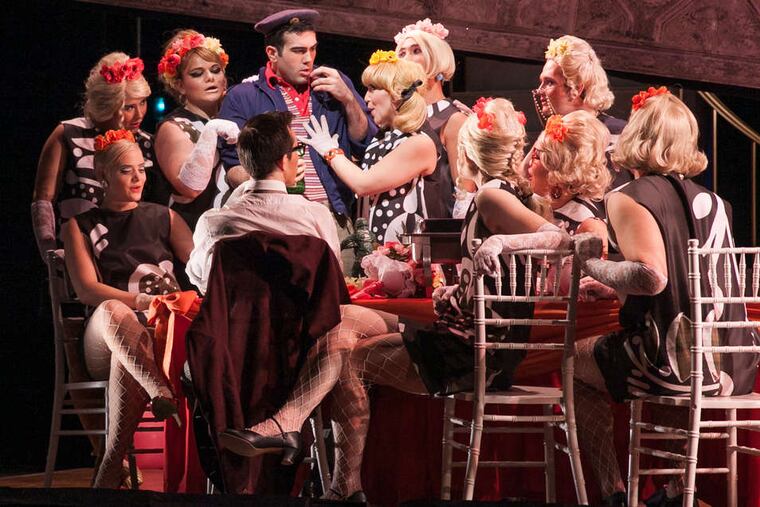
The Metropolitan Opera's Elixir attempts to explain the piece with political underpinnings; this Curtis production just assumes everyone is onstage for a good enough reason and frames them with handsome but to-the-point stage pictures in the Amy Rubin-designed sets. A few key plot points are underscored by expressionistic lighting, with great wit.
Overall, this modern-dress production doesn't tell the story as much as establish the characters - not as types, but as people you've known or met - often with physical comedy that tells you where they're coming from.
The townspeople become a motley mixture of uniformed cater waiters for the wedding du jour. The lovelorn tenor Nemorino is the guy who likely got beat up in high school gym class. His love object, Adina, probably has neglectful parents, which is why she has to play the field in the marriage game. The snake-oil salesman, Dulcamara, may be slime, but he also knows he stimulates people's dreams.
All of the above are underscored by conductor Parameswaran's variety of phrasing and ability to find areas of sensitivity in the score that many don't detect.
Since the opera hails from the bel canto era, the steep vocal demands must be handled with a fluency that enhances the opera's overall playfulness. And even when the singers weren't right for their roles, the opera never turned into heavy labor. Tenor Roy Hage was a good vocal fit with Nemorino, and even though his big aria "Una furtiva lagrima" didn't go as well as it might have, the performance bared his soul.
Rachel Sterrenberg (Adina) sometimes sounded more like a mezzo-soprano than a soubrette, but she had all the notes, and a good, subversive attitude. Andrew Bogard came off as a fully finished baritone whose weight was ideal for Dulcamara. Johnathan McCullough (Belcore) sounded more like a Wagnerite in training. Then again, he does play the bully.